
40 - 50 - 50

2023 is a year marked by the 50th anniversary of the civic-military coups in Uruguay and Chile and the 40th anniversary of the return to democracy in Argentina, events in the contemporary history of Latin America that shape current challenges in the search for alternatives to strengthen democracy and keep the flame of memory alive.
UruguayOn June 27, 1973, then-President Juan María Bordaberry dissolved Parliament with the support of the military and police forces. That day marked the beginning of the civic-military dictatorship that lasted until March 1, 1985.
ChileOn September 11, 1973, with the assault on the La Moneda Palace and the death of the constitutional president Salvador Allende, a dictatorship led by General Augusto Pinochet was established, ending the Popular Unity government. In 1990, Patricio Aylwin assumed the presidency, inaugurating the democratic transition.
ArgentinaOn December 10, 1983, with the assumption of power by the radical Raúl Alfonsín, the civic-military dictatorship established on March 24, 1976, with General Jorge Rafael Videla at its head, came to an end.
The military regimes imposed in South America in the 50s, 60s and 70s promoted neoliberal policies through fierce repression with assassinations, disappearances, political prisoners and exiles and a repressive coordination known as Operation Condor.
To analyze, debate and remember these three key moments in our region, various activities were organized on “Memories, Human Rights and Democracy”, the first of which was: “Social dialogues 40 years after the democratic recovery in Argentina”, Forum organized by CLACSO and the Floreal Gorini Cultural Center of Cooperation, Tuesday 21 and Wednesday 22 of March at Corrientes Avenue 1543, Buenos Aires.
Workshops
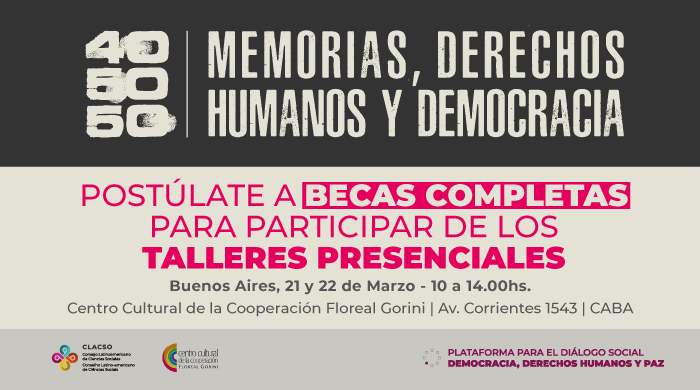
Apply for full scholarships to participate in the in-person workshops
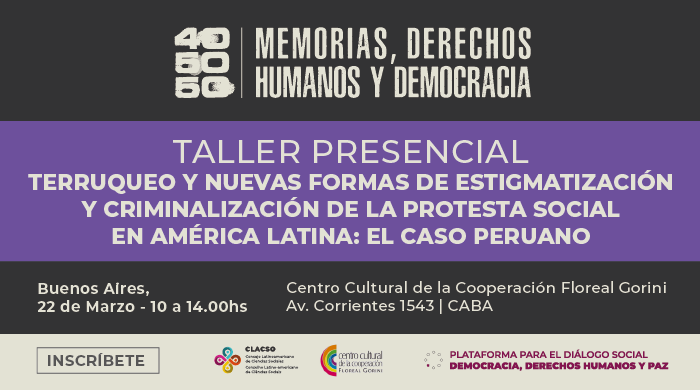
Terrorism and new forms of stigmatization and criminalization of social protest in Latin America: the Peruvian case
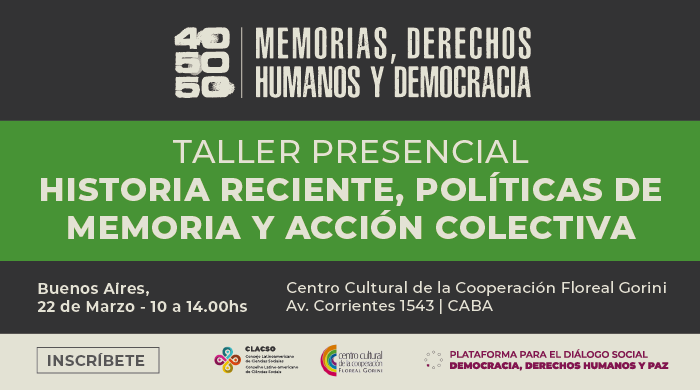
Recent history, memory policies and collective action
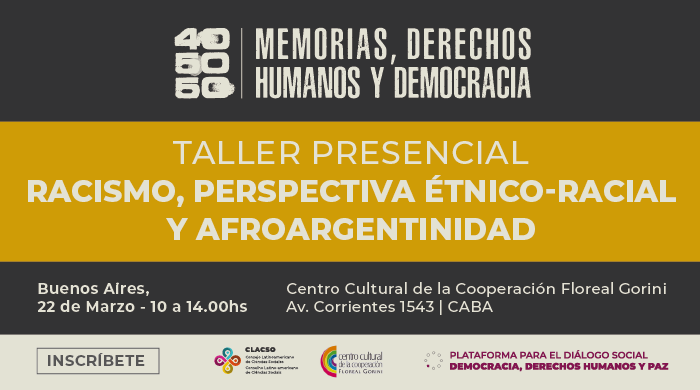
Racism, ethnic-racial perspective and Afro-Argentine identity
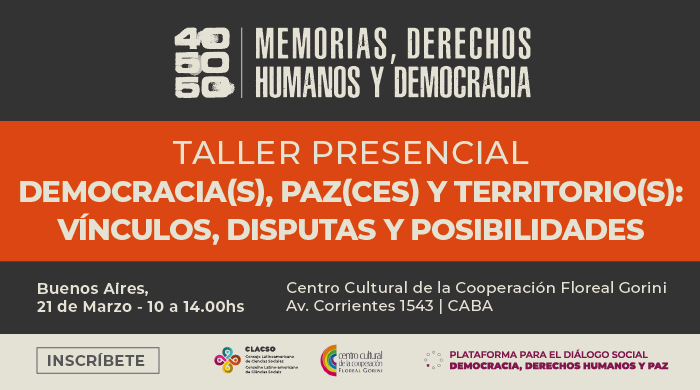
Democracy(ies), peace(ies) and territory(ies): links, disputes and possibilities
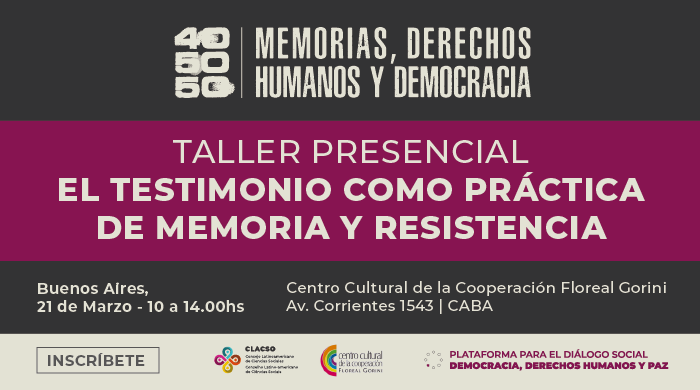
Testimony as a practice of memory and resistance
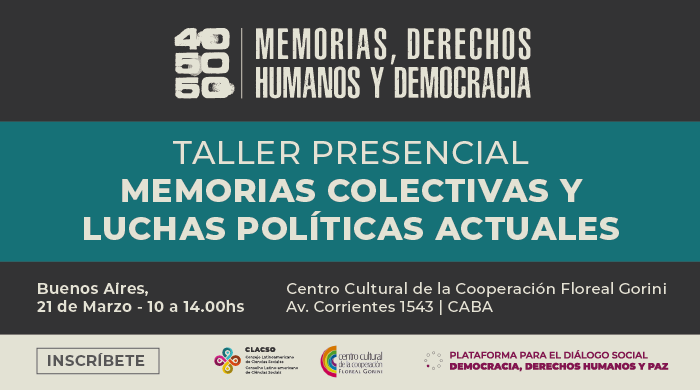
Collective memories and current political struggles
Program
Tuesday 21
10:00 a.m. to 14:00 p.m. (Laks, Dubrovsky and Pugliese Rooms)
Workshop 1 – Collective memories and current political struggles – Coordination: Isabel Piper (University of Chile)
Workshop 2 – Testimony as a practice of memory and resistance – Coordination: Ana Cacopardo (University of Lanús, Argentina)
Workshop 3 – Democracy(ies), peace(ies) and territory(ies): links, disputes and possibilities – Coordination: Sandra Carolina Bautista Bautista (National Open and Distance University of Colombia)
Book presentation – 13:00 to 14:00 (Ponce Room)

"It Was Always About Us: Accounts of Gender-Based Political Violence in Brazil" [Comp.] Manuela D'Ávila. Presented by: Karina Batthyány

"The Weavings of Time: Family, Gender, Memories, Rights, and Social Movements" by Elizabeth Jelin. Presented by Guido Sciurano

"The Falklands in the Geopolitics of Latin America." [Comp.] Luis Wainer / CCC Editions. Presented by Luis Wainer

15:00 p.m. to 17:00 p.m. (Pugliese Room)
Dialogue: Collective Memories, Human Rights and Democracies
As we approach the commemoration of the coups d'état in Uruguay and Chile, and the restoration of democracy in Argentina, we propose to critically examine, from the present, the strategies developed by our societies to confront the authoritarian legacies of the civic-military dictatorships. The implementation of public policies of remembrance and political actions by social organizations have sought to build guarantees of non-repetition of state terrorism and NEVER AGAIN violations of Human Rights. Today, after several decades of the recovery of our democracies and the development of these policies for managing the past, we ask ourselves what their impact has been on the construction of current democracies, and what has become of the promises of truth, justice, and reparations.

They spoke:
Gerardo Caetano, University of the Republic, Uruguay
Verónica Torras, Open Memory, Argentina
Marcela Perelman, CELS, Argentina
Elizabeth Jelin, CIS-CONICET/IDES-UNTREF, Argentina
Isabel Piper, University of Chile, Chile
Moderator: Graciela Castro, National University of San Luis, Argentina
17:00 p.m. to 17:40 p.m. (Pugliese Room)
Presentation of the poster “Right to memory and resistance”

Testimony of Nora Cortiñas, Mothers of Plaza de Mayo Founding Line, Argentina
Karina Batthyány, CLACSO, Uruguay
Erick Fuentes, Memories and Human Rights, Valparaíso Cultural Park, Chile
Eric Domergue, CLACSO
17:45 p.m. to 20:00 p.m. (Solidarity Room)
Opening Conference: Manuela D'Ávila, Brazil: "Hate speech and the new threats to democracy"

Institutional message: Juan Carlos Junio, Director of the CCC, Argentina
Karina Batthyány, Executive Director of CLACSO, Uruguay
Musical closing: Sofía Viola, Argentine composer, singer and actress.

Miércoles 22
10:00 a.m. to 14:00 p.m. (Laks, Dubrovsky and Pugliese Rooms)
Workshop 4 – Racism, ethnic-racial perspective and Afro-Argentine identity
Coordination: Federico Pita (African Diaspora of Argentina)
Workshop 5 – Recent history, memory policies and collective action
Coordination: Emmanuel Kahan (National University of La Plata, Argentina)
Workshop 6 – Terruqueo and new forms of stigmatization and criminalization of social protest in Latin America: the Peruvian case
Coordination: Gerardo Saravia (Coordinator Against Terrorism, Peru)
13:00 to 14:00hs. (Ponce Room)
Presentation of books resulting from CLACSO Research Calls.
Pablo Vommaro, CLACSO, Argentina
Fernanda Pampín, CLACSO, Argentina

-State, democracy and social movements. Continuities and emergencies in the 21st century.
Presented by: Enzo Scargiali, Argentina – Ana Mercado, Argentina – Laura García-Corredor, Argentina
-Rights in question. Threats and challenges to democracies.
Presented by: Marcos Carbonelli, Argentina – Victoria Darling, Argentina
-Human rights and peace. Dimensions for strengthening democracy.
Presented by: Rossana Gauna, Argentina

15:00 PM to 17:00 PM (Tuñón Room)
-Dialogue on Democracies and Current Political Violence:
Unlike the coups and civic-military dictatorships of the 1970s and 80s, which relied on state terrorism, current strategies for destabilizing democracy take different forms, such as lawfare. We aim to explore past and present strategies for imposing authoritarian policies and persecuting radical political practices, as well as the resistance mounted against them. The criminalization of protests, the stigmatization of activists as terrorists, current forms of political imprisonment, and the diverse responses to this repressive violence will be key topics of discussion in this panel.

They spoke:
Gerardo Saravia, Human Rights Movement of Peru, Legal Defense Institute, Ideele Magazine, Coordinator Against Terrorism, Peru
Sandra Carolina Bautista Bautista, National Open and Distance University of Colombia, Colombia
Erick Fuentes, Memories and Human Rights, Valparaíso Cultural Park, Chile
Silvina Romano, Area of Our American Studies – CCC, Argentina
René Ramírez, CES, Ecuador
Moderator: Pablo Imen, CCC Floreal Gorini, Argentina
17:30 PM to 18:00 PM (Tuñón Room)
Presentation of the documentary video “Ciudad Bolívar”

Constanza Ramírez (Colombia), researcher and producer of artistic and audiovisual projects. She uses art to educate about serious human rights violations. She is the president of the Otras Voces Association, a civil society organization that works through art, law, and education to restore the social fabric torn apart by armed conflict.
Karina Batthyány, CLACSO, Argentina
Juan Pablo Russo, Coordinator of the Audiovisual Arts Area of the CCC
Gustavo Lema, CLACSO, Argentina

18:00 PM to 20:00 PM (Tuñón Room)
Dialogue: Inequalities and resistance in current democracies:
To understand current forms of inequality, it is necessary to analyze the various dimensions of domination that contribute to their production, such as class, gender, race, cultural identity, and generational affiliation, among others. We propose to discuss these dimensions, their interrelationships, and the various ways to address them in order to build more just, participatory, and egalitarian democracies. This discussion will foster dialogue between the management of participatory public policies that address inequalities and the experiences of activists from social organizations, reflecting together on the demands of current protests and movements.

They spoke:
Caterine Galaz, PRODEMU Foundation and FACSO UChile, Chile
Laurana Malacalza, MMGyD, Argentina
Mabel Thwaites Rey, IEALC, Argentina
Paula Lucía Aguilar – Gender Studies Space CCC/UBA/CONICET, Argentina
Flavia Guardia, MTL, CTA and councilor for Cañuelas, Argentina
Moderated by: Florencia Rodríguez, CCC and CONICET, Argentina
CCC Samples
The exhibition "We Have Known How to Resist: Voices of Latin American Women," curated by Virginia Corda and Paula Doberti, recovers the words of women from the 19th and 20th centuries in various South American countries. Using typographic posters as tools and means of resistance, these voices are not brought into the present to be crystallized under the lens of a past that renders them inert. On the contrary, each one resonates in the present as a rallying cry, a mission, a possible horizon.
Raúl Lozza Room [2nd Floor] – Admission: Free – Visiting Hours: Monday to Friday from 12:00 to 20:00 – Saturdays and Sundays from 14:00 to 22:00
Iron Book – María Tapia
In this month of Remembrance for Truth and Justice, we present the exhibition "Iron Book" by María Tapia, whose work focuses on the forms of collective self-care and resistance of women political prisoners during the last civic-military and ecclesiastical dictatorship in Argentina. These women were imprisoned in Devoto Prison, the "showcase," a place where the confinement of female political activists had been consolidated since before the military coup, under conditions of apparent legality, a situation in which practices of torture and abuse were not dismissed.
Space Room [1st Floor] – Admission: Free – Visiting Hours: Monday to Friday from 12:00 to 20:00 – Saturdays and Sundays from 14:00 to 22:00
Geishas / Against a mandate – Eugenia Streb
The exhibition brings together 14 textile artworks, all sharing a common theme: the accepted submission of women to men by patriarchal society. The geisha is depicted as a cultured and docile lady-in-waiting. The exquisite combination of silks, moiré fabrics filled with wadding and fleece, chiffon, denim, satin, and embroidery with colorful cotton thread symbolically alludes to this subjugated, immutable world.
Abraham Vigo Room [Ground Floor] – Admission: Free – Visiting Hours: Monday to Friday from 12:00 to 20:00 – Saturdays and Sundays from 14:00 to 22:00
Photos by Yamila Díaz Barcos
If you would like to receive more information about CLACSO's training programs:
[widget id=”custom_html-57″]
to our email lists.

