
What image will we have of our revolution?
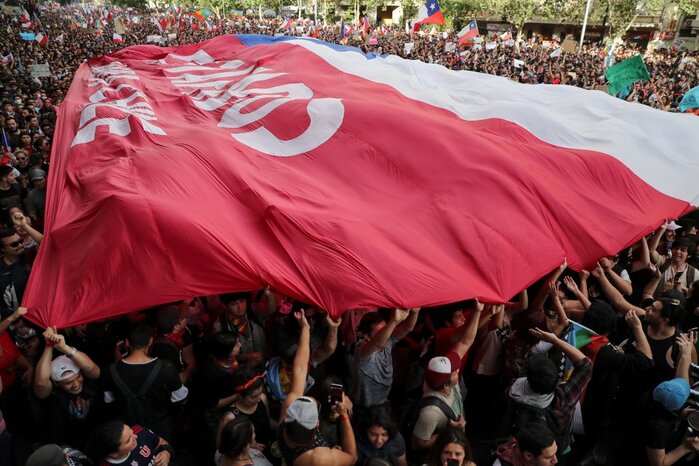
Pelao Carvallo*
At the Huaso de Olmué Festival in January 2023, the first major festival of the Chilean summer season, a prelude and complement to the Viña del Mar festival, the comedians made several references to the defeat of the "approve" option in the 2022 exit plebiscite and to the government of Gabriel Boric.[1]Of course, there were also mentions of the pandemic and the lockdowns. But nothing was said about the revolutionary process that erupted with the social uprising of October 2019. Nothing, despite the fact that this festival, like others, hadn't been held for two years, and that in the last festival season, during the summer of 2020 in the Southern Hemisphere, the social uprising and its circumstances were a recurring theme for comedians.[2], who took a favorable stance towards that revolutionary process and the repression it suffered.
Over the decades, comedians at Chilean summer festivals have become a space for social analysis of what has happened in the past year (and further back), reflecting the urgencies and priorities of social sentiment.[3]Therefore, it is significant that a socially relevant event such as the social uprising that began in October 2019[4] Because there were no references to it, it disappeared from the conversations in those places where there is strong social interaction about important, valuable topics. The annual analysis of comedians dismissed the issue, even though this year that analysis covered the entire period that the Olmué festival (and all others) was suspended.[5]
These days, the social uprising is only discussed in certain committed or academic circles, such as among those fighting for justice for those who were imprisoned, maimed, or killed by the repression during the uprising.[6]But in everyday conversation, in routine social activity, both the pandemic and its quarantines, as well as the constitutional plebiscites, and the ongoing struggle for survival and living, relegated the social experience of the October 2019 uprising to a remote and uncomfortable place from which it has only returned due to the presidential pardon of some political prisoners from the uprising.[7].
Social memory is unfair because it is selective: not all social events or occurrences are worthy of social memory, even if they are present in personal/individual memory. For events of struggle and social transformation, this is even more problematic: social memory prefers triumphs to defeats, the complacent to the sorrowful. The social uprising of October 2019 and the revolutionary process it entailed were neither defeated nor achieved a resounding victory; Chilean institutions tried to suppress it with an overabundance of institutional processes and electoral participation.[8] Thus, our rebellious, defiant, and revolutionary memory of the revolutionary process is relegated, isolated to a personal, individual matter or to small and limited collectives, both as a result of normal social processes related to the passage of time and the pressure of novelties, and due to the pressure of cultural industries in the construction of imaginaries in accordance with the state institutions of which they are a part.[9].
Human social memory, by its very nature, takes the preferred form of images due to the preeminence that we as societies have given to vision over other senses.[10]Seeing is believing. Our social memory is based on agreements about images, so much so that even what was said must be printed to be considered true.[11]What we see shapes our social memory, provided there is a collective agreement about what we have seen. This agreement typically synthesizes a collection of experiences, memories, opinions, positions, objectives, and so on into a single image.[12].
Although not part of the October uprising, the “quiltro” Matapacos was and is an image of that revolutionary process insofar as he synthesized images of unequal struggle, persistence, street life, combativeness, resistance and a certain aesthetic insofar as he wore a handkerchief around his neck[13]What other images contribute to the social imaginary of the October uprising? That has been left to research, photo albums, documentaries, and museums.[14] Apparently, the creation of that image agreement has been interrupted, as the conversation about the uprising was efficiently displaced, by state institutions, to conversations about constitutions, parliamentary agreements, and pandemics.[15]vaccines, migrants, plebiscites, voting, withdrawals and quarantines and now, the weight of the return to “normality”.
The debate then remains open on how to shape the images that will give form to social memory.[16] of the revolutionary process initiated with non-violent direct action in October 2019[17]Because what image will capture the joyful break from normality? What image will capture the happiness of feeling circumstances unexpectedly turn in your favor? What image will capture the affective politicization of dialogues and their exponential expansion on sidewalks, in stores, at markets, on buses? What image can synthesize in an agreement that feeling of triumph and self-control acquired during those days? A photograph, a painting, a piece of graffiti that encapsulates the deep and conflicted feelings regarding the looting in the neighborhoods, especially regarding who has the right to loot?[18]Because yes, peoples in rebellion also build their law and their constitution against the institutional framework.
State institutions made an effort to maintain and support the executive branch during its decline in November 2019.[19] through the electoral and representative co-optation of sectors that were becoming part of the revolutionary process. This strategy was successful, and instead of striving to change the status quo, they moved to accepting electoral normality with minimal changes sufficient to make it attractive (such as independent lists, gender parity, reserved seats, etc.). Now it will be the cultural industry[20] whose mission will be to provide images that signify the revolt in accordance with state guidelines to supply social memory.
One of the most important functions of the cultural industry (in the world) is to provide narrative and image[21] to state guidelines that contrast with and compete with the imaginary[22] Social memory is constructed from each person's own images, and pressure can modify social memory regarding certain events of social change. Television and streaming companies are notable examples of this, but they are not the only ones. Regarding the redirection of the collective imagination in social memory to suit the state's interests, the usual procedure involves three stages: 1) minimizing and distorting (this is what happened on Chilean television and news programs in the first months of the uprising).[23]2) To appropriate and close the failed constituent process, which only failed in terms of the constitutional proposal, but not in terms of appropriating and closing the revolt.[24]And 3) forgetting and construction of a narrative that is functional to the state: we are in this period and the humor at the Olmué festival 2023 demonstrates this.
Accustomed to understanding revolutionary processes in a mechanical and bellicose sense, whose last memory of regional success dates back to the 70s, we find it difficult to see and feel the revolutionary processes that currently exist.[25]...when they exist. That's why there's a certain reluctance to say that what happened in Chile, centered on October 2019, was a revolutionary process: the revolutionary process that the people who make up Chile could have in a neoliberalized, institutionalized, and ultra-statized country, so much so that more than one sociologist is content to say "that in Chile the State came first and that the State built the nation."[26]Well, against that statist and nationalist mythology, the people of Chile carried out their own process, within a regional event that is not yet over.[27]Furthermore, it is revolutionary, against and despite that institutionalist, statist and electoral culture that oppresses us.
Western cultural industry, and Chilean culture in particular, has strived to erase the revolutionary element. It is either an exotic past or a distant evil. In Chile, it is seen as a defeat that has already occurred. This has made it very difficult to recognize the revolutionary moment as it unfolds: revolution is always something grand, total, and distant that happens to others.[28]That's why it's hard to tell yourself that what happened in Chile from October 2019 onward was a revolutionary process, even though it was massive and all-encompassing, but too close to home to truly see in the streets, in the assemblies, in front of the barricades, looking at the looted supermarkets, laughing with neighbors you just met at the assembly despite years of living together. The myth of revolution makes it difficult to see the revolution that is actually happening. Every revolution ends as soon as it becomes institutionalized. The powers that be in Chile did understand that they were living through a revolutionary moment and acted accordingly to ensure it was short-lived and easily contained.
Viewing past experiences as tumultuous, rebellious, and revolutionary can provide us with a vast array of images that can nourish a discontented and dissenting social memory, one that challenges the cultural industry's attempts to reshape narratives and ultimately erase the facts. One of the cultural industry's most useful tools for constructing imaginaries is what has been called the "nostalgia industry," which functions as a privatization of social memory.[29] But I disagree that it's an industry; it's more of a way of designing cultural works to construct a domesticated political perspective on the past and the future. Nostalgia in the cultural industry allows for the anesthetization of any critical sense that might be present in the work by incorporating an anecdotal sentimentality that colors it. I can cite Chilean series like Los 80'[30] and 62' History of a World Cup as examples, since in both the critical intentions present are lost thanks to the nostalgic key constantly pressed.
Nostalgia is the uncritical way of approaching the past[31]The aesthetic refinement of a certain self-defense against past harm, which, for example, makes us remember only recess and brief moments of entertainment in high school amidst a sea of boredom, mistreatment, and competition. Nostalgia is a self-defense mechanism of memory captured by the culture industry to rewrite history without complaint. All past times were nostalgic, we are told, regardless of the dictatorship, the abuses, or the exploitation. It is certainly possible to explore the past critically, even critiquing that tendency toward nostalgia inherent in those who defend themselves against their past. The documentary Olympic Village[32] Sebastián Kohan Esquenazi's work is an example of this: the childhood exile of the Southern Cone in Mexico reviews their Mexican life from the perspective of the exile that was their return, with nostalgias that are deeply re-spun in criticism.
These images that we have to construct as input for the contested social memory are nourished by the narrative we create of the revolutionary experience we had[33]Whether we have done little or much, it is the act of recounting our experiences to one another that gives meaning to those experiences. Not just anyone makes a revolution, they say, and even fewer will happen if we don't speak of them. The first act is speaking, as Agustín García Calvo said, and the most important act of insubordination is saying no.[34]No to the cultural industry narrating the revolution we are living through from a place of nostalgia; the revolution is still underground, crawling, searching for another way out, one where it isn't used to install a new elite alongside the old one.[35].
[*] CLACSO Working Group “Collective Memories and Practices of Resistance”Paper presented at the Colloquium on Legacies and Memories of Social Struggles in Latin America and the Caribbean (20th and 21st Centuries) January 27, 2023
[1] Humorous routines at the Olmué festival 2023 https://www.youtube.com/watch?v=u9FqaZGz2ss&t=2448s https://www.youtube.com/watch?v=c6h9KRt8xjs&t=1583s https://www.youtube.com/watch?v=ESGLxA2FKaM https://www.youtube.com /watch?v=wiWFHuLfuBc
[2] Humorous routines Viña 2020 https://www.youtube.com/watch?v=5NkJpEP2AuI&t=4185sRelevant: Stefan Kramer's routine at Viña 2020 is not available on YouTube. https://www.youtube.com/watch?v=AczaEiqaKyg
[3] https://radio.uchile.cl/2020/02/25/populismo-o-resistencia-el-humor-en-tiempos-de-crisis/
[4] https://www.youtube.com/watch?v=SlRb-S47qq4 European report on the “outbreak”
[5] https://www.biobiochile.cl/noticias/nacional/region-de-valparaiso/2021/12/10/por-segundo-ano-consecutivo-anuncian-la-suspension-de-tradicional-festival-del-huaso-de-olmue.shtml
[6] https://www.elmostrador.cl/noticias/pais/2022/10/03/caso-kayser-y-los-cinco-muertos-olvidados-del-estallido-social-familiares-de-las-victimas-apuntan-contra-el-fiscal-de-la-causa/
[7] https://radio.uchile.cl/2022/12/30/presidente-boric-ordena-indulto-de-10-presos-detenidos-durante-el-estallido-social-y-a-jorge-mateluna/
[8] https://www.clacso.org/la-influencia-anarquista-en-constituyente-en-chile-analisis-con-ojos-acratas/
[9] https://journals.openedition.org/cybergeo/2549?lang=es
[10] Joly, Martine. Introduction to Image Analysis, p. 13: “Thinking that we live in a 'civilization of the image' seems to be the most widely shared opinion regarding the characteristics of our time.” La marca editora, Buenos Aires, 2012.
[11] https://www.agendaoculta.com.mx/santa-selfie-que-nos-das-fuerzas-para-soportar-la-pandemia-eterna/
[12] file:///C:/Users/usuario/Downloads/Dialnet-NosotrosEntreLasImagenesOLosUsosSocialesDeLasImage-5716824.pdf
[13] https://www.clarin.com/viste/negro-matapacos-perro-icono-resistencia-social-chile_0_cRqHy8gx.html
[14] https://museodelestallidosocial.org/
[15] https://www.clacso.org/contra-la-revuelta-enfermedad/
[16] https://dspace.unila.edu.br/bitstream/handle/123456789/6370/Memorias%20en%20Disputa%3A%20el%20Estallido%20Social%20y%20la%20Convenci%C3%B3n%20Constitucional%20como%20una%20V%C3%ADa%20de%20Escape%20a%20los%20Amarres%20de%20la%20Dictadura%20Civil-militar%20Chilena?sequence=1&isAllowed=y
[17] https://www.clacso.org/la-influencia-anarquista-en-constituyente-en-chile-analisis-con-ojos-acratas/
[18][18] https://gargantas-libertarias.blogspot.com/2019/10/chile-quienes-saquean.html
[19] https://www.uchile.cl/noticias/192614/los-significados-del-acuerdo-politico-del-15-de-noviembre-de-2019
[20] (an integral part of the conglomerate we suffer as a State)
[21] https://www.agendaoculta.com.mx/memoria-musica-infancia-la-historia-del-rock-y-sus-bemoles/
[22] https://www.agendaoculta.com.mx/wandavision-en-la-memoria-de-la-memoria-audiovisual-y-la-nostalgia-del-imperio-2/
[23] https://www.elciudadano.com/columnas/el-golpismo-de-pinera/02/02/
[24] https://www.elciudadano.com/columnas/el-anarquismo-en-la-region-chilena-ante-el-plebiscito-de-abril-si-es-que-se-hace/03/16/
[25] https://www.agendaoculta.com.mx/la-muerte-del-tobi-y-la-memoria-revolucionaria-en-vidas-sin-revolucion/
[26] Example: Alberto Mayol in one of the latest Cosa Nostra broadcasts.
[27] https://www.clacso.org/la-primavera-andina-florece-en-pandemia/
[28] https://www.agendaoculta.com.mx/la-muerte-del-tobi-y-la-memoria-revolucionaria-en-vidas-sin-revolucion/
[29] https://elpais.com/icon/2022-12-27/atrapados-en-el-agujero-negro-de-la-nostalgia-como-el-pasado-se-ha-convertido-en-el-mayor-enemigo-del-futuro.html
[30] To see in https://www.youtube.com/watch?v=QI_RQxjivSY&list=PL-rRpq1GD0fqW9FJOiqN4JJHk25w44WHX y https://www.youtube.com/watch?v=JXLVXwHTJhQ&list=PLTNAcsgsZizOCcpI5JJZcXMFTXvp8iYal
[31] https://www.agendaoculta.com.mx/wandavision-en-la-memoria-de-la-memoria-audiovisual-y-la-nostalgia-del-imperio-2/
[32] Chilean-Mexican-Argentine, not yet available on platforms.
[33] Example https://www.clacso.org/la-revuelta-social-contra-el-servicio-militar/
[34] Example file:///C:/Users/usuario/Downloads/’Contra%20el%20Tiempo%20y%20el%20Poder’,%20de%20Agust%C3%ADn%20Garc%C3%ADa%20Calvo.pdf
[35] https://www.elciudadano.com/chile/chile-capitalismo-contra-neoliberalismo/01/20/

