
The anarchist influence on the Chilean Constituent Assembly: An analysis from an anarchist perspective
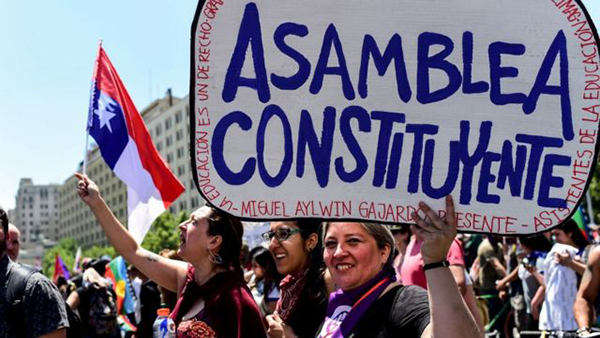
Pelao Carvallo[1]
This analysis focuses on the anarchist influence on the constitutional process currently underway in Chile. It is not the only influence in this process. There are many others, such as the feminist movement, which, for example, achieved gender parity in the elections. This is an exploration of a process in which many influences are at play, some of which are the product of revolutionary libertarianism.
The Influence
The constitutional process began as an elite response to redirect the revolutionary process initiated in October 2019 by the nonviolent direct action of high school students protesting against public transportation fare hikes. This action involved jumping the turnstiles of the subway. The government's initial response to these nonviolent direct actions was repression, which proved clearly insufficient, as these actions were replicated and amplified by all segments of the population. Not only did the repression fail, but repressive measures such as closing the subway actually helped to broaden the protest and foster practical solidarity with the high school students.
On the night of October 18, 2019, the situation reached a point where the mainstream press had to describe what was happening as an “outbreak” or “uprising,” acknowledging the concrete beginning of a revolutionary process. The tactics of nonviolent direct action—individual and mass fare evasion, the mass boycott of a public transportation system that treats city residents as raw material for an extractive industry, the rejection of repression as a way to address social discontent with the extractive nature of public transportation—all of this had been part of anarchist action since the inception of the Transantiago transportation system in 2007. The high school students who started the uprising by jumping turnstiles included anarchists among them. They weren't the only ones, nor the majority, but there they were, jumping the turnstiles. When the city and the country awoke rebellious, revolutionary and with uniformed repression upon them, local anarchism gave an immediate response, amplifying the revolt through barricades, pot-banging, and the first constructions of self-managed neighborhood or trade union councils and assemblies.
Because, let's not forget, the first assemblies and town hall meetings emerged from behind the barricades, not the other way around. At those barricades, in those assemblies, anarchists weren't the majority, nor were they the only ones, but they were there. They were so present that in the first weeks and months, when the establishment wanted to make a general accusation, looking for a culprit, they directly mentioned anarchism.
The constituent process began in the Chilean Congress as a negotiated way to redirect a situation that, for the established order, was headed straight for chaos and nothingness, that is, to losing its millions.[2]The fundamental fact is that the political elite prioritized an issue that was secondary or tertiary to the uprising because the demands and anger were not focused on the constitution but on life itself: on defending it from lethal repression (at least 34 deaths between October and March and more than 350 with eye injuries or mutilations) and on defending it from consumerist neoliberalism and its reward and punishment system (if you behave, there are no shortages; if you misbehave, there are shortages—that was the practice in that initial phase; privileged neighborhoods were supplied, while rebellious and poor neighborhoods were left without supplies, and would have fared even worse were it not for the existence and permanence of the open-air markets). The constitutional issue was presented in the press with a showmanship, with municipal and union intervention (remember the constituent assemblies?) with the aim of diminishing the importance of all the other issues. Constitutional change was indeed a demand, but not the main one, nor the only one. They tried to make it the main and only force, but they couldn't. The revolt and protests continued, with marches and mega-marches until March 2020, at which point the government breathed a sigh of relief, thinking the pandemic had come to its rescue. The anarchist presence and action are inseparable from the revolt; the constituent process was born from the revolt, both as a continuation of and as a brake on that revolutionary process.[3].
The social influence of anarchism on the constitutional process is evident in the increased electoral possibilities for independent candidates, who were allowed to run on party lists, something previously reserved for political parties. This was a way of acknowledging the weight of the prevailing non-partisan and anti-party sentiment and, at the same time, a way of channeling the anti-party rebellion into the electoral system. To achieve this, not only were independent lists permitted, but the very driving force behind the party lists was the inclusion of independent candidates on them.
Nonpartisanship and anti-party sentiment in Chile, since the early 90s, were fueled by anarchism. The anti-party stance of the right, one of its ideological cornerstones during the Pinochet dictatorship, was silenced, sidelined, and postponed when the administration of the transition fell into the hands of political parties, especially right-wing parties. Let's not forget that the UDI, born under the dictatorship to support Pinochet in the 1988 plebiscite, stands for Independent Democratic Union. Independent from the parties. This nonpartisanship, this "apolitical independence," was no longer useful during the transition and was abandoned by the right.
In contrast, anarchism, based on the social experience of political parties as tools of control during the Chilean transition—expressed in the partisan control of all existing social organizations, from neighborhood associations and unions to student organizations—developed an efficient, rebellious anti-party movement that called for self-management, autonomy, and direct action by social organizations in their struggles. The disastrous actions of the political parties in the coal miners' struggles serve as a stark example.[4] And the demands of secondary and university students exemplify this social experience. The first media-recognized response to this non-partisan movement, in which anarchism played a role, was the creation of ACES (Coordinating Assembly of Secondary Students of Santiago) in 2000, which in 2001 carried out the first successful social protest against the neoliberal two-party transitional model: the Mochilazo (Backpack Protest).[5]From that moment onward, non-partisanship and anarchist anti-party sentiment gradually became common sense among the people of Chile, aided by the practical ineffectiveness of political party governments, especially in the last decade. This non-partisanship prevailed in both electoral events of the constitutional process, alongside anti-electoralism.
Anarchist anti-electoralism stems from its preference for non-hierarchical, non-elitist, non-discriminatory, and non-competitive forms of political participation, based on collaborative and inclusive approaches that foster creativity, free expression, and the capacity of every individual and social group to understand the issues that affect them. Therefore, in contrast to voting and the electoral system, anarchism proposes decision-making by consensus.[6]It is a complex technique, requiring some practice, that guarantees full social participation both in decision-making and in the outcomes of those decisions. Anarchist anti-electoralism is strategic; it is part of a concrete proposal: we want to decide, not vote. This anti-electoralism has been coloring the Chilean political landscape for decades, aided by transitional governments that made it clear that nothing was decided in elections that hadn't already been settled behind closed doors.[7]".
This became clear with the notable decrease in voter registrations, even though the law mandated voting (under penalty of fine) but not registration. Since the electoral system shamelessly disregarded the possibility of being declared illegitimate due to low turnout, it yielded to the prevailing anti-electoral sentiment and declared voting non-compulsory.[8]This brought transparency to the situation and simultaneously allowed parties to improve their electoral marketing, as the electorate became a small and captive audience. The D'Hondt system was implemented to address the perception of an aging electorate caused by widespread voter non-registration and, at the same time, to attract new political leaders who emerged from the student movements of the 2010s.[9] This opened up parliament, previously closed by Pinochet's two-party system, to young parties of young people eager to be part of the political machine. These new leaders and parties failed to curb anti-electoral sentiment, a fact that was evident in the October 2020 plebiscite. Despite the political motivation behind the referendum (the possibility of getting rid of Pinochet's constitution), barely more than half of the eligible population actually voted. For the election of the constituent assembly members a few days ago, that percentage dropped to less than half.
The question of why, despite the low voter turnout on those days, the parliamentary opposition and the more radical independent lists were able to win, has an answer that sheds more light on the influence of anarchism. To understand this, it's important to remember that anarchism in Chile generally called for abstaining from voting or only voting for the constituent assembly.[10] by those who claimed to be turning the constituent assembly into a space for amplifying the revolt. The discourse of certain right-wing groups claiming that their electoral defeat was due to a large portion of the right not voting is wrong, wrong out of self-interest. The right wing was not only defeated, but it disappeared electorally because its voters didn't vote for it; it's not that they didn't go to the polls. Electoral participation[11] The turnout on May 15 and 16 was lower than that of the October plebiscite, but not lower than usual.[12]Then, there was an electoral shift to the left that reflects the socio-political situation of the majority in Chile who, influenced by anarchism, push the entire political spectrum, including the electoral one, compressing the right wing.
The people's list as an example of this influence
To delve deeper, I'll use the People's List as an example. Its story has been familiar to many since it became fashionable—and because of this, it's been told and retold, even in the most mainstream media outlets in Chile. Many people voted for this list because they identify with certain anarchist ideas and proposals that resonate with them. First, it was a list that managed to elect constituent assembly members who aren't professional politicians, who aren't (generally speaking) political activists, people anyone can confidently say "are just like us"—a list that recognizes that anyone is capable of holding an administrative/representative role in society and championed this as its defining electoral feature. Anarchism generally proposes that political and administrative positions, if they exist, should be rotated because everyone has both the capacity and the social responsibility. The electorate voted for this idea: something we all understand.
On the other hand, they have thus far maintained a strong distance from the Broad Front, the Communist Party, and the opposition in general, which they accuse, based on the facts, of being part of the established order and of having negotiated the constitutional process with the right wing in exchange for the anti-barricade law and for keeping political prisoners from the Chilean revolutionary process in jail. They have incorporated a clear anti-party stance into their discourse, thus translating, in their own terms, a very clear anarchist position since October 2019. Furthermore, they ran a campaign with a self-management focus (which, of course, may be due more to circumstances than to an ideological orientation). They have a strong anti-repression stance, but it doesn't quite reach the level of anti-militarism, at least not yet. Anarchist orientations and proposals have influenced some of their practices and proposals. [13] As an example, it is sufficient; it is an electoral list and that is its limit. There is no anti-statist ideology there, nor should they dream of taking advantage of the constituent assembly to propose a confederation of autonomies in the Chilean region.
The inevitability of anarchist influence.
All of the above already describes the inevitability of this anarchist influence on the constitutional process. Anyone can trace anarchism among their contacts and will see that every inhabitant of Chile today, at least within their second or third circle of acquaintances, has an anarchist contact, which is similar, though not equal, to the relative weight of all political parties in Chile (538.497 people registered with political parties out of 19.100.000 inhabitants).[14]), this fact illustrates the anarchist presence in Chile.
Anarchism in Chile has been acting as an active majority since before October 2019, made up of those who act anarchically in the social/political sphere and not strictly those who declare themselves anarchists, in contrast to the active minority that Moscovicci speaks of.[15]An active majority with a presence, recognition, and influence; an established social representation that speaks to a certain capacity for action and commitment, with core ideas that are positively reflected in reality. An active majority that drives social events that change reality and thus determine and influence the actions of both political actors within the established order and other active participants in the ongoing revolutionary process (it is important to remember that revolutionary processes have moments of both calm and tension).
It is an active majority with varied local forms, ranging from small groups acting as active minorities to assembly spaces and others that, at this point, are permanent autonomous zones, in the sense that Hakim Bey gives to the concept. This occurs within a revolutionary process that has not yet completely broken two pillars of the Order: the power of the economic right and the repressive power of the armed forces and police. The former is under threat due to the withdrawals of funds from the AFP pension funds, but the sacrosanct right to property has not been affected (not even by the looting of 2019), nor has there been a push for direct action unionization or labor conflict. In fact, proportionally, the "strikes" in support of the uprising, both in 2019 and 2020, fell short. Regarding the armed forces and police, the long antimilitarist struggle in Chile succeeded in defeating mandatory military service.[16] and boycott police recruitment. Even so, among the proposals of the more radical lists for the constituent assembly, the popular anti-militarist demand does not appear, so far.
Another strong influence is the rise of anti-authoritarianism, the discrediting of all authority.[17]If we could ethnographically visit Chile in the early 90s and trace its evolution through time to the present day, we would find a society that is far less, radically less, authoritarian. Police, military, administrative, governmental, age-based, patriarchal, and paternalistic authority has declined sharply, the result of years of anti-authoritarian influence and practices in all spheres, from the political to the scientific. Of course, several proposals have converged in anti-authoritarianism, not only anarchism; for example, the anti-authoritarian contribution of feminism has been remarkable, but among all these contributions, anarchism stands out.
This anarchist influence has a historical trajectory that encompasses a significant portion of social life in the Chilean region, within its various cultures. Let's look at an example of a possible trajectory: an anarchist teacher, currently working in public, private, or subsidized education, was politically formed in the student struggles—both secondary and university—of the feminist March of 2018, 2011, 2006, or 2001, to name a few key years (from a period of many struggles). These struggles ousted political parties from secondary school organizing and, starting in the 2010s, with advances and setbacks, from university organizing. Today, these teachers are fighting to change the union. The same story applies to other professions, such as the press, lawyers, etc. The anarchist presence is no longer limited to young people; it's also possible to speak of libertarian senior citizens. There's a trajectory that makes anarchist influence inevitable, regardless of current circumstances. It's so present in today's culture that even a well-known stand-up comedian mentions a quote from Bakunin in his show. A quote from Bakunin[18]In a show that's not political at all: that's what cultural influence looks like.
Concerns
A certain anarchist modesty, a misguided sense of humility, and a certain fragmentation prevent our comrades in Chile, in the midst of the struggle, from fully grasping the impact of their actions. This makes it difficult for them to amplify their influence to deepen, extend, and sustain the revolutionary process. Having social, cultural, and political influence is an achievement, a great achievement for the present and for what is to come. It is not enough, but it is important. This should be celebrated, and we should consider how it can serve as a springboard for even greater leaps forward.
A certain weariness that leads to stagnation is also a concern for the revolutionary process, primarily due to a failure to recognize the moment, the momentum—in other words, the revolutionary process unfolding in Chile. This is compounded by the fears inherent in the actions of those in power: namely, the potential for manipulation, co-optation, and the erosion of its meaning.
The concern is the lack of capacity and willingness to increase scope and organicity and/or to move beyond what works and makes sense: mutual support, self-management, direct action, abandoning that in search of more systemic drivers.
That is why the danger of this influence is not building a minimum network relationship, not just coordination, but a certain capacity for encounter in difference (without thereby accepting sexist or mere posturing) that allows for outlining feasible strategic goals and having broader analyses of all the realities involved.
The inability to delve deeper into the practice of the anarchist proposal, which is evident in the limited scope (shortcomings in the organization of resistance at work, whether as a union or not), in consumption (cooperatives), in federated and coordinated associations of all kinds, limits the great reach that anarchism has today in Chile, so much so that it has influenced, until now, even a constituent process made, among other things, to curb that influence.
[1] Member of the CLACSO Working Group on Collective Memories and Practices of Resistance. Presentation given on May 24th, available at: https://www.facebook.com/1421886927880165/videos/289913749531895. With thanks to Roberto, Felipe, Caracolito, Ramalc, the Chilean Antimilitarist Assembly, and Oscar.
[2] http://periodicoellibertario.blogspot.com/2020/10/debate-voto-anarquismo-y-plebiscito-en.html
[3] It is a revolutionary process with these contents: it is self-managed, of direct action, it is lived in joy, people recovered their speech, it is a process of autonomies, it is anti-authoritarian, self-organized, in networks, anti-repressive and anti-military.
[4] 1996
[5] https://www.eldesconcierto.cl/opinion/2021/05/09/mochilazo-2001-un-camino-que-no-se-cierra-en-la-constituyente.html[6] https://www.nonviolence.wri-irg.org/es/node/40512
[7] https://www.elmostrador.cl/noticias/opinion/2014/07/17/zaldivar-y-la-cocina-en-la-que-somos-cocinados-los-ciudadanos/
[8] In 2012, mandatory voting with voluntary registration was replaced by mandatory (automatic) registration and voluntary voting due to anti-electoral pressure (people stopped registering).
[9] 2015: end of the Pinochet-era binomial system that supported the transition and implementation of the D'Hont electoral system in order to add dissidents and stop anti-electoralism and anti-party sentiment.
[10] https://www.elciudadano.com/columnas/chile-voto-y-anarquismo-una-opinion-proactiva/05/07/
[11] October 2020 (originally April): Opening Plebiscite, 51% turnout. May 2021: Constitutional Convention Election, 42% turnout. Compare to the 2017 Presidential Election (Second Round): 49% turnout and the 2013 Presidential Election (Second Round): 42% turnout. Same turnout, but a larger number of people participated.
12] https://twitter.com/mmlagoscc/status/1397541316628779012
[13] In summary: People's List: anyone can be a constituent assembly member/ Anarchism = rotation; People's List: PC-FA = Traitors, because of the November Peace Agreement and the Anti-Barricade Law/ Anarchism: almost the same, plus pardon and reparations for the victims of repression and trial for the repressors at all levels; People's List: Demand for Freedom for Political Prisoners/ Anarchism: same; People's List: Anti-repression (not anti-military)/ Anarchism: anti-repression and anti-military; People's List: self-managed campaign based on Mutual Support (they emphasize that)/ Anarchism: self-management and mutual support are the basis of their practice and proposal; People's List: It has no anti-statist ideology/ Anarchism: it is their basic proposal.
[14] https://www.servel.cl/estadisticas-de-afiliados-a-partidos-politicos/
[15] https://www.redalyc.org/pdf/726/72620106.pdf
[16] https://www.clacso.org/la-revuelta-social-contra-el-servicio-militar/
[17] (except for my mom's).
[18] https://www.youtube.com/watch?v=NFHfpArVbOw minute 49 approx.
If you would like to receive more information about CLACSO's training programs:
[widget id=”custom_html-57″]
to our email lists.

