
Against the revolt, disease
Pelao Carvallo1
Why Eurocentric discourses on COVID-19
They are not suitable for Latin America and the Caribbean
The Latin American uprisings of recent years have been against the reality that governments insist on constructing for us. There is apathy towards this imposed reality, and at the same time, there is revolt for the reality we want to create. Governments and elites are the fake news and deepfakes in these conflicting realities that affect us. Regarding Covid-19 in our region, the reaction has not been exaggerated; there hasn't been much panic, except in elite neighborhoods, because for us poor people, our reality has been shocking us for quite some time. The virus, rather, has been a sedative that governments/fake news have used entirely to their advantage to quell the uprisings against them and their reality of subjugation and subordination for the vast majority. Our enemy is the reality of the elites, those who travel to Europe, Korea, China, and Japan. They construct a reality of elite predation through extractivism and dispossession, in a repeated colonial logic of destroying everything and placing the palace on top to mask the absence.
The reality constructed by those in power in our region has been a constant game of escape, political training, spectacle, and thriller—before the advent of touchscreen television, and before that, on radio and in the press. Escape from reality to endure it; political training to perpetually indoctrinate you with the virtues of the current government or local system; the spectacle of football, baseball, sports, and easy music; the thriller, because the normalization of political massacre involves a policy of massacres, and for this, they use the criminal apparatus, a subsidiary of the police-political apparatus, to fulfill that function. The pages are now filled with crime stories; the constant shock is a strategy employed by the elites to remain in charge of a ship that will never sink because it set sail already sinking.
The digital landscape in Latin America is experienced as an extension of our hierarchical reality. High-ranking public officials, predators of the people, have access to the most advanced mobile devices as part of their positions, while poor people must focus intently on the small, modified, resold, or heavily rationed screens to which they have access. The size of the screen, whether held in hand or displayed in the living room, reflects one's place in the local hierarchy and what and to whom one has access. A poor person with an expensive cell phone is viewed with suspicion, making them a target for the elites and the mass media.
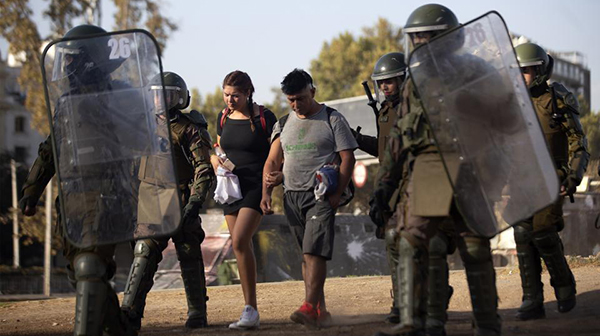
This virus, in the Latin American and Caribbean region, has come to halt revolutions. That's also what this is about: the Haitian, Ecuadorian, and Chilean experiences, to cite the most recent, have been stopped—much to the delight of the governments in crisis—by the development of this pandemic, which in the region reproduces the elitist system of hierarchies and classes, where the poor are dealt the death brought back by the rich from their vacations abroad, since they, that 6%, will not die because they have access to reliable health systems built on the plunder of the poor's healthcare.
Latin American and Caribbean borders were closed long before this pandemic. They were closed to the people of Haiti and Central America who wanted to cross AMLO's Mexico to reach Trump's US. The incredible Central American migrant caravans ended up forcibly camped between the border fences erected against them—and only against them—between Mexico and Guatemala, between Guatemala and Honduras, between Honduras and El Salvador, and so on, all the way to the sea. The political xenophobia of the Central American elites had no qualms about obstructing migration from neighboring countries and, consistent in their abuses, had no problem expelling poor people from their own countries, considering them foreigners—because poverty in Latin America and the Caribbean has never granted citizenship, nor a passport with a visa.
The southern borders—long before the pandemic—were also closed to the flow of forced Venezuelan migration, which by the millions sought the advertised paradises where they would find work and opportunities… both of which vanished with the economic collapse of the extractive export model and its dependence on prices imposed by buyers. The experiences of closed borders in the region show a Venezuelan woman trapped in the desert between Chile and Peru, expelled from one of those countries and denied entry to the other; the long migrant train between Panama and the US border, with prison-like controls at every border crossing, formal or informal; they show the “coyotes” who have made a profession of the very limited mobility that reigns in our region for the poor. Because the rich, with their charters or private planes, their speedboats and cruise ships, their permanent visas thanks to their dollars and million-dollar deposits, have no problems with their destructive mobility, because that mobility feeds on the exploited immobility of the region's poor.
So, there is no immunological weakness in the region—in the sense that Byung-Chul Han uses the term—but there is a strong and demagogic militarization of the borders, which has its own particular trajectory: first against drug trafficking, then against migrants, now against a virus. There is always a reason to involve the military in the border business. Panic wasn't necessary to close the borders, and there has never been such permissiveness regarding the movement of people in this part of the world. We always forget this fundamental fact of the region: the Latin American and Caribbean states were built on the free flow of capital and goods. All interstate recognitions of independence are based on free trade clauses. We have thus experienced globalization since the statization of politics as formally independent state formations, some 200 years ago and more.
It is true that Latin America's dependence on China is increasing daily, so much so that the next economic crisis will not be due to what happens in the US, as was the case until 2008, but rather to what happens or doesn't happen in a China to which everything is bought and sold. There is a key aspect where this dependence can be avoided: local states have spent two hundred years developing their own techniques and technologies, mostly analog, of capitalist policing—including liberal, Keynesian, and neoliberal periods, democracies and dictatorships. These local techniques currently combine forms of community, migratory, media, digital, biological, and geographic control, functioning perfectly to the point that, in this Covid-19 crisis, even sectors of the most "revolutionary" left are calling for, for example, xenophobic and militaristic measures such as closing borders and airports. Alongside security cameras in cities, residents are enthusiastically reporting to the police those who are out on the streets during quarantine. The main problem is not a future regime of digital police control, but the current culture of denouncing what is different and unknown, the stigmatization and marginalization of what is not normal, according to the pattern and discourse of normality imposed by the elites and those who aspire to be part of them.
1- Chilean writer. Member of the Latin American and Caribbean Antimilitarist Network. This text originated from the translation of an article by the philosopher Byung Chul Han (a Korean living in Europe) published in the Spanish edition of the newspaper El País, which was widely shared on social media, especially in Latin America and the Caribbean. Reading the text made me question the reasons for its widespread dissemination in this region of the world, given that the text never mentions it.
If you would like to receive more information about CLACSO's training programs:
[widget id=”custom_html-57″]
to our email lists.

