
The Andean spring blossoms during the pandemic
Pelao Carvallo*
The Andean Spring is the series of revolts, uprisings, and social resistance movements that took place in the Andean region.[1] From 2017 to the present day, November 2020, with no end in sight, these social uprisings feed off and reinforce each other, both in their materiality and their content, forming a recognizable whole that speaks to both the communicative nature of the peoples who inhabit these territories and the similarity of their experiences of oppression and exploitation. From the heart of Latin America, South America, and the Andean Region, there is no effort to see this as a whole due to the need of the political, academic, economic, and military elites to keep the peoples of Latin America and the Caribbean divided and confined within national and patriotic discourses and sentiments. For the peoples of the region, however, this shared, palpable experience transcends borders and discourses, generating feelings of unity and empathy.
The journey of the Andean spring
The Andean Spring began in 2017 with protests in Venezuela against hunger, unemployment, shortages, forced migration, and repression as the main public policies following the policy of impoverishment. These protests arose from the internal political conflict that Maduro resolved by resorting to the Fujimori coup.[2]When he attempted to abolish Venezuela's National Assembly (Congress) by electing and installing a Constituent Assembly, which, in practice, assumed legislative functions, this political conflict transformed into a social struggle for survival in the streets.
In Colombia, the protests began in 2018, as part of a massive nationwide university strike, which was harshly repressed by the ESMAD (Mobile Anti-Disturbance Squadron).[3] This repression sparked new protests against the human rights violations suffered by the demonstrators. In these protests, social demands were added to university demands; thus, the call for increased public spending on education was accompanied by demands for compliance with the peace agreement with the former FARC.[4]The demands included ending extractive policies that damage the environment and valuing Indigenous and peasant life, among others. These demonstrations continued in November 2019 as resistance to the military and paramilitary massacres and the targeted assassinations of social leaders. Above all, they were a response to the impunity surrounding these crimes, coupled with resistance to an economy focused on benefiting the wealthy. The protests took on the character of a National Strike. The protests were only suspended due to the pandemic in February 2020 and resumed with renewed force in September 2020 following the police killing of Javier Ordóñez, with a distinctly anti-repression character. The Indigenous Minga (protest movement) gave new impetus to this social uprising in October, reactivating the national strike in the streets, villages, roads, and paths of Colombia.[5].
In Ecuador, the presidency of Lenin Moreno enabled a resistance that the preventive repression of the Correa government did not allow, as exemplified by the Yasuní case.[6]Thus, faced with economic measures that threatened the already difficult situation of the most vulnerable and marginalized sectors in a dollarized country, people reacted with mobilizations, strikes, and road blockades, just as in the pre-Correa era, when the Citizens' Revolution had not yet become the dominant force controlling what could and could not be demanded. These demonstrations against the rising cost of living took place during October 2019 and resulted in a high toll in deaths, injuries, and police and labor repression. Despite this, the urban, rural, and Indigenous mobilizations managed to force the government's hand, which had militarized the conflict.[7]The repressive and vengeful aftermath of a defeated government continues to this day.
In Bolivia, the intra-elite dispute over the re-election of Evo Morales provoked a social revolt by popular sectors affected by decades of justification of extractivist policies that deprive them of water and land.[8] The indigenous/peasant communities, which had been part of the critical support for the MAS, were alienated by Morales's authoritarian drift and his disregard for the popular mandate. The fundamentalist right, an ally of the MAS until then, attempted to co-opt the popular protests following the withdrawal of the state's repressive apparatus (police and military) that had supported Morales. This allowed a representative of this fundamentalist Christian right to seize control of the Bolivian executive branch, implementing a racist policy that further alienated any remaining popular support, provoking protests and uprisings against this transitional government. The MAS provided the solution to the conflict. Despite its claims of having suffered a coup, it registered and participated in the general elections, winning by a wide margin after distancing itself from Morales and electing Luis Arce, the architect of the extractivist policies that prioritize cities over rural areas and indigenous territories, as president.
In Chile, the social uprising that began in mid-October 2019 drew on the social experience of at least a decade of resistance to a privatizing, extractivist, and neoliberal system in education, pensions, maritime and fishing activities, real estate, and mining, sustained by center and center-left governments that quelled social unrest with bonuses and transfers to the most impoverished sectors, with public works, but above all with heavy investment in the repressive apparatus.[9] and in a discourse that associated progress, development and happiness with consumption - preferably in retail[10]– sustained by personal and family debt. That's why the minuscule 30-peso increase in the Metro fare is so significant.[11] The protests in Santiago led to direct action resistance by high school students who evaded and called for evasion of public transportation fares until the increase was rescinded. The revolt was summarized in the phrase “It’s not about 30 pesos.”[12]"It's been 30 years."[13] Their weariness with policies and practices that benefited only the elites and the governments that represented them, including all the parties that make up the current Congress, from left to right, fueled the uprising. A central component of the revolt is anti-authoritarianism, expressed in opposition to the elites who managed the Pinochet legacy: a constitution that remains in effect. The revolt took on revolutionary overtones, despite and against an escalating wave of repression that left dozens dead, thousands wounded and imprisoned, hundreds mutilated—especially with eye injuries—and completely discredited the repressive forces, particularly the military (which were deployed by Sebastián Piñera's right-wing government with the approval of Congress, including the left represented there—with very few and honorable exceptions). This revolt continued in the streets until the massive feminist demonstration of March 8, 2020, at which point the organizations autonomously took precautionary measures and suspended the demonstrations in response to the government's Darwinian health policy, which left people exposed to all the dangers of a health and economic crisis. In fact, faced with a government unconcerned about the effects of the pandemic on the survival of communities, these communities demanded and obtained the withdrawal of part of their mandatory pension savings, which are managed by private financial companies. A plebiscite, conceived as a social calming measure—but which failed to function as such—was held, after postponements under the pretext of the pandemic, in October 2020. It made it clear that the polarization or stalemate claimed by the government and the right wing did not exist, with nearly 80% of the electorate voting to replace Pinochet's constitution. Despite this, the parliamentary opposition has become entirely part of the problem by continuing to support Piñera's repressive government in power, which now represents no one, not even the right wing that has effectively abandoned it.[14]
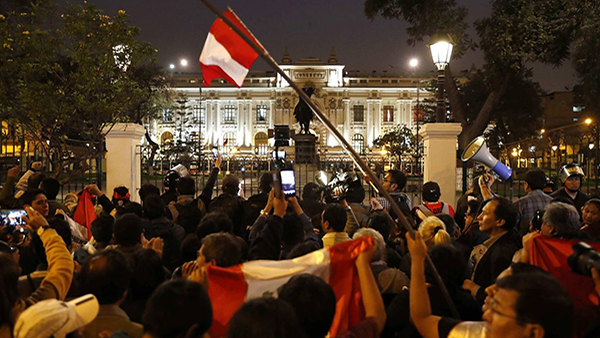
In recent days, Peru has been shaken by a social awakening that, once again, has taken advantage of a conflict within the elites, reflected as a government crisis created by Congress to get rid of a president (Vizcarra) whom they considered unproductive for the election period.[15] The situation is unfolding. Popular sectors have taken to the streets to voice their own demands, which do not include Vizcarra's return; quite the contrary, in fact. It's a widespread "out with them all" sentiment, reflecting a belief, with few exceptions, that the pervasive corruption within the political and economic elite involves all its players, large, medium, and small, and that political representation must, at the very least, be completely renewed. The protests have spread throughout the country, as has the repression, which has so far resulted in two deaths and dozens of disappearances.[16]The people of Peru have overcome the Vizcarra regime by putting their demands, including constitutional reform, at the forefront.[17] left to them by Fujimori's dictatorship (and self-coup). The social demands call for a change in the political and economic systems that favor and foster exploitation and oppression in all aspects of life. The success of these demonstrations is such that the interim president, Merino, was forced to resign, and any solutions now, even those implemented by Congress, must take into account the social demands expressed in the streets.
The Andean spring in a pandemic
Geographically, culturally, and socially, it is a spring of social uprisings sweeping across the Andes Mountains, shaking up against mining and all forms of extractivism that are devastating the region, especially its glaciers. The struggles uniting these mobilizations are against decades of environmental and urban real estate exploitation, against predatory elites who merely exploit their differences as publicity stunts to win votes during election periods. The fight is against governments and oppositions detached from reality, attempting to construct a fantasy in which everyone accepts their rightful place in the world without demanding it. These elites clothe themselves in whatever ideological garb they desire in their lust for power. In fact, in practice, social democracy, Christian democracy, and the left in general function very efficiently as the great peacemaker, as demonstrated by, among others, Bachelet's two terms in Chile and the Morales era in Bolivia, including the recent election of Arce. This year, the elites have attempted to use the pandemic as a tool for social pacification, but their Darwinian mindset, their use of the state as a machine for lining their own pockets, their corrupt, marketing-driven administration, and their ineffectiveness in everything except stalling and drafting explanatory reports have transformed the social experience of the pandemic into a true survival catastrophe for the vast majority. The social Darwinism of government policies during this pandemic is based on a "survival of the fittest" approach, under the fundamental assumption that the elites possess superior resources such as healthcare, food, hygiene, and medication, and that the poor, lacking these necessities, will be unable to survive.
Just as all the governments in the region have adopted, with varying degrees of discretion, Darwinian policies in health and the economy during this pandemic, all the peoples of the region and of the broader Latin American and Caribbean region have resisted, in diverse and original ways, the policies of hunger and death imposed by these governments that we suffer today. This is why the pandemic as a means of appeasement has not worked, or has only worked partially.[18].
On the one hand, elites communicate their fears and repressive strategies; on the other hand, they are limited by the constraints of the nation-state. There is no, and cannot be, a regional strategy to confront the pandemic, except for the repeated and hypocritical idea of closing legal borders while elites and illegal powers keep their borders open, whether legal or not. Meanwhile, financial borders, which are what truly interest those in power today, remain open, allowing them to evade taxes.
The internal strategies of regional elites include seizing control of the executive branch during election periods. This allows them to use the resources, funds, and information managed by the executive branch of each state to benefit a specific sector of the elite. This is why, with varying degrees of publicity, adjustments are made "behind closed doors" during election times. Honduras, Paraguay, Brazil (with Dilma Rousseff), and Bolivia have all experienced this notably; other states have seen it with less fanfare, but with equal effectiveness. Elites fight for public administration resources before and during elections, and this period of habitual, routine tension can be used by the people as an outlet for their desire for change.
The Andean Spring of the Peoples
People communicate today more rapidly than ever before, inspiring and admiring one another, valuing the efforts of each struggle, and adopting and adapting what might be useful from other struggles. This is how the self-organized shields of the 2017 Venezuelan street protests have been adapted in Ecuador, Chile, and Peru, and how the health brigades and teams that emerged from the Ecuadorian resistance last year have been recreated in Bolivia and Chile. Another example is the use of lasers to counter the repression that crossed the Pacific Ocean to reach Chile from Hong Kong. Nonviolent direct action is central to these struggles, as it is a tool that appeals to creativity and the value of the body and imagination as materials for social struggle: for example, the action that sparked the uprising in Chile was jumping over the turnstiles of the Santiago metro.
This Andean spring is anti-patriarchal, led by cis and trans women, so much so that the appeasement offer in Chile had to include parity in the election of the constituent assembly members, or in Peru where, to prevent it, the male powers have refused to allow the presidency to be, for the first time in history, held by a woman.[19] It is also a youthful spring, because young people without hope, without a future, without anything in their hands have stopped kicking stones.[20] And they have taken them into their own hands, launching them forward to build the future and the epic that the elites, wanting to leave them with nothing, have stolen from them. It is a peasant spring, small and familial, which in times of pandemic has been the source of survival and self-managed, solidarity-based food for communities, towns, and cities, and which has grown strong in the struggle for water and against the predatory extractivism that destroys soil, forests, water, and subsoil. It is also the spring of the sacrifice zones that have brought to the forefront the demand against the chemical and agrochemical poisoning left by the large energy, forestry, textile, mining, and livestock industries. It is, clearly, an Indigenous spring whose banners have displaced or shared space with the national flags that increasingly represent less and less of the people because it is becoming ever clearer that they are the property of and represent the elites who cloak themselves in them to continue plundering the lands, the people, the communities.
* Chilean writer. Member of the Latin American and Caribbean Antimilitarist Network. CLACSO Working Group on Collective Memories and Practices of Resistance
[1] Venezuela, Colombia, Ecuador, Peru, Bolivia, and Chile, structured along the Andes Mountains
[2] A self-coup following the model of Alberto Fujimori in Peru during 1992, which involved the creation of a constitution tailored to his needs by a subservient constituent assembly.
[3] Mobile Anti-Riot Squadron of the Colombian National Police
[4] Revolutionary Armed Forces of Colombia, a guerrilla group that laid down its arms as part of that peace agreement
[5] https://ramalc.org/2020/09/10/militarizacion-policial-en-colombia-alerta-inmediata/
[6] https://spip.ecologistasenaccion.org/IMG/pdf/la_iniciativa_itt_yasuni.pdf
[7] http://ramalc.org/2019/10/13/apuntes-ecuatorianos-observaciones-sobre-la-represion-contra-la-resistencia-a-los-dictados-del-fmi/
[8] https://colectivocasa.org.bo/?p=368
[9] Carabineros (uniformed national police) and PDI (civil investigation police)
[10] Large commercial areas
[11] Urban train
[12] 0,04 cents
[13] The transition began in 1989-1990
[14] https://www.elciudadano.com/columnas/la-caida-del-gobierno-de-pinera-continuidad-de-la-revuelta-social-y-mandato-del-plebiscito/11/07/
[15] The general elections are scheduled for April 2021, meaning this government crisis is happening right in the middle of the pre-election period.
[16] https://www.pagina12.com.ar/306037-peru-la-coordinadora-nacional-de-derechos-humanos-denuncio-q
17] The constitution dates from 1993, Fujimori's self-coup happened in 1992.
[18] https://www.clacso.org/anarquismo-en-tiempos-de-punkdemia/
[19] https://www.infobae.com/america/america-latina/2020/11/15/el-congreso-de-peru-discute-al-sucesor-de-manuel-merino/
[20] https://www.youtube.com/watch?v=qeDjwjAqw_E
If you would like to receive more information about CLACSO's training programs:
[widget id=”custom_html-57″]
to our email lists.

