
Public Policies and Gender Justice
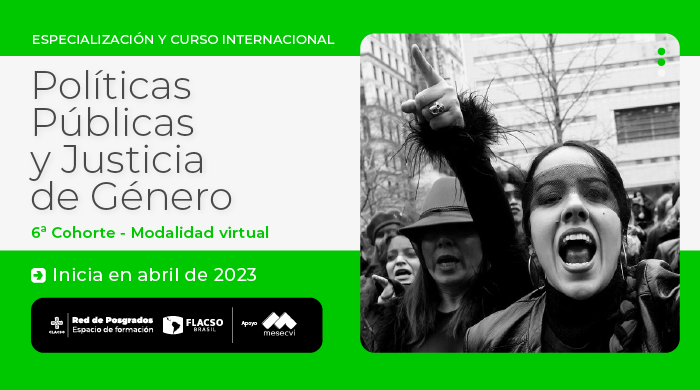

6th Cohort | Virtual modality (2023-2024)
Specialization: 40 credits, 360 hours / lecture
International Course: 9 credits, 90 hours/lecture
Duration: April 2023 to March 2024
The accreditation and certification of the Specialization and the International Course will be carried out by the Latin American Council of Social Sciences (CLACSO) and by the Latin American Faculty of Social Sciences (FLACSO Brazil).
With the support of MESECVI
GENERAL COORDINATION
Michelle Ferreti (FLACSO Brazil) and Magdalena Valdivieso Ide (University of Chile)
GENERAL DIRECTOR
Rita Gomes do Nascimento (FLACSO Brazil) and Karina Batthyány (CLACSO)
The specialization seeks to offer a comprehensive training space where situations of structural and gender inequality are analyzed based on the provisions contained in the international human rights framework for women and their approach from public policies.
The inequalities, inequities, and gender-based obstacles that persist regarding the autonomy of women in Latin America and the Caribbean constitute situations of injustice, vulnerability of rights, and obstacles to the full incorporation of women in their diversity into economic, social, cultural, and political development.
States that support international conventions and agreements and the demands of women's movements have prioritized mainstreaming a gender perspective in public policies. This mainstreaming has aimed to raise awareness and address gender inequalities and inequities, as well as promote the cultural shift necessary to eliminate gender stereotypes.
The Global Gender Gap Report, published in October 2013 by the World Economic Forum (WEF), assesses 136 countries on their capacity to reduce gender inequalities, considering four key areas of action: health and survival; educational attainment; political participation; and economic equality. The Report indicates that the greatest progress is made in reducing gender inequality where there is greater parity in economic equality and political participation. However, job insecurity, problems with access to and the right to health, gender-based violence, and limited political representation persist, demonstrating that the capacity of states to recognize and guarantee the full exercise of women's rights and quality of life remains a challenge.
States have the obligation to observe, implement and report on compliance with the provisions contained in international agreements, conventions, treaties and resolutions that recognize and protect the human and civil rights of women.
It is a challenge for States, for human rights organizations, and especially for women's rights, and for professionals working in this field, to develop, implement, monitor, and evaluate culturally and territorially relevant public policies that allow progress toward equality and gender equity, as well as the fulfillment of the objectives proposed by the international community for the full recognition and guarantee of women's human rights.
Through the Specialization in Public Policy and Gender Justice, FLACSO Brazil and CLACSO intend to continue offering a comprehensive space for theoretical and practical training that allows for understanding situations of structural and gender-specific inequality, analyzing these inequalities from the perspective of the international human rights framework for women and studying how public policies address them.
GENERAL PURPOSE
The Specialization aims to provide high-level training focused on developing capacities for the formulation, management and evaluation of public policies aimed at eradicating gender inequalities and inequities.
SPECIFIC OBJECTIVES
Students enrolled in the Specialization program must:
- Understanding the main characteristics that define current Latin American societies in terms of gender inequalities, the exercise of women's human rights and access to justice.
- Understanding the institutional conditions, as well as the government instruments to promote public policies committed to the defense of the human rights of women and girls.
- Develop the ability to process information and analyze statistical data.
- Advance the use of indicators and analytical tools for monitoring public policies on women's human rights.
- To be able to carry out a theoretical production exercise on the topics covered throughout the course.
The Specialization and the International Course are aimed at university graduates; postgraduate students; public officials and officials in the field of justice; members of the Legislative Branch; members and managers of Non-Governmental Organizations and professionals interested in gender public policies; activists and militants of social organizations and movements; representatives of political parties.
A university degree/undergraduate degree or equivalent is required.

The Specialization in Public Policy and Gender Justice will last 12 months and requires for its accreditation the completion of: an international course and two optional virtual seminars from the curriculum; a writing support workshop; and the preparation of a final monograph.
The international course will last 12 months and requires, for its accreditation, the completion and approval of a final project, in addition to participation in at least 80% of the activities and tasks proposed by the teachers.
The specialization and international course will take place between April 2023 and March 2024
Students in the specialization and international course will have the support of academic tutors who will accompany them through the virtual seminars and guide them in completing their final projects.
Once the seminars have concluded, students will have four months to submit their final project. If they still need to complete a credit, they will also have four months to do so.
The specialization and international course are certified by CLACSO and FLACSO Brazil.
The specialization certifies 360 hours/chair of work; the international course 90 hours/chair.
CLARIFICATION: Those who enroll in the full specialization should not enroll in the International Course separately.
The online seminars will be offered in either Spanish or Portuguese. The course materials may be provided in both official languages, depending on availability. Student contributions to the discussion forums may also be in either language. The final research paper may be written in either Spanish or Portuguese.
Summary:
International Course “Public Policies, Justice and Autonomy of Women in Latin America and the Caribbean”
The course addresses the situation of women in five major dimensions: political participation; sexual and reproductive rights from a gender and childhood perspective, gender violence also from a gender and childhood perspective; economic autonomy, public policies on gender, childhood and adolescence with a human rights approach and access to justice.
Topics of the International Course:
1. Public policies with a human rights approach and based on women's autonomy
2. Gender gaps in Latin America
4. Social rights, gender inequalities in access to justice
5. Economic rights, gender and public policies
6. Education, public policies and cultural transformation
7. Public policies, gender, childhood and adolescence
8. Judicial systems and practices and gender justice
9. Public policies and access to justice for victims of political violence
10. Communication and gender justice
Coordination: Magdalena Valdivieso, Michelle Ferreti and Berenice Fuentes
Abstract: This seminar reconstructs the characteristics adopted in the process of including the demands of feminist and women's organizations in the political and governmental agenda. The course analyzes the approaches that guide public policies for gender equality in Latin America and the Caribbean, within the framework of the Sustainable Development Goals, the Regional Gender Agenda, and the Montevideo Strategy, as well as the structural challenges to development with gender equality and sustainability on the continent.
Coordination: Magdalena Valdivieso Ide (University of Chile)
Abstract: In almost every country in our region, a strong women's movement has been developing across diverse social sectors. This seminar reviews the history of feminist struggles and demands in Latin America and the Caribbean, providing background for sharing an assessment and considering the perspectives on the relationship between women's and feminist movements and states. For decades, the feminist movement has been characterized by its growing success in achieving gender equality, expanding citizenship, and deepening democracy. This seminar examines the strategies that have allowed it to play a significant political role in the region today. The continent's cultural, ethnic, social, and linguistic diversity is reflected in the diversity of feminist proposals and approaches: from the community feminism of Indigenous women in Guatemala and Bolivia, to decolonial anti-racist feminism in Colombia and Brazil, to feminism from the perspective of sexual diversity, among others, which critique and redefine classical feminist discourse. This seminar reviews these currents and their contributions.
Coordination: Alba Carosio (Central University of Venezuela)
Summary: This course covers the main international instruments for the protection of women's rights. It reviews the obligations arising from international treaties and the duty of States to report to and be accountable to treaty mechanisms and bodies.
Coordination: Luz Patricia Mejía Guerrero (MESECVI, Venezuela)
Abstract: This seminar offers conceptual elements on the environmental crisis, climate change, and their differentiated gender effects. It analyzes territory as a socio-political category that intersects with other axes that cause gender inequalities and exclusions. It reviews the proposals and actions of resistance by women and feminist movements and their intersection with environmentalism.
Coordination: Michelle Ferreti (FLACSO Brazil)
Summary: This workshop is a training space designed to guide the development of the final monograph for the specialization. It will support students in defining their object of analysis, translating it into a viable research problem, constructing a work plan, developing argumentative frameworks, and establishing analytical conclusions. These tasks will be carried out individually and collectively through peer exchange and with the workshop instructor, following a discussion forum format. The workshop's objective is to produce a draft of the final specialization paper. The final monograph may be written in Spanish or Portuguese.
Coordination: Magdalena Valdivieso, Michelle Ferreti, Berenice FuentesCM PlenosIf you belong to a Full Member Center of CLACSO.
CM Associates: Yes You belong to a CLACSO Associated Centre.
No linkIf you DO NOT has any of these links with CLACSO.
| Discount for payments made by 10/04 | A payment after 10/04 | Payment in 3 installments | |
| CM Plenos | $460 | $570 | USD 750 (3 x 250 USD) |
| CM Associates | $590 | $700 | USD 1020 (3 x 340 USD) |
| No link | $660 | $960 | USD 1290 (3 x 430 USD) |
In all cases, payment can be made by credit card, deposit or bank transfer.
CM PlenosIf you belong to a CLACSO Full Member Center
CM Associates: Yes You belong to a CLACSO Associated Centre
No linkIf you DO NOT has any of these links with CLACSO
| Discount for payments made by 10/04 | A payment after 10/04 | Payment in 3 installments | |
| CM Plenos | $175 | $230 | USD 315 (3 x 10⁵ USD) |
| CM Associates | $235 | $290 | USD 420 (3 x 140 USD) |
| No link | $300 | $360 | USD 540 (3 x 180 USD) |
In all cases, payment can be made by credit card, deposit or bank transfer.
The Specialization and the International Course are aimed at university graduates; postgraduate students; teachers; activists and members of trade union organizations, social movements and political parties; public officials; press workers; members and managers of non-governmental organizations and professionals interested in the subject.
A university degree/undergraduate qualification is required.
You will need to complete the form available on the website.
Registration will be open between August 2022 and April 2023 through this website.
Upon completion of the registration process, you will receive a confirmation email. On the first day of the course, you will receive your login details for the online platform.
The classes will take place from April 2023 to March 2024.
All students will receive the necessary instructions to access classes, bibliography, and discussion forums through the virtual platform.
Accessing and navigating the Virtual Learning Environment is very simple and user-friendly. In any case, a technical and academic support team will always be available to you.
You must pass the International Course, two (2) elective Virtual Seminars, the methodological workshop and complete the final integrative work.
All training courses must be completed and passed - without exception - in order to receive the digital certificate of completion.
To obtain the certificate of completion for the Specialization, you must complete a final monograph. The methodological workshop is mandatory and aims to support you in the completion of this final project.
You must participate in the classes and activities proposed by the teachers and complete the final monograph.
The Specialization and the International Course are accredited by FLACSO Brazil and CLACSO. The Specialization has a total workload of 360 hours, and the International Course 90 hours. Certificates of completion for both programs, as well as certificates of passed courses for the Specialization, will be sent digitally and are completely free of charge.
The International Specialist diploma and academic transcript, printed and apostilled, are issued by the General Secretariat of FLACSO, located in Costa Rica. Students who wish to arrange for the issuance and delivery of these documents can find the fees and procedures on the FLACSO Brazil website: https://flacso.org.br/tramitacion-de-titulos-y-certificados-2/
Students can request and pay for the issuance and shipping of their apostilled International Specialist diploma. This diploma is issued by the General Secretariat of FLACSO, located in Costa Rica. Afterward, students must complete the validation process according to the regulations in force in their respective countries. The fees and procedures for issuing and shipping the apostilled diploma can be found on the FLACSO Brazil website: https://flacso.org.br/tramitacion-de-titulos-y-certificados-2/
Please refer to the price table under the item “Payment methods”.
If, after successfully completing the Specialization, you wish to obtain the apostilled Diploma and academic transcript issued by FLACSO, you will need to pay an additional fee.*
* The issuance of the printed diploma, along with the academic transcript, costs USD 222 (two hundred and twenty-two US dollars). This fee includes shipping the printed and signed documents to the student's address. The procedures for issuing and shipping the apostilled diploma can be found on the Flacso Brazil website: https://flacso.org.br/tramitacion-de-titulos-y-certificados-2/
For any other questions, please contact [email protected]
Or send a WhatsApp message to +5491138801388
For group and institutional discounts, please contact [email protected]
Return to the complete list of Specializations and International Courses

