
Public Policies for Equality in Latin America and the Caribbean

7th Tourma | Virtual modality (2023-2024)
Specialization: 40 credits, 360 hours / classrooms
International course: 9 credits, 90 hours / classrooms
Duration: April 2023 to March 2024
The credential and certification of Specialization and the International Course will be carried out by the Latin American Council of Social Sciences (CLACSO) and the Latin American Faculty of Social Sciences (FLACSO Brazil)
GENERAL COORDINATION
Pablo Gentili (FLACSO Brazil)
ACADEMIC COORDINATION
Florence Stubrin
GENERAL MANAGEMENT
Rita Gomes do Nascimento (FLACSO Brazil) and Karina Batthyány (CLACSO)
Despite two advances achieved in some countries in the region, the balance of the two first decades of the 21st century shows a deep deficit and no progress in the permanence of policies to combat poverty and misery. There is also a multiplicity of inequalities that deeply impact the living conditions of the majority. The study and analysis of the effective conditions that allow the development of equality policies is one of two main democratic challenges in Latin America and the world. A challenge that multiplies and deepens due to the legacy of the Covid-19 pandemic and the profound economic, political and social crisis that we face globally.
Main goal
The Specialization aims to provide tools for analysis, research and institutional intervention in various fields of public policies, contributing to the promotion of inclusion strategies, affirmation of human rights and strengthening of citizenship.
It will address, in an interdisciplinary and intersectoral manner, the challenges of the current political situation for the promotion of equality and social justice in Latin America from the field of analysis of social, economic, educational and cultural policies.
It will deal with the complexities of the production processes of inequalities and propose approaches based on gender perspectives, racial discrimination, violence and city safety, criticism of coloniality, regional integration processes, the situation of childhood and youth, and also justice and the promotion of public ethics.
The objective is to form professionals committed to deepening democracy and reversing the logic of retreat of social rights observed in the world in recent decades.
The Specialization of the International Course is intended for graduates; post-graduation students; professors; activists and activists of union organizations, social movements and political parties; public officials and public officials; printing workers and workers; members and managers of non-governmental and professional organizations interested in social quests.
It is a requirement for a university diploma.
The Specialization in Public Policies for Equality in Latin America and the Caribbean will last 12 months and for the certification to be necessary: the realization of an international course, two virtual seminars eletivo of the curricular structure, a support office for the redaction of the final work and the elaboration of the work final.
The International Course will last 12 months and will require for its certification the completion and approval of a final project, as well as participation in at least 75% of the activities and tasks proposed by teachers.
The International Course Specialization will take place between April 2023 and March 2024.
The students of Specialization and the International Course receive the support of academic tutors who will accompany the realization of two virtual seminars and guide the production of the final work.
Once the seminars are completed, the students will have a period of four months to submit their final work. If you are pending the conclusion of credits, you will also have this deadline to fulfill them.
The International Course Specialization requires CLACSO and Flacso Brazil certificates.
The Specialization has a total workload of 360 hours and an International Course of 90 hours.
To register for a complete Specialization, you do not need to register separately for the International Course.
The virtual seminars will be offered in both Spanish and Portuguese. Likewise, the bibliography may be offered in the two official languages of the course. As two students intervene in the discussion forums, they can also be used in different languages. The final monographic work may be in Spanish or Portuguese.
Summary:
International Course “Latin America: citizenship, rights and equality”
The course addresses the challenges of the current political situation for the promotion of equality and social justice in Latin America from the field of analysis of social, economic, educational and cultural policies. Analyzes the production processes of inequalities and proposes approaches based on gender perspectives, racial discrimination, violence and city safety, regional integration processes, the situation of childhood and youth, and also gives justice and the promotion of public ethics.
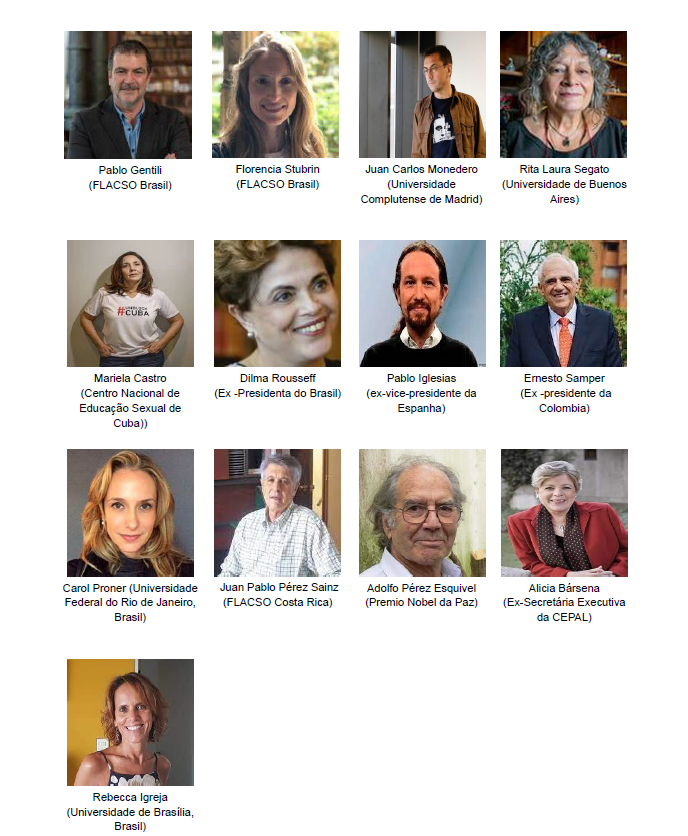
Teaching team: Professor: Pablo Gentili Professor of the University of the State of Rio de Janeiro; Pesquisador da FLACSO, Brazil. Doutor em educação (Universidade de Buenos Aires). Former executive secretary of CLACSO; former director of FLACSO, Brazil; Former Secretary of State for Educational Cooperation of the Argentine government. Author and compiler of more than 20 books in the area of educational policies, studies on inequality and exclusion in Latin America. Invited professors: Dilma Rousseff (former president of Brazil); Rita Segato (feminist intellectual, Argentina); Adolfo Pérez Esquivel (Nobel Peace Prize, Argentina); Juan Pablo Pérez Sainz (FLACSO, Costa Rica); Alicia Bárcena (former executive secretary of ECLAC, Mexico); Ernesto Samper (former president of Colombia); Mariela Castro (director of the National Center for Sexual Education of Cuba); Pablo Iglesias (former vice-president of Spain); Jorge Núñez Jover (FLACSO, Cuba); Ilka Tremiño Sánchez (FLACSO, Costa Rica); Miriam Abramovay (FLACSO, Brazil); Cecilia Nicolini (Argentine Secretariat of Climate Changes).
Summary:
The objective of the seminar is to debate the causes of two unusual setbacks in human rights in recent decades, making visible their hidden strategies outside the scope of formal democracy. The processes of co-optation of two international instruments for the protection of human rights will be discussed to guarantee the processes of concentration of power and wealth, with an immediate impact on citizenship and the culture of political and social violence. The topics addressed will be:
- Democracy and human rights in practice: treating causes as causes;
- The world-system is the co-optation of international instruments for the protection of human rights;
- International System for the Protection of Human Rights served by Lex Mercatoria. In the case of the Inter-American Protection System;
- To deconstruct the validation of human rights for the media and the relationship between rights and fundamental guarantees;
- International Humanitarian Directorate of selective and strategic application in the Americas;
- The opportunism of international cooperation and transnational and extraterritorial clauses to the detriment of sovereignty and political autonomy;
- The direction of the justice system as an effort in hybrid regional destabilization strategies: reconfirmedly competitive lawfare for political and economic purposes;
- Citizenship financed by the concentration of rhetorically humanitarian financial capital: the financing dilemma of think tanks and intellectuals in Latin America;
- Violence and social and political means as a form of control and destabilization: antipolitics as fim;
- Reactions to the field of politics and integration. New formulas based on learned languages;
- Reactions to the economic field and two human rights. New formulas based on learned languages;
- Democracy and Human Rights in practice: learning how to make mistakes.
Coordination: Carol Proner (Federal University of Rio de Janeiro, Brazil)
Summary: The 2008 crisis acted as a consensus-shatterer that inspired the Universal Declaration of Human Rights of 1948 and organized the world since the end of the Second World War. The United States, which will win the Cold War, will begin to show in the turn of the century its difficulties in maintaining world hegemony in an increasingly multipolar planet and with China as the main economic power, I foresee a new phase of conflicts with the departure of Afghanistan, the war in Ukraine and the conflicts in the Middle East alone. Sinais do collapse two ancient equilibria. Now, a paradox arises.
Right now she is abandoning her commitments to liberal democracy – coups, fake news, lawfare, international financial blackmail – while on the left she has become a defender of the model despite the few possibilities of profound changes in the governments. Feminism and environmentalism support the two great political actors in these times of change, embedding their repertoire of political organization remains unchanged, seeking a balance between parties and movements that still needs to be explored. If the pandemic returns to the State a central social role, the neoliberal government structures seem to work with oscillations and stops. In confusing times, first democratic obrigação is making good diagnoses. This seminar will seek to address the understanding of this complex international scenario from the perspectives of the theories of the State and the approach that they defend in relation to social production and inequality.
Coordinator: Carlos Monedero (Complutense University of Madrid, Spain)
Summary:
There are many empirical studies dedicated to portraying the situation of vulnerable populations, aiming to analyze their sociocultural profile and their socioeconomic conditions. Few are dedicated to developing the same profile of national elites, especially those who control public institutions and national decision-making processes. What is your cultural, racial and socioeconomic profile? How do we think, as an age, what values do we defend? In times of rise of neoconservativeism and extreme direita, as well as inequalities in Latin America, it is urgent to conduct studies based on empirical research that offer an analysis of the political elites in the different powers of nations, to understand how they think and oppress the ones that legitimate and operate.
The objective of this seminar is to discuss these questions based on sociological and anthropological studies, including transversality of gender, race and ethnicity.
Coordinator: Rebecca Igreja (National University of Brasília, Brazil)
Summary:
The consideration of education as a public and social environment, as a universal human right and as a responsibility of two States is based on a consensus and is expressed largely in the regulatory frameworks that govern the educational systems of Latin America. No entanto, in fact this direct is long to be a reality in our region. Educational inequalities continue to astonish our societies and our educational systems, finding new and increasingly sophisticated forms of expression. The increasing consolidation and expansion of differentiated educational circuits that result in the segmentation of two educational systems. In this way, we reproduce conditions of lesser quality in educability associated with social origin, ethnicity, gender, geographical location, characteristics of the family organization. We start from the recognition that education is a social, political and cultural fact and that, therefore, is traversed by permanent disputes that determine its main configurations and directions that do not reflect the particularities of two historical moments. In this way, the analysis of educational inequalities and public educational policies requires consideration of a multiplicity of dimensions.
The increasing privatization of the educational offer and the weakening of two public education systems, the lack of financing, the deficiencies in the infrastructure, the scarce incorporation of digital tools and media in the pedagogical processes and the consequent distance between school learning and the advancement of new forms and cultural manifestations There is some evidence of the region's main educational deficits. In turn, the impacts of the pandemic will highlight and dramatically intensify the aforementioned deficits, evidencing a series of unconquered challenges. In this seminar, we intend to reflect on the main debates that are presented today as urgent from the point of view of the conception of education as the direction and promotion of educational justice. The analysis of education in an emergency situation, the need to develop actions to strengthen and expand public investment in education in response to post-pandemic needs; The challenges of teacher training; new letters and digital citizenship; a gender perspective; reflections on ethics and human rights in artificial intelligence, among some of the quests we intend to address.
Coordinator: Florencia Stubrin (FLACSO Brazil)
Summary : The office is a training space intended to guide the preparation of the final monographic work of the Specialization. Students will receive accompaniment and guidance in the elaboration of the object of analysis, in their translation into a practical study problem, in the construction of a working plan, in the development of argumentative networks and in the definition of analytical conclusions. These tasks will be carried out individually and collectively by means of exchange between peers and as a professor responsible for the office, through the discussion forum. The objective of the office is to produce the outline of the final work of the Specialization. The final monographic work may be in Spanish or Portuguese.
CM Plenary: you belong to a Plenary Member Center of CLACSO
Associate CM: You belong to an Associated Center of CLACSO.
Without link: You do not have any links to CLACSO.
|
Payment in a parcel until 10/04 |
Payment on a parcel after 10/04 |
Payment in 3 parcels | |
| CM Pleno | $460 | $570 | USD 750 (3 x USD 250) |
| CM Associate | $590 | $700 | USD 1020 (3 x USD 340) |
| No connection | $660 | $960 | USD 1290 (3 x USD 430) |
In all cases, payment may be made by letter of credit, deposit or bank transfer.
The certification of the Specialization and the International Course will be carried out by the Latin American Faculty of Social Sciences (Flacso Brasil) and the Latin American Council of Social Sciences (Clacso).
CM Plenary: You belong to a Plenary Member Center of CLACSO.
Associate CM: You belong to an Associated Center of CLACSO.
Without link: You do not have any links to CLACSO.
| Payment in a parcel until 10/04 | Payment on a parcel after 10/04 | Payment in 3 installments | |
| CM Pleno | $175 | $230 | USD 315 (3 x USD 105) |
| CM Associate | $235 | $290 | USD 420 (3 x USD 140) |
| No connection | $300 | $360 | USD 540 (3 x USD 180) |
In all cases, payment may be made by letter of credit, deposit or bank transfer.
The Specialization of the International Course is intended for graduates; post-graduation students; activists and activists of union organizations, social movements and political parties; public officials and public officials; printing workers and workers; members and managers of organizations not governed and professionally interested in the matter. A university diploma/graduation is required.
You must pre-enter the form available on the website. Registration will be open between August 2022 and April 2023 through this site.
Upon completion of the registration process, you will receive confirmation by e-mail. On the start day of the course, access data to the virtual platform will be sent.
The classrooms will run from April 2023 to March 2024.
All students will receive the necessary instructions to access the classrooms, bibliography and discussion forums through the virtual platform.
The navigation access to the Virtual Training Space happens in a simple and clear way. In any case, a technical and academic support team will always be at your disposal.
You must approve the International Course, two (2) eletive virtual seminars, the support office to carry out the final work and carry out the final integrative work.
Without exception, to receive the specialization certificate all training spaces must be completed and approved.
To obtain the certificate of completion of the Specialization, it is necessary to carry out a final monographic work. The methodological office will provide and visa accompanies you in the completion of the final work.
You must participate in the classrooms and activities proposed by the teachers and do the final monographic work.
However, the Specialization in the International Course requires credentials from Flacso Brasil and CLACSO. The specialization has a total workload of 360 hours and an international course of 90 hours. The sending of two certificates of completion of both activities and the approved disciplines of the Specialization will be done digitally and is completely free.
The International Specialist diploma and analytical certificate, printed and apostilled, are only issued by the General Secretary of the Flacso, located in Costa Rica. Students who wish to manage the issuance and delivery of the aforementioned documents will find the values and procedures to follow by entering the Flacso Brasil site: https://flacso.org.br/emissao-de-diplomas-certificados-e-historicos-de-notas-2/
Or someone will be able to request and pay for the issuance and delivery of the apostilled diploma of International Specialist, which is issued by the General Secretary of the Flacso, located in Costa Rica. Next, someone must carry out the validation process in accordance with the regulations in force in each country. The values and procedures for issuance and delivery of the apostilled diploma can be consulted on the Flacso Brasil site: https://flacso.org.br/emissao-de-diplomas-certificados-e-historicos-de-notas-2/
See the table of prices and modalities, available above, in the item Payment Methods
In case, once the Specialization has been satisfactorily concluded, an additional fee must be paid for the international certification issued by the Secretary-General of the Flacso.*
*The issuance of the printed diploma, together with the grade history, costs USD 222,00 (two and twenty dollars). The value includes the sending of two printed and assigned documents for the student's residential address. The procedures for issuing and sending the international diploma can be consulted on the Brazil Flacso page: https://flacso.org.br/emissao-de-diplomas-certificados-e-historicos-de-notas-2/
Please feel free to contact us through two e-mails [email protected] and [email protected]
Send a WhatsApp to +5491138801388
For discounts for groups and institutions, you can contact us at [email protected]
More specializations and international courses
[widget id=”glob_block_5_widget-136″]

