
Public Policies for Equality in Latin America and the Caribbean
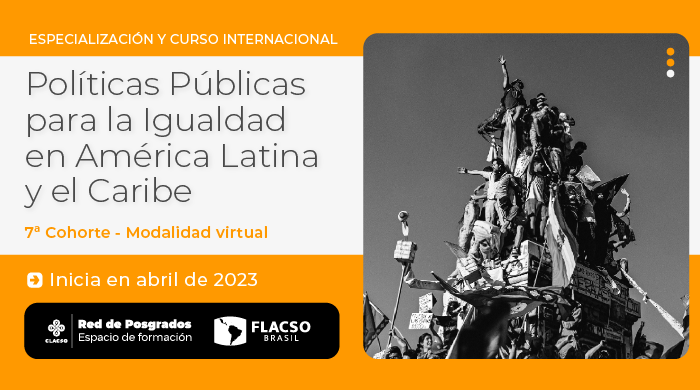

7th Cohort | Virtual modality (2023-2024)
Specialization: 40 credits, 360 hours / lecture
International Course: 9 credits, 90 hours/lecture
Duration: April 2023 to March 2024
The accreditation and certification of the Specialization and the International Course will be carried out by the Latin American Council of Social Sciences (CLACSO) and by the Latin American Faculty of Social Sciences (FLACSO Brazil).
GENERAL COORDINATION
Pablo Gentili (FLACSO Brazil)
ACADEMIC COORDINATION
Florencia Stubrin (FLACSO Brazil)
GENERAL DIRECTOR
Rita Gomes do Nascimento (FLACSO Brazil) and Karina Batthyány (CLACSO)
The course addresses the challenges of the current political climate for promoting equality and social justice in Latin America from the perspective of social, economic, educational, and cultural policy analysis. It also examines the complexities of the processes that produce inequalities, proposing approaches from the perspectives of gender, racial discrimination, violence and citizen security, critiques of coloniality, regional integration processes, the situation of children and youth, and justice and the promotion of public ethics.
Despite progress made in some countries of the region, the first two decades of the 21st century reveal a profound deficit in the advancement and sustainability of policies to combat poverty, destitution, and a multitude of inequalities that deeply impact the living conditions of the vast majority. Studying and analyzing the actual conditions necessary to design policies promoting equality is one of the main democratic challenges in Latin America and the world today. This challenge is compounded and intensified by the legacy of the COVID-19 pandemic and the profound economic, political, and social crisis we face globally.
With this new cohort of the Specialization in Public Policies for Equality, we intend to continue contributing to the training of public agents, social, trade union, community, feminist, anti-racist and environmental activists, as well as personnel in the field of critical academic research, teachers and postgraduate students in the most diverse fields of social sciences and humanities.
Objective
The Specialization aims to provide tools for analysis, research, and institutional intervention in diverse fields of public policy, contributing to the promotion of inclusion strategies, the affirmation of human rights, and the strengthening of citizenship. It will address, in an interdisciplinary and intersectoral manner, the challenges of the current political situation for the promotion of equality and social justice in Latin America from the perspective of social, economic, educational, and cultural policy analysis. It will explore the complexities of the processes that produce inequalities, proposing approaches from the perspectives of gender, racial discrimination, violence and citizen security, the critique of coloniality, regional integration processes, the situation of children and youth, as well as justice and the promotion of public ethics.
The goal is to train professionals committed to deepening democracy and reversing the trend of social rights erosion observed worldwide in recent decades.
The Specialization and the International Course are aimed at university graduates; postgraduate students; teachers; activists and members of trade union organizations, social movements and political parties; public officials; press workers; members and managers of non-governmental organizations and professionals interested in social issues.
A university degree/undergraduate degree or equivalent is required.

The Specialization in Public Policies for Equality will last 12 months and requires for its accreditation the completion of: an international course and two optional virtual seminars from the curriculum; a writing support workshop; and the preparation of a final monograph.
The international course will last 12 months and requires, for its accreditation, the completion and approval of a final project, in addition to participation in at least 80% of the activities and tasks proposed by the teachers.
The specialization and international course will take place between April 2023 and March 2024
Students in the specialization and international course will have the support of academic tutors who will accompany them through the virtual seminars and guide them in completing their final projects.
Once the seminars have concluded, students will have four months to submit their final project. If they still need to complete a credit, they will also have four months to do so.
The specialization and international course are certified by CLACSO and FLACSO Brazil.
The specialization certifies 360 hours/chair of work; the international course 90 hours/chair.
CLARIFICATION: Those who enroll in the full specialization should not enroll in the International Course separately.
The online seminars will be offered in either Spanish or Portuguese. The course materials may be provided in both official languages, depending on availability. Student contributions to the discussion forums may also be in either language. The final research paper may be written in either Spanish or Portuguese.
Summary:
International Course “Latin America: Citizenship, Rights and Equality”
The course will address the challenges of the current political climate for promoting equality and social justice in Latin America from the perspective of social, economic, educational, and cultural policy studies. To this end, it will analyze some of the processes that produce inequalities, proposing approaches based on gender perspectives, the study of racial discrimination, the world of work, violence and citizen security, regional integration processes, the situation of children and youth, as well as justice and the promotion of public ethics.
Professor: Pablo Gentili, Professor at the State University of Rio de Janeiro; researcher at FLACSO, Brazil. PhD in Education (University of Buenos Aires). Former Executive Secretary of CLACSO; former Director of FLACSO, Brazil; former Secretary of State for Educational Cooperation of the Argentine government. Author and editor of more than 20 books in the field of educational policies, studies on inequality and exclusion in Latin America. Guest Professors: Dilma Rousseff (former President of Brazil); Rita Segato (feminist intellectual, Argentina); Adolfo Pérez Esquivel (Nobel Peace Prize laureate, Argentina); Juan Pablo Pérez Sainz (FLACSO, Costa Rica); Alicia Bárcena (former Executive Secretary of ECLAC, Mexico); Ernesto Samper (former President of Colombia); Mariela Castro (Director of the National Center for Sex Education of Cuba); Pablo Iglesias (former Vice President of Spain); Jorge Núñez Jover (FLACSO, Cuba); Ilka Tremiño Sánchez (FLACSO, Costa Rica); Miriam Abramovay (FLACSO, Brazil); Cecilia Nicolini (Secretary of Climate Change of Argentina).Abstract: This seminar aims to discuss the causes of the unprecedented setbacks in human rights in recent decades, highlighting the hidden strategies employed within the framework of formal democracy. It will examine the processes of co-opting international human rights instruments to ensure the concentration of power and wealth, with an immediate impact on citizens and on the culture of political and social violence. Topics to be covered include:
- Democracy and human rights put to the test: treating causes as causes;
- The world-system and the co-optation of international human rights protection instruments;
- International System for the Protection of Human Rights at the service of lex mercatoriaThe case of the Inter-American System of Protection;
- The devaluative deconstruction of human rights by the media and the relationship between fundamental rights and guarantees;
- International humanitarian law of selective and strategic application in the Americas;
- The opportunism of international cooperation and transnational and extraterritorial clauses to the detriment of sovereignty and political autonomy;
- Law and the justice system as an effort in hybrid strategies of regional destabilization: lawfare recognized as competitive for political and economic purposes;
- Citizenship financed by the concentration of rhetorically humanitarian financial capital: the dilemma of financing think tanks and intellectuals in Latin America;
- Violence and social and political fear as a form of control and destabilization: anti-politics as an end;
- Reactions in the field of politics and integration. New formulas based on lessons learned;
- Reactions in the fields of economics and human rights. New approaches based on lessons learned;
- Democracy and Human Rights put to the test: learning from mistakes.
Coordination: Carol Proner (Federal University of Rio de Janeiro, Brazil)
Summary: The 2008 crisis has acted as a shredder on the consensus that inspired the 1948 Universal Declaration of Human Rights and organized the world since the end of World War II. The US, which won the Cold War, began to show, at the turn of the century, its difficulties in maintaining global hegemony in an increasingly multipolar world with China as the leading economic power, foreshadowing a new era of conflicts where the withdrawal from Afghanistan, the war in Ukraine, and the conflicts in the Middle East are signs of the breakdown of the old balances. At the same time, a paradox emerges. The right is abandoning its commitments to liberal democracy—coups, fake news , lawfare , international financial blackmail—while the left has become the defender of the model despite the limited possibilities for profound changes from within governments. Feminism and environmentalism are emerging as the two major political actors in these times of change, although their repertoire of political organization remains largely unchanged, seeking a balance between parties and movements that is yet to be fully explored. While the pandemic has restored the state to a central social role, neoliberal governance structures seem to operate with bursts of acceleration and deceleration. In these confusing times, the first democratic obligation is to make sound diagnoses. This seminar will seek to approach an understanding of this complex international scenario from the perspectives of state theories and the approach they advocate regarding the social production of inequality.
Coordination: Carlos Monedero (Complutense University of Madrid, Spain)
Summary:
Many empirical studies have focused on portraying the situation of vulnerable populations, analyzing their sociocultural profile and socioeconomic conditions. Few, however, have dedicated themselves to developing the same profile of national elites, especially those who control public institutions and national decision-making processes. What is their cultural, racial, and socioeconomic profile? How do they think, how do they act, and what values do they defend? In times of rising neoconservatism and the far right, as well as increasing inequalities in Latin America, it is urgent to examine studies based on empirical research that offer an analysis of these political elites in the various branches of power within nations, in order to understand how they think about and operate the oppressions they legitimize. The purpose of this seminar is to discuss these issues from the perspective of sociological and anthropological studies, including the intersections of gender, race, and ethnicity.
Coordination: Rebeca Igreja (National University of Brasilia, Brazil)
Summary :
The view of education as a public and social good, a universal human right, and a responsibility of states is now a consensus and is reflected in much of the regulatory framework governing educational systems in Latin America. However, the effective realization of this right is far from being a reality in our region. Educational inequalities continue to plague our societies and our educational systems, finding new and increasingly sophisticated forms of expression. The growing consolidation and expansion of differentiated educational circuits result in the segmentation of educational systems. This, in turn, reproduces conditions of lower quality in education associated with social origin, ethnicity, gender, geographic location, and family structure. We begin with the recognition that education is a social, political, and cultural phenomenon and is therefore subject to ongoing disputes that determine its main configurations and directions within the specific context of historical moments. Thus, the analysis of educational inequalities and public education policies requires the consideration of multiple dimensions. The increasing privatization of educational offerings and the weakening of public education systems, the decline in funding, infrastructure deficiencies, the limited integration of digital tools and resources into pedagogical processes, and the consequent disconnect between school learning and the development of new cultural forms and expressions are some of the main educational shortcomings in the region. For their part, the impacts of the pandemic dramatically highlighted and intensified these shortcomings, revealing a series of unavoidable challenges. In this seminar, we propose to reflect on the main debates that are currently urgent from the perspective of the conception of education as a right and the promotion of educational justice. These include the analysis of education in emergency situations, the need to develop actions to strengthen and expand public investment in education in response to post-pandemic needs, and the challenges of teacher training. New literacies and digital citizenship; the gender perspective; reflections on ethics and human rights in artificial intelligence, are some of the topics we propose to address.
Coordination: Florencia Stubrin (FLACSO Brazil)
Summary: This workshop is a training space designed to guide the development of the final monograph for the specialization. It will support students in defining their object of analysis, translating it into a viable research problem, constructing a work plan, developing argumentative frameworks, and establishing analytical conclusions. These tasks will be carried out individually and collectively through peer exchange and with the workshop instructor, following a discussion forum format. The workshop's objective is to produce a draft of the final specialization paper. The final monograph may be written in Spanish or Portuguese.
CM PlenosIf you belong to a Full Member Center of CLACSO.
CM Associates: Yes You belong to a CLACSO Associated Centre.
No linkIf you DO NOT has any of these links with CLACSO.
| Discount for payments made by 10/04 | A payment after 10/04 | Payment in 3 installments | |
| CM Plenos | $460 | $570 | USD 750 (3 x 250 USD) |
| CM Associates | $590 | $700 | USD 1020 (3 x 340 USD) |
| No link | $660 | $960 | USD 1290 (3 x 430 USD) |
In all cases, payment can be made by credit card, deposit or bank transfer.
CM PlenosIf you belong to a CLACSO Full Member Center
CM Associates: Yes You belong to a CLACSO Associated Centre
No linkIf you DO NOT has any of these links with CLACSO
| Discount for payments made by 10/04 | A payment after 10/04 | Payment in 3 installments | |
| CM Plenos | $175 | $230 | USD 315 (3 x 10⁵ USD) |
| CM Associates | $235 | $290 | USD 420 (3 x 140 USD) |
| No link | $300 | $360 | USD 540 (3 x 180 USD) |
In all cases, payment can be made by credit card, deposit or bank transfer.
The Specialization and the International Course are aimed at university graduates; postgraduate students; teachers; activists and members of trade union organizations, social movements and political parties; public officials; press workers; members and managers of non-governmental organizations and professionals interested in the subject.
A university degree/undergraduate qualification is required.
You will need to complete the form available on the website.
Registration will be open between August 2022 and April 2023 through this website.
Upon completion of the registration process, you will receive a confirmation email. On the first day of the course, you will receive your login details for the online platform.
The classes will take place from April 2023 to March 2024.
All students will receive the necessary instructions to access classes, bibliography, and discussion forums through the virtual platform.
Accessing and navigating the Virtual Learning Environment is very simple and user-friendly. In any case, a technical and academic support team will always be available to you.
You must pass the International Course, two (2) elective Virtual Seminars, the methodological workshop and complete the final integrative work.
All training courses must be completed and passed - without exception - in order to receive the digital certificate of completion.
To obtain the certificate of completion for the Specialization, you must complete a final monograph. The methodological workshop is mandatory and aims to support you in the completion of this final project.
You must participate in the classes and activities proposed by the teachers and complete the final monograph.
The Specialization and the International Course are accredited by FLACSO Brazil and CLACSO. The Specialization has a total workload of 360 hours, and the International Course 90 hours. Certificates of completion for both programs, as well as certificates of passed courses for the Specialization, will be sent digitally and are completely free of charge.
The International Specialist diploma and academic transcript, printed and apostilled, are issued by the General Secretariat of FLACSO, located in Costa Rica. Students who wish to arrange for the issuance and delivery of these documents can find the fees and procedures on the FLACSO Brazil website: https://flacso.org.br/tramitacion-de-titulos-y-certificados-2/
Students can request and pay for the issuance and shipping of their apostilled International Specialist diploma. This diploma is issued by the General Secretariat of FLACSO, located in Costa Rica. Afterward, students must complete the validation process according to the regulations in force in their respective countries. The fees and procedures for issuing and shipping the apostilled diploma can be found on the FLACSO Brazil website: https://flacso.org.br/tramitacion-de-titulos-y-certificados-2/
Please refer to the price table under the item “Payment methods”.
If, after successfully completing the Specialization, you wish to obtain the apostilled Diploma and academic transcript issued by FLACSO, you will need to pay an additional fee.*
* The issuance of the printed diploma, along with the academic transcript, costs USD 222 (two hundred and twenty-two US dollars). This fee includes shipping the printed and signed documents to the student's address. The procedures for issuing and shipping the apostilled diploma can be found on the Flacso Brazil website: https://flacso.org.br/tramitacion-de-titulos-y-certificados-2/
For any other questions, please contact [email protected]
Or send a WhatsApp message to +5491138801388
For group and institutional discounts, please contact [email protected]
Return to the complete list of Specializations and International Courses

