
Care Policies with Gender Perspectives
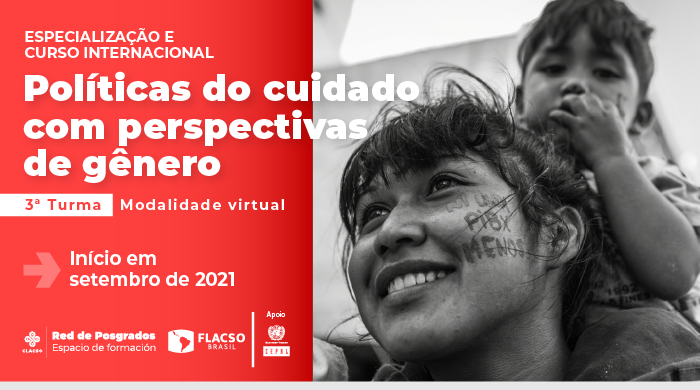
3th Tourma | Virtual modality (2021-2022)
Specialization: 40 credits, 360 hours/cadeira
International course: 9 credits, 90 hours/cadeira
Duration: September 2021 to August 2022
The credential and certification of Specialization and the International Course will be carried out by the Latin American Council of Social Sciences (CLACSO) and the Latin American Faculty of Social Sciences (FLACSO Brazil)
GENERAL COORDINATION
Karina Batthyány (CLACSO and Universidade da República, Uruguay) and Joan Tronto (Universidade de Minnesota, United States)
ACADEMIC COORDINATION: Valentina Perrotta (Universidade da República, Uruguay)
ACADEMIC COMMITTEE
Salete Valesan Camba (FLACSO, Brazil), Karina Batthyány (CLACSO and University of the Republic, Uruguay), Joan Tronto (University of Minnesota, United States), Natalia Genta (University of the Republic, Uruguay)
As academic support from ECLAC
The changes experienced in recent years in Latin American societies regarding female participation in the labor market, the development process and family transformations invite us to reflect on the social organization of care in contexts of change.
Recently, empirical analyzes and research by academia on the topic of care have expanded significantly: development of new concepts such as the social organization of care, studies on the configuration of demand and supply of care, research on the links between female migration and care, analysis of public policies, studies on care practices in different generations, surveys on the social representations of care, among many others.
Soma-se is the expansion of policies aimed at care in Latin America, so it is necessary to have people trained in this subject in order to contribute to the incorporation of the gender perspective in the formulation, implementation and endorsement of policies.
The objective of the Specialization consists of:
- provide theoretical tools that allow a solid formation to respect the link between gender and care, its main debates and tense concepts;
- to know the advances of empirical research carried out in the region and its main contributions;
- train to analyze and formulate public policies so that students are capable of making contributions that allow them to incorporate a gender perspective into care quests.
The Specialization of the International Course is intended for undergraduate and post-graduation students; teachers of all ages; activists and activists of union organizations, social movements and political parties; public officials; printing workers; members and managers of non-governmental and professional organizations interested in the study and implementation of care policies in Latin America and the Caribbean.


The Specialization in Care Policies with Gender Perspectives will last 12 months and for the certification to be necessary: the realization of an international course, two virtual seminars eletivos of the curricular structure, a support office for the redaction of the final work and the elaboration of the work final.
The International Course will last 12 months and will require for its certification the completion and approval of a final project, as well as participation in at least 80% of the activities and tasks proposed by teachers.
The International Course Specialization will take place between September 2021 and August 2022.
The students of Specialization and the International Course receive the support of academic tutors who will accompany the realization of two virtual seminars and guide the production of the final work.
Once the seminars are completed, the students will have a period of four months to submit their final work. If you are pending the conclusion of credits, you will also have this deadline to fulfill them.
The International Course Specialization requires CLACSO and Flacso Brazil certificates.
The Specialization has a total workload of 360 hours and an International Course of 90 hours.
To register for a complete Specialization, you do not need to register separately for the International Course.The virtual seminars will be offered in both Spanish and Portuguese. Likewise, the bibliography may be offered in the two official languages of the course. As two students intervene in the discussion forums, they can also be used in different languages. The final monographic work may be in Spanish, Portuguese or English.
Summary
The course will address the main discussions and analyzes around the topic of care based on a gender analysis. Throughout the conferences, the discussions and the challenges conceived will be focused on the content and scope of care, as well as on the link between the regimes of assistance and welfare, citizenship and rights, and the analyzes and research on migration and care.
Classrooms and teachers
Classroom 1 - Gender and care: central concepts - Profa. Karina Batthyány (CLACSO and University of the Republic, Uruguay)
Classroom 2 - Ethics of care and democracy of care - Prof. Joan Tronto (University of Minnesota, United States)
Classroom 3 - Care and use of time - Prof. María Ángeles Durán (Conselho Superior de Pesquisa Cientifica, Spain)
Classroom 4 - Care approach methodologies - Prof. Lucía Scuro (ECLAC, Uruguay)
Classroom 5 - Direitos à assistência - Profa. Laura Pautassi (University of Buenos Aires, Argentina)
Classroom 6 - Health Professionais - Profa. Nadya Guimarães (Universidade de São Paulo, Brazil)
Classroom 7 - Care and State - Profa. Bila Sorj (Federal University of Rio de Janeiro, Brazil)
Classroom 8 - Care and migration - Profa. Amaia Pérez Orozco (Complutense University of Madrid, Spain)
Classroom 9 - Care regimes: challenges and opportunities for equality - Prof. Juliana Martínez (University of Costa Rica, Costa Rica)
Classroom 10 - The state of parenthood in Latin America: genes, economic support and care - Profa. Juliana Martínez (University of Costa Rica, Costa Rica)
Classroom 11 - Aesthetic care and racial repair - Prof. Mara Viveros Vigoya (Universidade Nacional da Colômbia)
Classroom 12 - Care and development - Prof. Rosario Aguirre (University of the Republic, Uruguay)
Summary: In this curricular unit, students will be presented with various definitions of care and work around reflections on the perspective of the ethics of care; The connections between gender theory and care; reflections on different dimensions of care, among others. It will be addressed as positions that are recognized as a job associated with love and female identity, as well as positions that are defined as a paid and unpaid job, assimilated or not to other types of work. In the same way, it will work on the challenges and methodological reflections for care measurement. Qualitative and quantitative care methodologies in different countries of the region will be addressed, as well as the challenges of quantitative care measurement based on the contributions of research on the use of time in the region and its main challenges.
Coordinator: Karina Batthyány (Universidade de la República, Uruguay), Joan Tronto (Universidade de Minnesota, United States) and Valentina Perrotta (Universidade de la República, Uruguay)
Summary: This course aims to work on care as a component of social welfare, and how it is provided and distributed in different welfare regimes. Isso or connect with the discussion of public policies and with the direct assistance. It will work on the concept of social organization of care, analysis of the supply and demand of care, developments and strategies of family care, analysis of studies of social representation of care.
Coordinator: Eleonor Faur (National University of San Martín, Argentina)
Summary: We will work on the impacts on the origin and destination of migration for the social organization of child care and people with dependence, addressing the analysis of studies in the national and regional context. Discussions on global care chains have been studied and numerous researches have been presented in Latin America on the issue.
Coordination: Gender Affairs Division – ECLAC
Summary: This course will present paradigmatic or notable cases of regional countries related to the development of their public care policies. The course will be carried out based on a comparative analysis of public policies related to family, social protection, assistance, life path, well-being from a gender perspective, in different countries of the region.
Coordinator: Valentina Perrota (University of the Republic, Uruguay)
Summary : The office is a training space intended to guide the preparation of the final monographic work of the Specialization. Students will receive accompaniment and guidance in the elaboration of the object of analysis, in their translation into a practical study problem, in the construction of a working plan, in the development of argumentative networks and in the definition of analytical conclusions. These tasks will be carried out individually and collectively by means of exchange between peers and as a professor responsible for the office, through the discussion forum. The objective of the office is to produce the outline of the final work of the Specialization. The final monographic work may be in Spanish, Portuguese or English.
Coordinator : Karina Batthyány (University of the Republic, Uruguay), Joan Tronto (University of Minnesota, United States) and Valentina Perrotta (University of the Republic, Uruguay)
2021-2022
|
sep-21 |
International course “Latin American perspectives on Gender and Care” |
Eletive Seminar "Conceital and methodological debates on care" |
Eletive Seminar "A Social Organization of Care" |
|
|
|
|
oct-21 |
|
|
|
|||
|
nov-21 |
|
|
|
|||
|
dic-21 |
|
|
|
|
|
|
|
ene-22 |
Holiday break |
|||||
|
feb-22 |
International course “Latin American perspectives on Gender and Care” |
|
|
|
|
|
|
Mar 22 |
|
|
Eletivo Seminário " Migration, gender and care" |
Eletive Seminar "Care Systems and Policies in Latin America" |
|
|
|
abr-22 |
|
|
|
|||
|
May-22 |
|
|
|
|||
|
Jun-22 |
|
|
|
|
>Office to support preparation of final work |
|
|
Jul-22 |
|
|
|
|
||
|
ago-22 |
|
|
|
|
|
|
Full CM: You belong to a Full Member Center of CLACSO.
Associate CM: You belong to a CLACSO Associated Center.
Without link: You do not have any of the links with CLACSO.
| A payment before 10/09 |
Um pagamento após 10/09 |
Payment in 3 installments | |
| Full CM | USD 350 | $500 | USD 660 (3 x USD 220) |
| CM Associate | $400 | $600 | USD 870 (3 x USD 290) |
| Sem link | $450 | $800 | USD 1080 (3 x USD 360) |
In all cases, payment may be made by letter of credit, deposit or bank transfer.
The credential and certification of Specialization and the International Course will be carried out by the Latin American Council of Social Sciences (CLACSO)
CM PlenosIf you belong to a CLACSO Full Member Center
CM Associates: Yes You belong to a CLACSO Associated Centre
No linkIf you DO NOT has any of these links with CLACSO
| One payment by 10/09 |
A payment after 10/09 |
Payment in 3 installments | |
| CM Plenos | $100 | $200 | USD 270 (3 x USD 90) |
| CM Associates | $150 | $250 | USD 360 (3 x USD 120) |
| No link | $200 | $320 | USD 450 (3 x USD 150) |
In all cases, payment can be made by credit card, deposit or bank transfer.
The International Course Specialization is intended for undergraduate and post-graduation students; teachers of all ages; activists and activists of union organizations, social movements and political parties; public officials and legal agents, day laborers, communicators and press consultants; members and leaders of non-governmental and professional organizations interested in the matter.
To participate, it is essential that you register on the website.
Registration will be open between
Registration will be open between July 8 and September 21.Upon completion of the registration process, you will receive confirmation by e-mail.
If any of the mandatory training sessions are not completed, in all cases, an additional amount must be paid to recover the aforementioned credit.
If a student decides not to take the Specialization or International Course before its formal start, he or she may request a refund of the registration fee. CLACSO will calculate as equivalent to 10% of the administrative allowances.
Exceptional Criteria: In exceptional cases, in the first two months of the start of the specialization, someone may request to leave the school and resume it the following year. In all cases, the reasons justifying the request must be presented in writing. Two months after the start of the course, it will no longer be possible to request this procedure.
If a student decides not to take the specialization or international course before its formal start, he or she may request a refund of the registration fee. CLACSO will calculate as equivalent to 10% of the administrative allowances. After all, no refund will be made.
The classrooms will start in September 2021 and will be completed in August 2022.
All registered participants will receive the necessary instructions to access the classrooms, bibliography and discussion forums through the CLACSO Virtual Training Space.
Access and navigation in the Virtual Training Space is very simple and friendly. In any case, a technical and academic support team will always be at your disposal.
You must certify the International Course, two (2) eletive Virtuais Seminars, a support office to carry out the final work and carry out the final work.
To obtain the title of the Specialization, you must conclude a final monographic work. The support office for the completion of final work is obligatory and objectively accompanies you in the completion of final work.
You must participate in the classrooms and activities proposed by the teachers and do the final monographic work.
However, the Specialization in the International Course requires certificates for CLACSO and Flacso Brazil.
The specialization has a total workload of 360 hours and an international course of 90 hours.
The sending of the certificate of completion will be done digitally and is completely free.
The international Specialist diploma is issued by the Secretary-General of the Flacso, located in Costa Rica. The values and procedures for issuing and sending the international diploma can be consulted on the Flacso Brasil page: https://flacso.org.br/?page_id=24376 (português version)
The specialty is credentialed by CLACSO and FLACSO Brazil.
The international Specialist diploma is issued by the Secretary-General of the Flacso, located in Costa Rica. The values and procedures for issuing and sending the international diploma can be consulted on the Flacso Brazil page: https://flacso.org.br/?page_id=24376 (português version).
See the table of prices and modalities available above.
If you do not want to extend the FLACSO certification, you will have to pay an additional fee. *
For this reason, you only need to request a diploma, or a fee of US$160,00 (one cent and sixty US dollars). To request diplomas and analytical certificates, the cost is US$200,00 (two US dollars). These costs are only used to cover the preparation, administrative processes and processing of the aforementioned stamps and stamps, as well as the shipping costs. Payment can be made by credit card via Paypal ticket, which will be sent by e-mail.
* Values subject to modifications
Any further questions can be contacted at [email protected]
Send a WhatsApp to +5491138801388
For discounts for groups and institutions, you can contact us at [email protected]
. . . . .
More specializations and international courses
[widget id=”glob_block_5_widget-42″]

