Master's Degree in Methods and Techniques of Social Research
2nd Cohort | Virtual and intensive modality (2024)
Master's degree: 1.500 hours of total dedication
Duration: April to December 2024 (intensive format)
The accreditation and certification of the Master's degree will be carried out by the Latin American Council of Social Sciences (CLACSO) and by UTE University
GENERAL COORDINATION : Juan Ignacio Piovani (Argentina)
TEACHING TEAM : Gabriela Rubilar (Chile), Joan Miquel Verd (Spain), Pablo Dalle (Argentina), Jésica Pla (Argentina), Fernando Tavares (Brazil), Santiago Poy (Argentina), Paola Mascheroni (Uruguay), Gabriela Gómez Rojas (Argentina), Juan Piovani (Argentina), Rodolfo Iuliano (Argentina), Ariadna Gorostegui (Argentina), Alberto Riella (Uruguay), Sofía Vanoli (Uruguay), Mauricio Tubío (Uruguay), Germán Quaranta (Argentina), Leticia Muñiz Terra (Argentina) and Eugenia Rausky (Argentina)
ACADEMIC PROPOSAL
To transform reality, it is essential to have critical theories and powerful and diverse research methods.
The strength of critical thinking in Latin America and the Caribbean is based on a deep and vast methodological tradition that has successfully combined the advances of the Social Sciences with a commitment to social change, justice, and equality.
The diverse research methods used by researchers in the field of Social Sciences are a fundamental tool for documenting and making intelligible the social injustices and vulnerabilities experienced by our communities. This Master's program continues and strengthens the tradition of methodological rigor that critical research in our continent has maintained since its inception, enabling new generations to adopt these methods and techniques and apply them creatively in the production of social research that contributes to academic, social, and political debates for social change.
The Master's program aims to train professionals with advanced skills in various research methods and techniques in the Social Sciences, with a particular emphasis on the ability to effectively integrate key theoretical approaches with current state-of-the-art research in each discipline, as well as creative and relevant technical and methodological approaches for the critical development of research relevant at the local, regional, and international levels. In this way, it seeks to promote the development of solid skills, knowledge, and experience to support and enhance knowledge production within disciplines and in interdisciplinary, transdisciplinary, and multidisciplinary contexts.
The program is aimed at professionals with a bachelor's degree, preferably in the field of Social Sciences and Humanities. Professionals with a bachelor's degree in other fields who demonstrate two years of experience in the subject matter, or those accepted by the academic committee after a justified review, may also apply.
The program will last 1 year (intensive modality), organized into 2 academic periods of 16 weeks each, totaling 1.500 hours with the purpose of harmonizing and articulating with the standardization of the European Higher Education Area, so that the offer is comparable internationally.
The Master's program is organized around 3 training units:
1) Advanced disciplinary training unit: oriented towards the acquisition of advanced critical knowledge, skills and competencies regarding the different methods and techniques of research in the field of Social Sciences.
2) Research unit: focused on acquiring skills and knowledge related to the design and implementation of research in Social Sciences.
3) Graduation unit: oriented towards the preparation of an individual work that demonstrates mastery of the content and skills worked on during the course.
Each seminar will last 8 weeks (except for the graduation seminar, which will last 16 weeks).
The format of each seminar will be synchronous (via the Zoom platform) on one weekday between 19pm and 21pm ARG and will be combined with weekly asynchronous readings and activities .
Attendance at synchronous meetings will be mandatory.
Seminars:
First two-month period - April 08 to May 31, 2024
Summary: Construction and analysis of qualitative information applied to social research: ethnographic techniques, discourse analysis, focus groups, and forms of participant observation.
Teachers: Leticia Muñiz Terra and Eugenia Rausky
Class schedule: Wednesdays 19-21pm (Argentina time).
Summary: This course will explore the fundamental concepts that underpin the study of research designs. It will cover the different stages of the research process and their variations, according to the implemented theoretical and methodological strategy and within the framework of integrating qualitative and quantitative approaches. While this workshop will specifically address issues related to social research methodology, the work will be framed within the general principles that guide the production of scientific knowledge. Therefore, the interrelationship between theory, method, and techniques in constructing empirical approaches to the studied reality is considered the core of this production.
Teachers: Gabriela Gómez Rojas and Ariadna Gorostegui
Class schedule: Fridays from 19 to 21pm (Argentina time).
Abstract: This course brings together researchers with extensive experience in the social sciences to review current epistemological and methodological debates, with an emphasis on those most relevant to the socioeconomic, sociocultural, and socioenvironmental problems of Latin America. The course will explore epistemic shifts in situated research practices, contemporary methodological debates in qualitative research, and methodological proposals for working together with quantitative and qualitative techniques. It will also address the process of operationalization in the social sciences as the core of any methodological strategy, the controversies and opportunities related to the advent of big data, and the ethical discussions and criteria linked to social research practices.
Teachers: Juan Piovani and Rodolfo Iuliano
Class schedule: Tuesdays from 19 to 21pm (Argentina time).
Second two-month period - June 10 to August 02, 2024
Summary: This course aims to help students synthesize and apply the knowledge and methodological tools acquired in previous modules by developing their own research project. Throughout the course, students will understand the internal logic of a social science research project. The course will analyze its various stages: constructing a research object, defining a problem, and formulating questions, hypotheses, and objectives. Subsequently, students will be guided in developing their methodological strategy to empirically test their hypotheses or answer the questions guiding their research. Attention will be paid to establishing an appropriate relationship between theory and empirical evidence to evaluate the advantages and limitations of different research techniques. Finally, the course will discuss the procedures for analyzing the data produced, the expected results, and the alignment between available resources and project objectives.
Teachers: Alberto Riella and Paola Mascheroni
Class schedule: Tuesdays from 19 to 21pm (Argentina time).
Summary: Case studies as an empirical research strategy. Main perspectives on case studies. Single and multiple case studies. Why compare, how to compare, and what to compare.
Teachers: Germán Quaranta and Joan Miquel Verd
Class schedule: Wednesdays from 19 to 21pm (Argentina time).
Summary: This course will focus on presenting the challenges and procedures involved in conducting quantitative measurements of social reality using survey research techniques. It will cover the theoretical and methodological considerations of survey research, its different modalities, and how to develop and administer measurement instruments. The course will then address the concept of statistical sampling, presenting the most commonly used sample types for surveys and introducing methods for calculating sample size and sample selection.
Teachers: Mauricio Tubío and Alberto Riella
Class schedule: Thursdays from 19 to 21pm (Argentina time).
Third two-month period - August 19 to October 11, 2024
Abstract: To understand and transform reality, critical theories and robust, diverse research methods are essential. The various research methods used by researchers in the social sciences are a fundamental tool for understanding Latin American social problems. This course brings together Latin American researchers to explore diverse quantitative and qualitative strategies, methods, and techniques (and proposals for overcoming this division, such as mixed methods) for producing social scientific knowledge, emphasizing their properties, strengths, limitations, and ongoing debates.
Teachers: Sofía Vanoli and Victoria Tabárez
Class schedule: Mondays from 19 to 21pm (Argentina time).
Students must choose a curricular unit corresponding to the Master's Degree in Care and Gender with a Latin American Perspective CLACSO-UTE.
The offer available for selection will be announced in due course.
The seminar is designed to provide theoretical and methodological support to Master's students through the various stages of their own research projects. Based on the research findings, the seminar will support the development of a scientific article that maximizes the application of the content covered during the academic program. This article will serve as the Master's final assessment and will be reviewed by a team of specialists in the field before being submitted to an indexed academic journal for peer review. Projects must be developed according to the five lines of research:
- Social classes, education and work
- Culture and identities
- Gender inequalities and diversity
- Public policies and political action
- Rural areas and social conflicts
The graduation seminar will last 16 weeks during the third and fourth semesters. Passing all courses from the first and second semesters is a prerequisite for enrollment.
Fourth bimester - October 21 to December 13, 2024
Abstract: Statistical analysis applied to social research. Databases, descriptive statistics, bivariate and association analysis. Control variables, regression analysis, principal components, and factor analysis.
Teachers: Jesica Plá, Pablo Dalle, Fernando Tavares and Santiago Poy
Class schedule: Tuesdays from 19 to 21pm (Argentina time).
The graduation seminar course that began in the third term continues.

Students who have passed the Specialization in Methods and Techniques of Social Research of CLACSO-FLACSO or any of the curricular spaces that make it up, may accredit by equivalence up to 40% of the program of the Master's Degree in Methods and Techniques of Social Research of CLACSO-UTE.
You may also receive credit for one of the following CLACSO seminars:
-
Care systems and policies in Latin America
-
Migration, gender and care
For inquiries regarding equivalencies, please write to: [email protected]
Graduation requirements: Pass the Master's degree study plan and the Graduation Unit.
The Master's program in Methods and Techniques of Social Research has defined five lines of research:
-
Social classes, education and work
-
Culture and identities
-
Gender inequalities and diversity
-
Public policies and political action
-
Rural areas and social conflicts
APPLICATIONS
Application requirements:
- Possess a degree/undergraduate degree corresponding to a career of 4 (four) years duration at least, preferably in the field of knowledge of Social Sciences and Humanities.
- Complete the application form and wait for acceptance of the application.
You will need to upload the following documents to the form :
-
Color copy of national identity card or passport.
-
Copy of undergraduate/graduate degree certificate.
If the degree is obtained abroad (outside of Ecuador), before completing the program the student must present their degree duly apostilled or legalized through Consular channels - this procedure is personal.
-
Academic performance in undergraduate/graduate training.
Academic record of undergraduate studies / Academic certificate that includes the grade point average obtained in undergraduate studies -
Applicant's resume.
Curriculum Vitae, a document containing your professional and academic background.
-
Personal letter from the applicant stating:
- Their motivations for entering the program.
- Their availability and commitment on the scheduled days and times of the course.
- How do you think this program can contribute to your professional and/or academic development, including a possible topic to address in your research work and final article?
| Full tariff | 4.500 USD |
| Discount for students from Latin America and the Caribbean without a connection to CLACSO Centers | 3.900 USD |
| Discount for students affiliated with CLACSO Centers | 3.640 USD |
| Discount for students residing in Argentina | 1.730.560 ARG* |
The CLACSO-UTE master's programs are offered in a virtual and synchronous format . Each two-month period includes two to three seminars, with one mandatory synchronous meeting per week for each seminar, scheduled between 2:3 PM and 19:21 PM (Argentina time) . The course will be held in the CLACSO virtual platform classrooms and on the Zoom platform.
The program is organized into 2 academic periods of 16 weeks each, totaling 1.500 hours.
The Master's program is intensive , starting in March and ending in December 2024.
Application requirements:
- Possess a degree/undergraduate degree corresponding to a career of 4 (four) years duration at least, preferably in the field of knowledge of Social Sciences and Humanities.
- Complete the application form and wait for acceptance of the application.
You will need to upload the following documents to the form :
-
Color copy of national identity card or passport.
-
Copy of undergraduate/graduate degree certificate.
If the degree is obtained abroad (outside of Ecuador), before completing the program the student must present their degree duly apostilled or legalized through Consular channels - this procedure is personal.
-
Academic performance in undergraduate/graduate training.
Academic record of undergraduate studies / Academic certificate that includes the grade point average obtained in undergraduate studies -
Applicant's resume.
Curriculum Vitae, a document containing your professional and academic background.
-
A personal letter from the applicant expressing their motivations for joining the program, their availability and commitment to the scheduled days and times of classes, whether or not they have prior experience in social research, and how they believe this program can contribute to their professional and/or academic development, including a possible topic for their research work and final article.
Students who receive acceptance of their application must begin the registration process and pay the corresponding program fees, in accordance with the procedures, deadlines and locations established by CLACSO and UTE.
The awarding of postgraduate degrees will comply with the provisions of the Regulation for Harmonization of the Nomenclature of Professional Titles and Academic Degrees conferred by higher education institutions in Ecuador, issued by the Council of Higher Education.
For inquiries, please contact : [email protected]
Or send a WhatsApp message to +5491138801388
. . . . .
More master's degrees
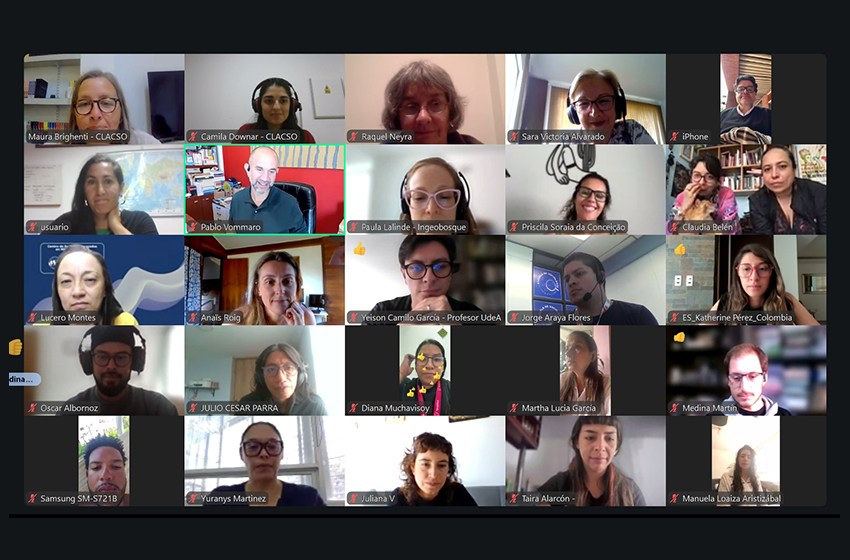
A regional commitment to critical thinking and socio-environmental justice
Master's Degrees 2026
Master's degree in Political Ecology
Master's Degree in Political Ecology
Master's Degree in Care and Gender with a Latin American Perspective