
Master's Degree in Political Ecology
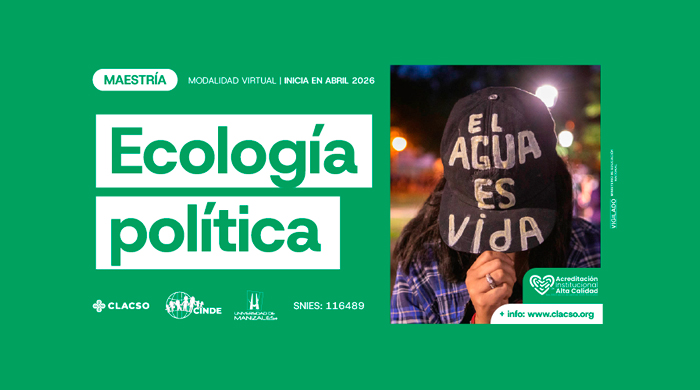
Online format | Starts in April 2026
Duration: 2 years
Course start date: April 06, 2026
Total number of credits and hours: 1728 hours – 36 credits
The Master's program is a joint academic proposal of the University of Manizales , the Latin American Council of Social Sciences (CLACSO) and CINDE , through its Center for Advanced Studies in Childhood and Youth (CEANJ).
It has an official degree with qualified registration, issued by the Ministry of National Education of Colombia – SNIES: 116489.
GENERAL COORDINATION
Carlos Alberto Davila Cruz y Raquel Neyra
The Master's Program in Political Ecology is based on an epistemological approach that integrates politics, environment, territory, and culture from a comprehensive and interdisciplinary perspective. Unlike other programs that address these fields in a fragmented manner, this program allows for an understanding of social realities as complex and situated wholes, promoting the construction of knowledge in and from local communities. An analysis of programs with current accreditation allows us to define its field of study and substantiate the relevance of this Master's program as an innovative research proposal.
In the context of the current civilizational crisis, characterized by environmental degradation and the breakdown of the ecological fabric, it is essential to train professionals capable of questioning the dominant rationales based on the overexploitation of nature. Contemporary socio-environmental conflicts highlight the centrality of territory and culture as geo-socio-historical dimensions from which nature is redefined as the material support for life and for the democratic processes of communities.
From this perspective, political ecology allows us to understand territory as a condition of existence, where space, time, imaginaries, and cultural practices intertwine. This requires professionals to critically analyze the diverse rationalities that shape lifeworlds, as well as the historical processes that have given rise to current socio-environmental tensions.
The Master's Program in Political Ecology , grounded in the Latin American and Colombian context, recognizes the plurality of territorial orders and the struggles for possible futures that emerge from diverse identities and territories. Within this framework, the program seeks to develop scientific, human, and technical capacities aimed at transforming the dominant techno-economic rationality, promoting the care of human and non-human life in the face of the planet's ecological limits.
The program contributes to the development of critical thinkers committed to environmental, territorial, and social justice, as well as to the processes of resistance and resilience of communities. It also aligns with the global challenges expressed in the Sustainable Development Goals, contributing to the development of public policies, projects, and strategies geared toward sustainability.
In summary, the Master's Degree in Political Ecology aims to train professionals capable of interpreting, analyzing and transforming contemporary socio-environmental conflicts, strengthening social, cultural, political and territorial processes that promote more just, equitable and environmentally sustainable societies.
The Master's Degree in Political Ecology will train individuals and actors from critical thinking and ethical-political positioning as researchers who, through committed research, contribute from consulting, the creation of public policies, development plans and government to the transformation of the tensions and conflicts that geo-socio-historically accompany the relationship between human beings and nature, with a vision situated in the realities that define the territories.
The Master's program is aimed at university graduates; postgraduate students; teachers; activists and members of trade unions, social movements and political parties; public officials; press workers; members and managers of non-governmental organizations and professionals interested in deepening and updating their knowledge on the subject.
A university degree/undergraduate degree or equivalent is required.
- Carlos Alberto Dávila Cruz (UManizales, Colombia)
- Raquel Neyra (GT CLACSO, Peru)
- Virginia Grosso (UNCUYO, Argentina)
- Francisca Fernández Droguett (UAHC, Chile)
- Natalia Agudelo Sepúlveda (UManizales, Colombia)
- Martin Medina (GT CLACSO, Argentina)
- William Gaviria (UManizales, Colombia)
- Oscar Castillo Oropeza (Mexico)
- Julián Loaiza (UManizales, Colombia)
- María Fernanda Troya (FLACSO Ecuador)
- Martha Lucia Garcia Naranjo (Manizales, Colombia)
The Master's Program in Political Ecology lasts two years and is delivered online. The coursework is primarily asynchronous and includes video lectures produced by the teaching team, available for students to view at their own pace. In addition, at least one optional synchronous meeting is scheduled per module to facilitate discussion and interaction. The dates and times of these meetings will be announced in due course, and recordings will be made available to those who are unable to attend.
The curriculum is organized into four academic periods, comprised of courses that integrate modules of conceptual and research training. Students must also complete and pass four elective courses, selected from the academic offerings of the University of Manizales.
The program's completion requires the preparation of a thesis in the form of an academic article, which will be presented at the Master's Final Symposium. Each student will be assigned a tutor who will guide them through the research and writing process. The article must then be defended before an academic panel.
To analyze the disciplinary and interdisciplinary paradigms and approaches used to interpret socio-territorial reality, based on the postulates that have allowed for different perspectives on territory, space, and place. To explain the emergence of territory as a field of power used by communities, institutions, individuals, and actors in their efforts to develop social, community, identity, economic, political, and cultural processes.
To propose a transformation of the concept of culture from anthropological and cultural studies perspectives. To conduct analyses from the field of cultural studies regarding the power relations established in territories as a result of resistance and re-existence.
To explore the origins, contributions, and tensions of political ecology based on the schools of thought that have contributed to this field of knowledge. To explain the evolution of political ecology as a field of Latin American critical thought.
To analyze the disciplinary and interdisciplinary paradigms and approaches for interpreting reality, based on the postulates that have allowed for different perspectives, explorations, descriptions, explanations, and interpretations, with which the subject—the researcher in training—can establish relationships of knowledge with themselves, with others, and with their object of study. To explain the different perspectives and approaches that emerge from the epistemologies of the Global South as builders of contemporary critical thought.
To conduct a geosociohistorical analysis of the civilizational crisis from a critical perspective. To describe socio-environmental conflicts and how counter-hegemonic movements highlight a plurality of territorial orders.
To conduct geo-socio-historical analyses from the perspectives of aesthetics and politics, with a cultural and territorial focus, of the diverse and plural realities and contexts that arise from resistance and re-existence, governmentality, and institutionality. To recognize the signs that enable the political dynamics of the territory and their aesthetic expression.
To analyze the disciplinary and interdisciplinary paradigms and approaches for interpreting reality, based on the postulates that have allowed for different perspectives, explorations, descriptions, explanations, and interpretations, with which the researcher in training can establish knowledge relationships with their object of study. To consolidate the protocol that defines the central research problems and its problematic, theoretical-practical horizons.
An elective module of the academic offer of the University of Manizales.
To identify the relationship between race, class, and gender with eco-territorial and environmental conflicts from a critical perspective of knowledge. To analyze development models, as well as socio-ecological transitions, in an effort to contribute to the construction of sustainable societies and communities.
Develop alternative proposals to foster dialogues that position political ecology as an epistemic, theoretical, methodological, and practical foundation for the construction of public and governmental policies. Present the contextual transitions and dynamics of their research process to understand the overall reality of cultural and territorial conflicts, and from there propose alternatives and/or solutions. Conduct critical reflection processes that facilitate the communication of tensions, frictions, and possibilities within the module.
Conduct field immersion to gather data to answer your research question. Construct interpretive matrices of categorical thinking. Give written meaning to other languages—codes from aesthetics and political ecology.
An elective module of the academic offer of the University of Manizales.
Prepare a report on the investigative process. Analyze other people's knowledge as a means of constructing one's own knowledge.
An elective module of the academic offer of the University of Manizales.
An elective module of the academic offer of the University of Manizales.
This forum serves as a platform for presenting graduate theses to the community of students and researchers. It is conceived as a space for interaction, discussion, reflection, and feedback among the Master's program participants, focusing on the progress of their research projects within each research area. Through this forum, the program also seeks to identify emerging knowledge challenges and categories that can generate new research projects, explore research trends, and exchange knowledge about Political Ecology.
1. Apply for the master's program by accessing the online application system. There you will need to complete your personal information and upload:
- National Identity Document (both sides)
- Undergraduate degree certificate (for those who studied in Colombia) or apostilled degree certificate* (for those who studied in another country)
*If you are unable to complete the apostille process during the registration period, you may still upload your degree and complete the process during the course. However, please note that you will not be able to receive your specialist degree until you submit your undergraduate degree with the apostille.
- Health insurance affiliation certificate (only for residents of Colombia)
2- Once you complete your application form, you will need to wait for technical approval. This process usually takes 15 days.
3- If your application was accepted, you will receive an email with the steps to follow to pay your tuition and formally complete your registration.
|
Rates |
General registration (until 30/03/2026) |
6 installments |
|
General rate |
$6.000 |
- |
|
Link with CLACSO Member Center, UManizales and CINDE/CEANJ |
$2.800 |
USD 3.600 (6 x USD 600) |
|
No link |
$3.600 |
USD 4.500 (6 x USD 750) |
• General registration (until 30/03/2026)
General rate: $6.000
Link with CLACSO Member Center, UManizales and CINDE/CEANJ: USD 2.800
No link: $3.800
• 6 installments
General rate: -
Link with CLACSO Member Center, UManizales and CINDE/CEANJ: USD 3.600 (6 x USD 600)
No link: USD 4.500 (6 x USD 750)
For any other questions, please contact [email protected]
Or send a WhatsApp message to +5491138801388
For group and institutional discounts, please contact [email protected]

