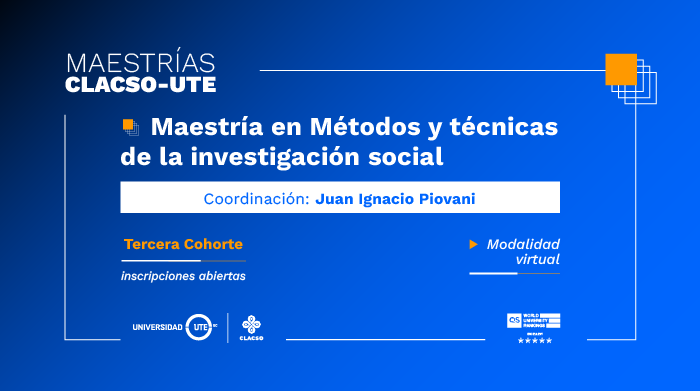
Master's Degree in Care and Gender with a Latin American Perspective
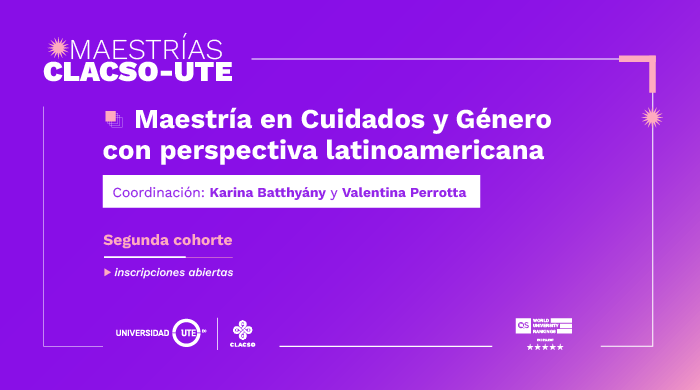
2nd Cohort | Virtual and intensive modality (2024)
Master's degree: 1.500 hours of total dedication
Duration: March to December 2024 (intensive format)
The accreditation and certification of the Master's degree will be carried out by the Latin American Council of Social Sciences (CLACSO) and by UTE University
GENERAL COORDINATION : Karina Batthyány and Valentina Perrotta (Uruguay)
ACADEMIC COORDINATION : Magela Romero Almodóvar (Cuba)
TEACHING TEAM : Karina Batthyány (Uruguay), Valentina Perrotta (Uruguay), Magela Romero Almodóvar (Cuba), María Ángeles Durán (Spain), Laura Pautassi (Argentina), Nadya Araujo Guimarães (Brazil), Mara Viveros (Colombia), Lucía Scuro (Uruguay), Bila Sorj (Brazil), Claudia Mora Del Valle (Chile) and Eleonor Faur (Argentina)
ACADEMIC PROPOSAL
The strain on the current social organization of care work leads to enormous inequalities in its provision, the majority of which falls on women and those with fewer resources, hindering their opportunities for development. Latin American states are not adequately addressing this demand, although in recent years they have made efforts to incorporate care into their agendas, developing various public policy initiatives that require further research to improve their impact.
To the already well-known care crisis, that is, the growing demand for care at the same time as the social capacity to assume it decreases, is added the situation of syndemic (health, economic, political, care crisis), caused by the Covid-19 pandemic that placed care at the center of the public debate, of the households and that overloaded women in their responsibilities.
Having experts in care and gender with a Latin American perspective who can promote care as a crucial component of well-being and a structural issue in the social and gender inequalities present in the region is crucial to continue moving towards better results.
GENERAL PURPOSE
The Master's program aims to train professionals with advanced skills in care theory and gender for analysis, knowledge production, and political and social intervention that contribute to the understanding of this social function and its link to social and gender inequalities, through a critical approach to available theoretical tools and empirical research, with an emphasis on those carried out in the Latin American region.
SPECIFIC OBJECTIVES
That the students:
-
Understand the main theoretical debates related to care, its various conceptualizations, and the Latin American journey toward its definition.
-
Understand the link between gender theory, social welfare theory, and care work.
-
Develop skills for research and design of public policies on care and gender inequalities, starting from the challenges and methodological reflections for their measurement and from Latin American contributions in this area.
-
Develop theoretical-argumentative production skills on the importance of care as a component of social well-being and the development of public policies that address it.
The program is aimed at professionals with a bachelor's degree, preferably in the field of Social Sciences and Humanities. Professionals with a bachelor's degree in other fields who demonstrate two years of experience in the subject matter, or those accepted by the academic committee after a justified review, may also apply.
The program will last 1 year (intensive modality), organized into 2 academic periods of 16 weeks each, totaling 1.500 hours with the purpose of harmonizing and articulating with the standardization of the European Higher Education Area, so that the offer is comparable internationally.
The Master's program is organized around 3 training units:
1) Advanced disciplinary training unit: oriented towards the acquisition of advanced critical knowledge, skills and competencies regarding the different methods and techniques of research in the field of Social Sciences.
2) Research unit: focused on acquiring skills and knowledge related to the design and implementation of research in Social Sciences.
3) Graduation unit: oriented towards the preparation of an individual work that demonstrates mastery of the content and skills worked on during the course.
Each seminar will last 8 weeks (except for the graduation seminar, which will last 16 weeks).
The format of each seminar will be synchronous (via the Zoom platform) on one weekday between 19pm and 21pm ARG and will be combined with weekly asynchronous readings and activities .
Attendance at synchronous meetings will be mandatory.
Seminars:
First two-month period - March 25 to May 17, 2024
Abstract: This course explores various definitions of care and reflects on the perspective of the ethics of care, the links between gender theory and care, and reflections on different dimensions of care, among other topics. It addresses viewpoints that recognize care as work associated with love and female identity, as well as those that define it as work, both paid and unpaid, and whether or not it can be considered equivalent to other types of work. The course also examines the challenges and methodological considerations for measuring care. Similarly, it analyzes qualitative and quantitative methodological aspects related to the study of care in different countries of the region, particularly the challenges in the quantitative measurement of care based on the contributions of Time Use Surveys.
Teachers: Karina Batthyány, Valentina Perrotta and Magela Romero Almodóvar
Class schedule: Tuesdays from 19 to 21pm (Argentina time).
Abstract: The methodological workshop is a training space designed to guide students in defining their research topic for the final article. It will support students in developing their object of analysis, translating it into a viable research problem, constructing a work plan, developing argumentative frameworks, and establishing analytical conclusions.
Class schedule: Wednesdays from 19 to 21pm (Argentina time).
Summary : This course addresses the theoretical discussions and diverse lines of research on care and public policy being developed in the region. It focuses on the debates and conceptual challenges surrounding the content and scope of care, as well as the link between care and welfare systems, citizenship, and rights. Topics covered include the connection between care and gender, the implications of care in power relations, "good care," violence in care work, and the right to care.
Teachers: Karina Batthyány, María Ángeles Durán, Laura Pautassi, Nadya Guimarães, Valentina Perrotta and Magela Romero Almodóvar
Class schedule: Thursdays from 19 to 21pm (Argentina time).
Second two-month period - May 27 to July 19, 2024
Summary: This course addresses care as a central component of social well-being. It analyzes the social and political organization of care within the regional context, paying particular attention to gender and class inequalities in this political, economic, and cultural framework. This connects care to discussions on public policy and to care as a right, thus incorporating the "political" dimension as fundamental to analyses of the supply and demand of care, as well as family care arrangements and strategies. The course also explores paid care work and social representations of care.
Teacher: Eleonor Faur
Class schedule: Tuesdays from 19 to 21pm (Argentina time).
Students must choose a curricular unit corresponding to the Master's Degree in Methods and Techniques of Social Research CLACSO-UTE.
The offer available for selection will be announced in due course.
Class schedule: Wednesdays from 19 to 21pm (Argentina time).
Summary: This course addresses the theoretical discussions and diverse lines of research on care and public policy in the region. It focuses on the debates and conceptual challenges surrounding the content and scope of care, as well as the link between care and welfare systems, citizenship, and rights. It incorporates approaches to care workers, care systems in the region and their promotion of paternal care, and the racial dimension of care.
Teachers: Karina Batthyány, Mara Viveros, Lucía Scuro, Bila Sorj, Valentina Perrotta and Magela Romero Almodóvar
Class schedule: Thursdays from 19 to 21pm (Argentina time).
Third two-month period - August 05 to September 27, 2024
This course aims to focus on care policies developed by Latin American countries, with some examples from European countries. Paradigmatic or prominent cases from countries in the region related to the development of their public care policies will be presented, as well as examples from the European experience. The approach will be developed through a comparative analysis of public policies related to families, social protection, care, life course, and well-being from a gender perspective in different countries of the region. This analysis will be based on research by women, allowing for an understanding of each country's trajectory regarding these types of policies. Students are expected to learn about the experiences of countries in the region with respect to care policies, develop a comparative public policy perspective on these policies, and delve into best practices regarding the inclusion of a gender perspective in care policy.
Teachers: Valentina Perrotta and Magela Romero Almodóvar
This course addresses the impacts of migration on the social organization of care for children and dependent persons, both in countries of origin and destination. It analyzes national and regional studies from a gender perspective. Global care chains are examined, and key aspects of the international debate are presented, connecting them to the findings of various Latin American research projects on this topic.
Teacher: Claudia Alejandra Mora Del Valle
The seminar is designed to provide methodological support to Master's students at different stages of their studies. Through it, tools are shared for constructing a methodological design that, from a gender perspective, guides the development of the thesis and contributes to maximizing the use of the content shared during the program. Likewise, resources are provided for writing a scientific article presenting the results achieved. This will be considered the final evaluation report and submitted to a team specializing in Care work and the editorial policies of indexed academic journals. Projects must be developed according to the four lines of research:
- Theoretical and conceptual debates surrounding care
- Social organization of care
- Methodological challenges and reflections for measuring care
- Public policies and care
The graduation seminar will last 16 weeks during the third and fourth semesters. Passing all courses from the first and second semesters is a prerequisite for enrollment.
Fourth bimester - October 14 to December 08, 2024
The course addresses care work from the perspective of those who provide it and the various ways in which this work can be carried out. It analyzes the impact of the gendered division of labor on the unequal distribution of care work and the fact that women are the primary providers. The course introduces the concept of care circuits (care as a “profession,” as an “obligation,” and as “help”), delving into the relational dimension of this work. It illustrates the analytical value of the notion of intersectionality for studying the workers who engage in care.
Teacher: Nadya Araujo
The graduation seminar course that began in the third term continues.

Students who have passed the Specialization in Care Policies with a Gender Perspective of CLACSO-FLACSO or any of the curricular spaces that make it up, may accredit by equivalence up to 40% of the program of the Master's Degree in Care and Gender with a Latin American Perspective of CLACSO-UTE.
For inquiries regarding equivalencies, please write to: [email protected]
Graduation requirements: Pass the Master's degree study plan and the Graduation Unit.
- Theoretical and conceptual debates surrounding care
- Social organization of care
- Methodological challenges and reflections for measuring care
- Public policies and care
APPLICATIONS
Application requirements:
- Possess a degree/undergraduate degree corresponding to a career of 4 (four) years duration at least, preferably in the field of knowledge of Social Sciences and Humanities.
- Complete the application form and wait for acceptance of the application.
You will need to upload the following documents to the form :
-
Color copy of national identity card or passport.
-
Copy of undergraduate/graduate degree certificate.
If the degree is obtained abroad (outside of Ecuador), before completing the program the student must present their degree duly apostilled or legalized through Consular channels - this procedure is personal.
-
Academic performance in undergraduate/graduate training.
Academic record of undergraduate studies / Academic certificate that includes the grade point average obtained in undergraduate studies -
Applicant's resume.
Curriculum Vitae, a document containing your professional and academic background.
-
Personal letter from the applicant stating:
- Their motivations for entering the program.
- Their availability and commitment on the scheduled days and times of the course.
- Whether or not you have prior experience in social research.
- How do you think this program can contribute to your professional and/or academic development, including a possible topic to address in your research work and final article?
| Full tariff | 4.500 USD |
| Discount for students from Latin America and the Caribbean without a connection to CLACSO Centers | 3.900 USD |
| Discount for students affiliated with CLACSO Centers | 3.640 USD |
| Discount for students residing in Argentina | 1.730.560 ARG* |
The CLACSO-UTE master's programs are offered in a virtual and synchronous format . Each two-month period includes two to three seminars, with one mandatory synchronous meeting per week for each seminar, scheduled between 2:3 PM and 19:21 PM (Argentina time) . The course will be held in the CLACSO virtual platform classrooms and on the Zoom platform.
The program is organized into 2 academic periods of 16 weeks each, totaling 1.500 hours.
The Master's program is intensive , starting in March and ending in December 2024.
Application requirements:
- Possess a degree/undergraduate degree corresponding to a career of 4 (four) years duration at least, preferably in the field of knowledge of Social Sciences and Humanities.
- Complete the application form and wait for acceptance of the application.
You will need to upload the following documents to the form :
-
Color copy of national identity card or passport.
-
Copy of undergraduate/graduate degree certificate.
If the degree is obtained abroad (outside of Ecuador), before completing the program the student must present their degree duly apostilled or legalized through Consular channels - this procedure is personal.
-
Academic performance in undergraduate/graduate training.
Academic record of undergraduate studies / Academic certificate that includes the grade point average obtained in undergraduate studies -
Applicant's resume.
Curriculum Vitae, a document containing your professional and academic background.
-
A personal letter from the applicant expressing their motivations for joining the program, their availability and commitment to the scheduled days and times of classes, whether or not they have prior experience in social research, and how they believe this program can contribute to their professional and/or academic development, including a possible topic for their research work and final article.
Students who receive acceptance of their application must begin the registration process and pay the corresponding program fees, in accordance with the procedures, deadlines and locations established by CLACSO and UTE.
The awarding of postgraduate degrees will comply with the provisions of the Regulation for Harmonization of the Nomenclature of Professional Titles and Academic Degrees conferred by higher education institutions in Ecuador, issued by the Council of Higher Education.
For any other questions, please contact : [email protected]
Or send a WhatsApp message to +5491138801388
. . . . .
More master's degrees
A regional commitment to critical thinking and socio-environmental justice
Master's Degrees 2026
Master's degree in Political Ecology
Master's Degree in Political Ecology
Master's Degree in Care and Gender with a Latin American Perspective