
Higher education is not a commodity
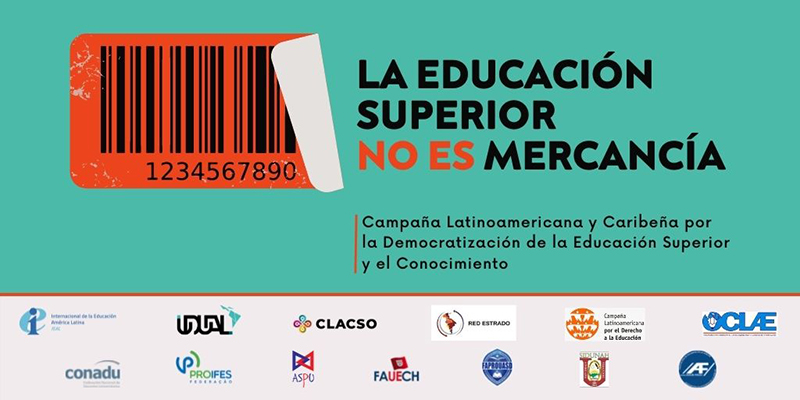
On the road to the World Conference on Higher Education (WHEC2022) to be held in Barcelona, Spain, from May 18 to 20, organized by UNESCO, the "Latin American and Caribbean Campaign for the Democratization of Higher Education and Knowledge: Higher Education is Not a Commodity" was launched, with the purpose of defending public higher education as a right and heritage of our peoples.
The regional campaign is sponsored by numerous educational institutions for whom higher education is a social public good, a universal human right, and a responsibility of states.
The World Conference on Higher Education (WHEC2022), to be held in Barcelona, aims to reshape ideas and practices in higher education to ensure sustainable development for the planet and humanity. Within this framework, UNESCO will seek to offer new knowledge, innovative ideas, creative partnerships, and foster an expanded and revitalized coalition of the international higher education community in support of the 2030 Agenda for Sustainable Development.
In this regard, the Executive Secretary of CLACSO, Karina Batthyány , stated in an interview that “we cannot think of strong, articulated, integrated higher education policies in our region that do not include the valuation of teaching work and, above all, that do not incorporate teachers into the discussion.”
What expectations and what diagnosis are brought to this World Conference on Higher Education?
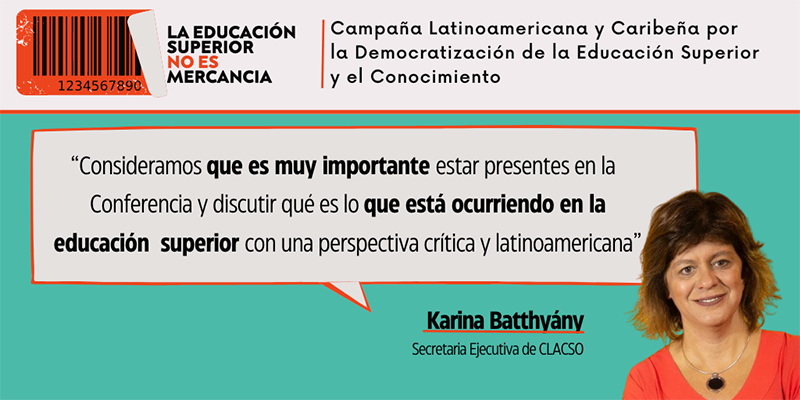
CLACSO will participate in the World Conference for the first time. Even amidst the ongoing discussions surrounding its organization, we believe it is crucial to be present and discuss what is happening in higher education from a critical Latin American perspective, recognizing it as a human right, and therefore possessing universal characteristics, and also as a public good. This is one of our institutional definitions and priorities. In this regard, we want to revisit, within the framework of the conference, some of the resolutions adopted by the CRES in Córdoba in 2018, specifically those related to access, use, and the democratization of knowledge as a public, social, and collective good, and a strategic asset for guaranteeing human rights. To say that higher education is a public and social good is to say that education is not a commodity and therefore should not be subject to market-driven political conditions, which, unfortunately, have been growing in Latin America since the 80s, even in countries with a strong tradition of public, secular, and free higher education and universities. This is partly because agreements at the regional level have not been reached, nor has there been a robust discussion on the funding of higher education. We consistently defend, especially in these pandemic and post-pandemic situations, the idea that life—all forms of life—and education must be central and should not be treated as purely commercial interests.
What is the situation in Latin America and what actions are being taken (or should be taken) by the countries to guarantee the democratization of knowledge production and circulation?
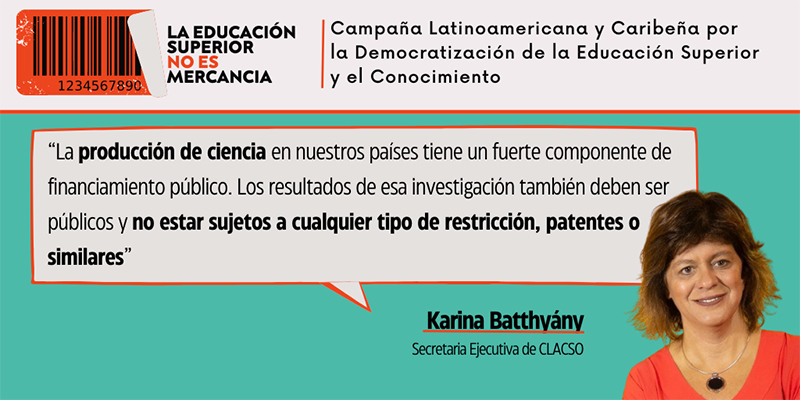
When we speak of higher education as a human right and a public good, we can extend this to knowledge and science in a broader sense, meaning that access should be completely free of barriers. This is also one of CLACSO's strategic and institutional definitions, one that has always existed but has been greatly reinforced by the experience of the pandemic, which made the problem of the commodification of knowledge abundantly clear, as exemplified by vaccines. We defend this idea not only in discourse but also in practice, by signing, discussing, and reaching agreements with various international institutions to move forward in this direction. This also applies to institutional practices such as our long-standing commitment to open access to all the research produced by CLACSO and its more than 800 member centers. For example, the Latin American and Caribbean Library of Social Sciences and Humanities is fully open access. We believe this is the right path because, moreover, scientific production in our Latin American countries has a strong public funding component in public universities and other institutions within the scientific system. The results of this research should also be public and not subject to any kind of restriction, patents, or similar measures.
Just as knowledge production is a platform with enormous potential for regional integration, in what other aspects do we need to build tools to deepen this process?
I believe there are two elements that are being addressed, but which need to be worked on more intensively. The first is integration from a knowledge perspective, and the second concerns agreeing on certain mechanisms regarding scientific practice or the practice of knowledge production. In this regard, CLACSO has strongly promoted what we call the Latin American Forum on Scientific Evaluation, which aims to discuss and propose alternatives to the ways in which scientific knowledge production is currently carried out and evaluated. This forum incorporates the particularities of different disciplines, particularly the social sciences and humanities, as well as the particularities of different regions, because we are doing this from Latin America but in dialogue with other regions of the world. This implies questioning the current parameters of relevance and scientific evaluation, for example, those associated with the well-known rankings of scientific journals. Moreover, most of the highest-ranked journals operate within a commercial framework, where one not only has to pay to read but often to publish. These are crucial elements for higher education and science to be recognized as a human right and free from the restrictions imposed by their commercialization. We believe this is one of the most important dilemmas facing our region and one that should be discussed within the framework of the World Conference on Higher Education.
Our region also possesses a vast accumulation of social knowledge, collectively produced not always within academia (in the "street," metaphorically speaking), related to combating various forms of inequality. Within this context, what aspects of this collective knowledge have been successfully applied within the higher education system, and what can be proposed for the international debate?
All Latin American reflection is strongly marked by one characteristic: our region is the most unequal in the world. And when we talk about these inequalities, we are referring to those linked to gender, race, Indigenous peoples, migration, environmental issues, age, and other distinct dimensions of inequality. This is a point that must always be present in the discussion and in policymaking. We must develop both science and higher education policies that incorporate this dimension because if we don't, and if we don't implement active policies to overcome these inequalities, all we will do is continue to reproduce them, including in the field of higher education and scientific practice. I also want to emphasize that there is an important tradition in Latin America—and this is also part of the work we are doing at the Latin American Forum on Scientific Evaluation—of integrating multiple forms of knowledge. Not only traditional or typically more established scientific knowledge, but also other forms of knowledge stemming from community knowledge, the knowledge of Indigenous peoples, and a long list of other sources that we believe must be integrated into the discussion on science and higher education policies so that these truly become a right for everyone. There are very significant outstanding issues, but I believe they have finally been placed on the discussion agenda. That is already a very important step, and, moreover, other regions of the world are also adopting them, driven by the discussion taking place in Latin America and the Caribbean. When we say that we want to defend this Latin American and critical perspective, it implies incorporating these elements into the discussion and policy formulation.
The pandemic has intensified the privatization and commodification of higher education, but it has also prompted a moment of reformulation and creative reflection within public systems. All of this has generated a significant upheaval in debates surrounding the working conditions of teachers and academics. What perspectives and needs do you believe are emerging for teachers in this new phase that is unfolding after the pandemic?
I believe the greatest challenge (it was before the pandemic, but perhaps it's even more pronounced now) is valuing the work of teachers. And I'm not referring exclusively to the economic dimension, which is, of course, important, but also to the social value of teaching at all levels, and in higher education in particular. We cannot conceive of strong, coordinated, and integrated higher education policies in our region that don't include this dimension, that don't include decent salaries, continuing professional development policies, gender equity policies, and policies that take into account the reproductive issues that so greatly affect women in the teaching profession. For me, this means valuing teaching in Latin America from an economic, social, and political perspective. It's impossible to imagine higher education policies that don't incorporate this point and, above all, that don't include teachers in the discussion.
How does the political situation on the continent impact these issues?
One point we view with concern is how the processes of political instability affecting the world and the Latin American and Caribbean region also impact the development of knowledge, particularly how these processes often jeopardize public universities and research institutions. This manifests in many ways, but two are perhaps the most significant: one is political restrictions on intellectual freedom and freedom of expression, and the other is budget cuts. In recent years, in many Latin American countries, we have witnessed budget reductions and the closure of higher education programs in the social sciences and humanities. I believe this point should also be on the agenda for discussion, and we should consider measures to strengthen these processes in countries experiencing political instability.
More information on the UNESCO World Conference on Higher Education 2022
INTERVIEW WITH ROBERTO ESCALANTE
PRESENTATION BY YAMILE SOKOLOVSKY
If you would like to receive more information about CLACSO's training programs:
[widget id=”custom_html-57″]
to our email lists.

