
“Latin American universities still have a long way to go in terms of achieving a real integration process.”


Roberto Escalante , Secretary General of the Union of Universities of Latin America and the Caribbean (UDUAL), was interviewed within the framework of the “Latin American and Caribbean Campaign for the Democratization of Higher Education and Knowledge: Higher Education is Not a Commodity,” which is sponsored by numerous educational institutions for whom higher education is a social public good, a universal human right, and a responsibility of states.
The regional campaign, which is taking place on the road to the World Conference on Higher Education (WHEC2022) to be held in Barcelona, Spain, from May 18 to 20 and organized by UNESCO, was launched with the purpose of defending public higher education as a right and heritage of our peoples.
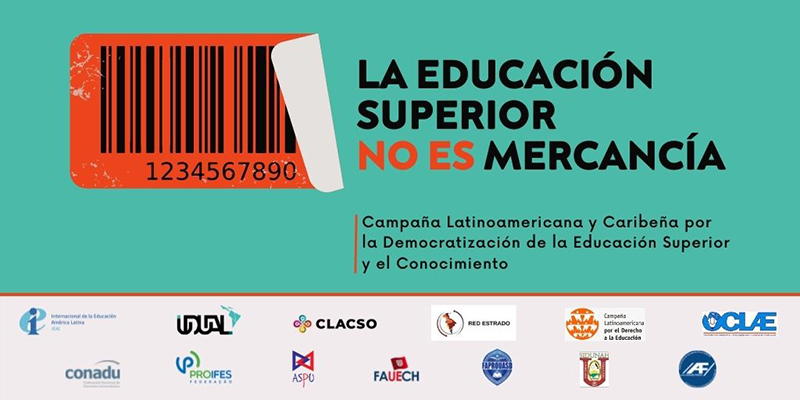
See: Higher education is not a commodity
What are your expectations for this new World Conference, and what do you think our continent's position should be?
Latin American and Caribbean universities (or at least a portion of them, because I believe there are many types of universities), the most important universities, particularly public ones, though not exclusively, are interested in the conference. We have been preparing position papers, and those of us who can attend will present these ideas, if possible. However, at least for me, the information we have received from UNESCO and IEASALC leads me to believe that it will be a lackluster event, one that won't have much significance. It's an international conference, meaning it has been degraded and is no longer governmental, where governments attend with their representatives and commit to a series of things. Some government representatives will attend, but many people will be there. If you wanted to submit a document and register it, you would receive a formal invitation from UNESCO to attend, and this is complicated. But, given this context, in which we have been observing a series of changes and a lack of clear explanations, I honestly don't have high expectations that we will obtain anything substantive from the World Conference. This doesn't mean we shouldn't go and speak—those of us who can—about the things we believe in and that are important. We've already said some things at the 2009 conference and at the Latin American and Caribbean conferences on higher education in 2008 and 2018, such as the issue of free education and understanding higher education as a right. But we need to say many more things that are happening because, regardless of how beneficial the 2008 and 2018 conferences were, the things said there are already becoming outdated.
In what sense?
It's no longer enough to simply say that education is a right. Many things are happening to us; education is being transformed, universities are becoming stratified, and there are pedagogical and didactic issues, such as how to understand what a professor is and what a student is today, what a university is, and how to use technology to truly fulfill the mission of universities both internally and externally. And I think we're not talking enough about these things. Among other things, because we don't all have a completely clear understanding of what this means and how it should be implemented. So, my reactions to the upcoming world conference are mixed, if I can describe them at all. I think UNESCO has shifted to the right, I have to say it like that. Today, it has a much clearer view of certain privatizing, mercantilist interests in higher education, which we don't share. I should add that for many university presidents, the world conference is not on their agenda at all. Not only for Latin Americans, but even for Spaniards. Catalan universities aren't even paying attention to the matter. There's no interest in the event; I don't sense that atmosphere.
Did that happen at previous conferences?
I wasn't at the 2009 conference. But what I do know is that it was very turbulent, highly debated, and controversial because UNESCO had very clear intentions to steer higher education toward commercial interests. But they've already realized that, presented in that way, it won't be accepted by universities, especially public ones, particularly in Latin America but also in other parts of the world. They've degraded the institution, and it's like if you and I were to agree to call a conference on higher education in Jamaica or Argentina, invite some experts and scholars on the subject, and discuss it for a while.
Something more like a Congress…
It's not going to be a decisive conference. They're going to launch, surreptitiously, almost as a subliminal message, if I may say so, what they call a "roadmap," which is this idea of global campuses, the emphasis of education on work-related issues exclusively, the intensive use of technology—what's being dubbed the cyber society—but all tied to the university contributing more effectively and less costly to wealth creation in a market economy. That, in my opinion, is UNESCO's underlying intention.
Although the Conference may not help to energize these debates globally in a progressive direction, perhaps the preparations within our continent could do so within Latin America, leaving some positive outcome for our region. If so, what would it be?
To paraphrase a Mexican allegory, “may the Virgin of Guadalupe hear you” (laughs). I feel that Latin American universities still have a long way to go in terms of real integration. They are very preoccupied—and this has had a profound impact—with the whole issue of rankings, with the focus on the self instead of the collective . Of course, there are a few exceptions, which cannot be ignored. We have created a political discourse, which we defend and which is listened to, but not by the governments, except for Argentina, which has somewhat more open ears, and I would include Ecuador and, with some reservations, Bolivia. But in the rest… São Paulo, Buenos Aires, UNAM, San Marcos, the University of Chile, the National University of Colombia… they could form a truly Latin American and Caribbean alliance to jointly promote important projects in vaccines, patents, and territorial development. I'm not saying they shouldn't do it individually, but not in a network, with a Latin American and Caribbean vision. Perhaps those who read this report will say I'm pessimistic, but I don't see it that way. We do have a message, though, and some governments are adopting it. The Mexican government just passed a new law, something Perón did in Argentina in '49, which is free education for all, including higher education. That's important, but there's no money, and there's a lack of teamwork to be able to work together. So, the point is that we need a message, but we also need results. We need to reflect, but we need to act.
In what lines of action can this be promoted or consolidated?
There are very clear agendas and points, such as the issue of quality assurance with social service, with a social orientation, or the problem of funding. We must truly invest in universities to prevent this precariousness of teaching work, to renew the faculty and researchers. We must adapt cyber tools to education to put them at the service not only of problems, but also of issues that are already widely known, such as multidisciplinarity and interdisciplinarity. Beyond universities, there is a very clear agenda: water, care of natural resources, food, education, vaccines, patents, food security, and connection with the local community. We have been clear about these things for some time. If you analyze by country or by university, you will find that there are universities doing very valuable work. But it is not happening collectively. As a region, as a subcontinent, as Latin America, each one speaks for itself and tries to do what it does best. There are efforts like ENLACES, the university networks, but I certainly don't think it would be a false expectation to have a joint action like the Europeans. The Bologna Agreement works: mobility, recognition of degrees and titles, a series of academic facilities, but not so much in terms of addressing existing problems. If you really ask, do people in Latin America know what universities do? I can assure you they know very little. Now, for example, in Brazil, faced with this fascist attitude, universities definitely played a role, because scientists went on TV and radio to explain what the coronavirus was, what needed to be done, what couldn't be done, but in many other places, nothing, or very little. We need universities truly engaged in politics with society, not in the sense of favoring a party or a candidate, no, but engaging in politics through what they do: creating knowledge to solve problems. That's not happening. Or it's happening very little.
One complex issue in this context is the working conditions of teachers, which are so unequal and stratified in Latin America, with some universities offering certain levels of stability while others in other countries are completely precarious. Doesn't this hinder or discourage this type of intervention in societal debate?
Absolutely. Government funding for universities for these kinds of things is fundamental. The issue of universities' financial capacity and the payment of their professors and researchers is highly stratified. There are elite universities, generally private, with professors who earn very well and conduct excellent research. And there are others where professors don't. An extreme case: a Venezuelan professor earns one dollar a month. How can you expect science to benefit society in Venezuela? [Pay attention to this.] Funding must break down this stratification that has been created by all the incentives and rankings. That combination was disastrous for stratifying education. Many argue that distance education should be implemented because it's cheap. That's not true. The investment required for truly effective online education is costly. Because you need not only the technology, you need human capital—the people, the professors—who are truly qualified. What's being done now isn't online education; it's remote education, and it's very poor quality. That's useless. On the contrary, it bores students, encourages them to drop out, and lowers their learning levels. The issue of funding is fundamental, and governments are not investing enough in education for it to be a strategic and essential input for the development of our countries. And universities have to change. If they don't, they will become obsolete. Facebook, Instagram, and Google will beat them to it. Today, students quickly want skills they can sell in the job market to earn a living. This whole idea we have of forming critical, cultured citizens, aware of making education a social value, will be lost or minimized. That is a defeat. And that's where universities, networks, and university organizations have to come together and fight, or we won't fare well.
The outlook doesn't seem very encouraging…
I don't want to leave a pessimistic view. The only thing I want to emphasize is that we need to change things; we need a new idea of what we have to do. Latin America, and progressive universities and the left in general, are champions at how to divide themselves. Either we come together and reach an agreement, because governments either support us very little or almost not at all, or they are against us, or we won't be able to do what we believe in. This political discourse that universities should serve society and those most in need isn't going to work.
If you would like to receive more information about CLACSO's training programs:
[widget id=”custom_html-57″]
to our email lists.

