
“Higher education is a strategic element for the sovereign development of our nations.”
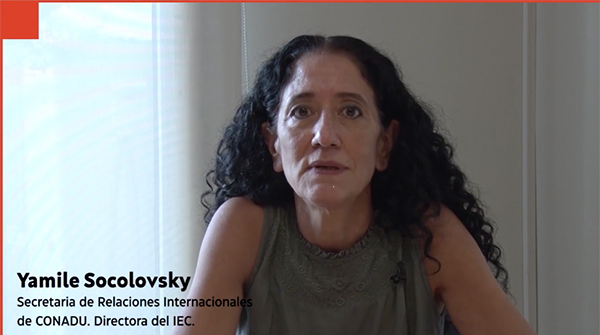
Yamile Socolovsky, Secretary of International Relations of the National Federation of University Teachers (CONADU) and Director of the Institute of Studies and Training (IEC) of Argentina, made a presentation within the framework of the “Latin American and Caribbean Campaign for the democratization of higher education and knowledge: Higher education is not a commodity”, which has the support of numerous educational institutions for whom higher education is a social public good, a universal human right and a responsibility of the states.
The regional campaign, which is taking place on the road to the World Conference on Higher Education (WHEC2022) to be held in Barcelona, Spain, from May 18 to 20 and organized by UNESCO, was launched with the purpose of defending public higher education as a right and heritage of our peoples.
We are working on a collaborative effort between organizations to launch a Latin American and Caribbean campaign in defense of the right to higher education and the democratization of knowledge. First and foremost, we are focusing on an immediate agenda because the UNESCO World Conference on Higher Education will be held in Barcelona in May. This has generated considerable controversy, with a lack of clarity regarding the participation of voices that we believe are involved in the debates, work, and activities taking place in higher education and public universities, particularly in Latin America.
We understand that at the Regional Conference on Higher Education held in Córdoba in 2019, on the occasion of the centenary of the University Reform, we reached very important and significant agreements, which we reaffirm, regarding the value of higher education and knowledge. On that occasion, we reiterated our conviction that the University, higher education, is a right, a fundamental human right. Therefore, it is a responsibility of states and a strategic element for the sovereign development of our nations.
From this perspective, which we advocate in Latin America, we understand that at this moment it is essential that all discussions surrounding the future of higher education, the future of universities, and knowledge-producing institutions must rethink how we guarantee this right and how we ensure that higher education and knowledge production in our countries respond to the objectives we have set for ourselves. In this sense, we believe it is crucial to discuss our concern about the deepening and accelerating trend toward the privatization and commodification of higher education and knowledge; along with this, the precariousness of work in higher education and the academic world in general, and the redirection of the organization and dynamics of higher education systems to serve the development of a higher education market, but also to serve the purpose of making higher education complement or function in a general precarization of the world of work.

This is an absolutely current discussion. These are processes that are taking place, and it is essential that those of us who defend this idea of the right to education, the idea that it is necessary to democratize the production, circulation, and access to knowledge, are discussing these functions and what policies need to be implemented by states to confront these trends. At the same time, we must be having a positive discussion about the reforms we need in our education systems, our university systems, and our science and technology systems, so that these transformations are democratizing transformations, transformations that aim to support the search for solutions to the major problems facing our societies, to address the profound inequalities that permeate our societies and the world. We must also be discussing how we guarantee the right to education and how we ensure that the educational world, the world of higher education, the university world, is a world of rights. Therefore, we must also discuss the ways in which inequality manifests itself within our higher education and university systems. Fundamentally, gender inequality, but also all the intersections of inequality, the various forms of social inequality that concern us; of course, issues related to class inequality, socioeconomic inequalities, the situation of migrants, the situation of Indigenous peoples, and also how we envision our higher education institutions as places where the richness of our cultures can be reclaimed, far removed from the prevailing trend in the development of higher education, which is to construct these institutions as spaces of cultural homogenization. We in Latin America and the Caribbean have a very clear concern regarding the need to recognize the cultural diversity that enriches our territories and for universities, higher education institutions, to be places where this diversity, this richness, is recognized, multiplied, and enriches us.
Right now, what we are doing with a group of highly representative entities involved in higher education, knowledge production, and academic activity in our region is laying the groundwork for a campaign that will highlight the concerns we have in our region. We want these concerns, warnings, criticisms, and proposals to reach not only the World Conference on Higher Education in Barcelona, but also to continue shaping the debates we need to develop and the strategies we need to implement within our own Latin American and Caribbean territory. That is why it is so important that the unions representing university faculty in the region, organized within Education International for Latin America, can come together with UDUAL, a very important association of university institutions in the region, with CLACSO, the Latin American and Caribbean Council of Social Sciences, with CLADE, the Latin American Campaign for the Right to Education, with OCLAE, the Latin American and Caribbean Student Organization, and with RED ESTRADO, the Network for Studies on Teaching Work. All organizations with which we have shared many meetings, much work, much struggle, and with which we are now thinking about how to bring this debate to the entire Latin American and Caribbean territory, to each and every one of the people who inhabit the universities, the institutions of higher education, but also to the entire citizenry and also, of course, to all the spaces where we can be having an impact on the discussion and on the development of the policies that we need, with which the states commit themselves to sustain these rights.
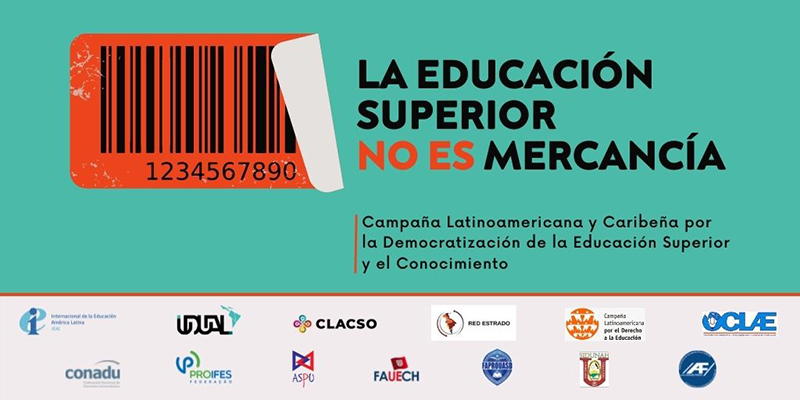
Ver: Higher education is not a commodity
If you would like to receive more information about CLACSO's training programs:
[widget id=”custom_html-57″]
to our email lists.

