
"In the Amazon, they want to turn everything into a commodity."
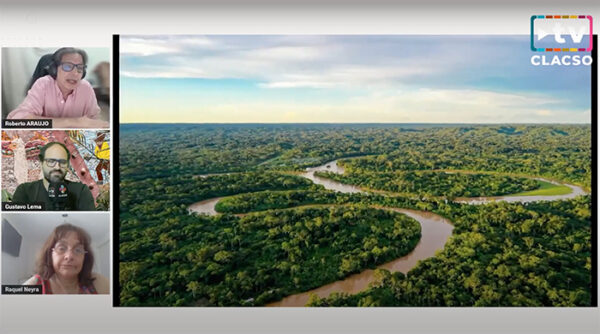
“The Amazon is one of the territories not yet conquered by extractive companies, although they are already entering with great force,” he asserted. InfoCLACSO Raquel Neyra, Peruvian activist and member of CLACSO Working Group on Political Ecologies from the South/Abya-YalaThe Doctor of Ecological Economics argued that the region is suffering an attack from different fronts: legal, political, social and cultural, which in the case of Peru has deepened in recent years.
Roberto Araujo Santos, Anthropologist at the Museu Paraense Emilio Goeldi in Amazônia and member of the same CLACSO Working GroupHe explained that in the Brazilian case, during the 1990s and up to the government of Jair Bolsonaro (2019-2022) there was an attempt by the State to build a socio-environmental model that considers ecological resources and native populations.
“When Bolsonaro took office, there was already an attempt by the state to reduce the rates of forest destruction,” breaking with the tradition of the military regime of the 70s and 80s, but he asserted that this changed again under the former president's administration. According to the researcher, the government took advantage of the pandemic to accelerate deforestation while people were too preoccupied with the health crisis to protest, something the Minister of the Environment at the time was heard to say.
Furthermore, the anthropologist emphasized that under Bolsonaro, a racist discourse against traditional Indigenous communities gained strength. While such discourse already existed, the violence against these populations became justified and legitimized by the state. “This was shocking, because it was the president’s word,” he declared.
Regarding Peru, Neyra emphasized that the political leadership and public policy decision-makers are completely out of their depth. At the time of the interview, the north of the country was still experiencing Cyclone Yaku and the beginning of El Niño Costero, two phenomena partly related to climate change, with devastating consequences. According to the activist, the government did nothing to prevent them, “even though a budget was allocated for it; corruption takes all the money and there is no preparation whatsoever.” She believes the authorities don't care about people's desperation, as long as it doesn't affect them.
Araujo Santos also identified a serious institutional problem, because "locally the people who make the laws and those of the municipalities, the loggers, are exactly the neo-extractivists who are profiting from it."
According to the Peruvian activist, legislation is one of the main fronts in the attack against the Amazon. “They want to modify forestry laws to make land use easier,” she stated. This issue is directly related to the expansion of the agricultural frontier. “Deforestation areas, according to studies by international organizations and the Ministry of the Environment itself, coincide with the expansion of oil palm plantations; and it is also in this area where the highest number of murders of Indigenous people have occurred,” she explained.
In agreement with the Brazilian researcher's remarks, Neyra also addressed the violence against the region's native communities, which is perpetrated even by state agencies. This is the case with the regional government of Iquitos, which seeks to deny the existence of uncontacted peoples, known in Peru as PIACI (Indigenous Peoples in Isolation and Initial Contact), in order to grant logging licenses. "They want to exclude the communities that live there and prevent them from participating, for example, in the management of their own forest, where they have lived for millennia," he asserted.
“The other problem we have is the expansion of drug trafficking,” Neyra added, noting that the classic area of illegal coca cultivation has increased by more than 10.000 hectares in recent years, which has also involved trafficking and land invasions and the spread of a lot of violence.
On this subject, Araujo Santos added that there is a “physical destruction of the populations, because they are removed from the territories to be exploited”, while those who try to resist are killed and others simply join the system, because “everything must be transformed into merchandise”.
Both researchers expressed concern about the co-optation of native populations: “Now there are techniques to convince indigenous peoples themselves to participate in the exploitation,” Neyra warned. “With the story that they will get rich and then be able to own their own land, they are the ones who will ultimately pay the consequences,” he added.
Furthermore, she argued that this brings with it other negative effects on the communities themselves. For example, she explained that to compensate Indigenous populations for the thousands of oil spills in the area, the Peruvian State pays them very large sums of money, unprecedented in the Amazon and unnecessary for their subsistence. “And then, what will that money be spent on in the heart of the Amazon? You can imagine: alcohol, prostitution; all those things that destroy cultures begin to appear,” the activist reflected.
Neyra identified that we are already exceeding the limit of environmental destruction, stating, “Climate change in the Amazon and other areas of Peru, as well as the rest of the world, is confirming this situation.” The researcher added that fewer and fewer people are speaking out against the advance of exploitation, while the majority are either uninterested or too preoccupied with daily life and survival. However, she asserted that “we must continue: Indigenous organizations have excellent proposals for forest recovery, administration, and management.”
Advanced Diploma in Gender and Climate Change
New publication: Recovery with gender equality and climate justice

