
Advanced Diploma in Gender and Climate Change
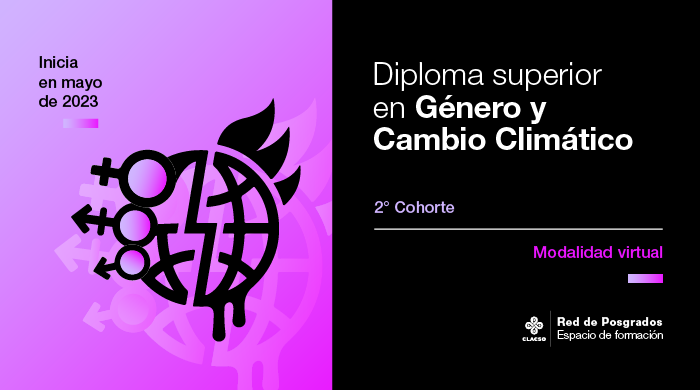
2th Cohort | Virtual Modality
ACADEMIC COORDINATION
Gabriela Merlinsky (University of Buenos Aires, Argentina)
PROFESSORS
Melissa Moreano Venegas (Andean University Simón Bolívar, Ecuador), Diana Carolina Ojeda Ojeda (University of the Andes, Colombia), Denisse Roca Servat (Pontifical Bolivarian University, Colombia), Libertad Chávez-Rodríguez (Center for Research and Higher Studies in Social Anthropology, Mexico), Mina Lorena Navarro (Meritorious Autonomous University of Puebla, Mexico), Margarita Velázquez Gutiérrez (National Autonomous University of Mexico), Miriam Lang (Andean University Simón Bolívar, Ecuador) and Gabriela Merlinsky (University of Buenos Aires, Argentina).
Virtual format | May to September 2023
In Latin America and the Caribbean, the impacts of climate change are intertwined with the effects of economic globalization, resulting in a “triple exposure” process (climate, colonialism, and capitalism) that disproportionately affects women. It is essential to promote a strategic agenda with a gender perspective in both research and policies on climate change. This requires revisiting the conceptual frameworks of Ecofeminism and Feminist Political Ecology, highlighting how women experience different effects of climate change in their care practices and their relationship with the environment and territory, which are shaped by specific historical and cultural processes. Likewise, it is necessary to challenge the dichotomous social and media representations that portray women either as vulnerable victims or as powerful agents of change. To achieve this, it is indispensable to strengthen relational and intersectional gender perspectives, which emphasize the importance of analyzing the power relations that underlie inequality. This diploma aims to contribute to strengthening women's participation by rescuing, highlighting and positioning in training proposals the different situated experiences of women's movements in pursuit of climate justice.
The implications of global climate change are now undeniable and include, among other things, the progressive degradation of environmental conditions, the acceleration of extinction rates, and a very severe impact on the conditions for the reproduction of human and non-human life. This realization compels us to carefully examine the relationships between nature and society, and how these are shaped by power.
The most recent report from the Intergovernmental Panel on Climate Change (IPCC) corroborated the findings of previous reports, with more precise and robust data: the warming of the atmosphere has extended to the oceans and land, and the scale of current changes is unprecedented in the planet's history (IPCC 2021). In recent years, it has also been recognized that pre-existing social inequalities strongly determine or influence the impacts of climate change on human populations. These inequalities produce "more vulnerable populations," with differentiated risks created by social, economic, cultural, ethnic, and gender marginalization.
The field of study known as gender and environment has been particularly fruitful in formulating questions about inequality and in analyzing how humanity has been defined throughout history through the exclusion of the feminine. Inspired by feminist political ecology, ecofeminism, and community feminism, and drawing on diverse materials including academic texts, documentaries, literature, and accounts from climate justice movements, this diploma program seeks to bridge disciplines, activist practices, and advocacy, while also fostering a rich teaching experience at the postgraduate level across several universities in Latin America.
The proliferation and creative expansion of the diverse feminist political ecologies that have emerged from local communities in recent years warrants an explicit development of feminist critique, debate, and praxis. This diploma program aims to contribute to the visibility of gender and environmental issues by rescuing and positioning the various situated experiences of women's movements for climate justice within educational offerings. It is essential to promote a strategic agenda with a gender perspective in both research and policies on climate change. We adopt a critical and decolonial approach that seeks to highlight how women experience the diverse effects of climate change in their care practices and their relationship with the environment and territory, effects that are shaped by specific historical and cultural processes.
This training initiative aims to deconstruct the dichotomous social and media representation of women—which portrays them either as vulnerable victims or as powerful agents of change. To achieve this, it is essential to strengthen relational and intersectional perspectives on gender, which emphasize the importance of analyzing the power relations underlying inequality. It focuses on addressing the situations of discrimination and systematic disadvantage faced by women in socio-economic, legal, and political terms in the face of climate change impacts. Finally, it seeks to build upon previous collaborative experiences among various CLACSO Working Groups and Latin American research networks on gender and the environment, which demonstrate the development of a feminist political ecology. The group of professors who developed this proposal draws on a rich tapestry of feminist practices, situated knowledge production, and participation in leading postgraduate programs in Latin America.
Objective
- To provide perspectives and conceptual tools that allow for a more complex and enriched understanding of climate policy and justice issues from an intersectional perspective, recognizing complex identities that incorporate class, gender, Afro-descendant identity, sexual diversity, sexuality, ethnicity, religion, and colonial legacy (among others).
Specific objectives
- To foster a perspective of convergence between theoretical-epistemological critique and the different expressions of feminisms and ecofeminisms in Latin America and the Caribbean.
- To offer elements that allow the recovery of knowledge networks between activists and academics to give visibility to territories in resistance and the political processes of building proposals for climate justice.
- To contribute to the creation and consolidation of research and postgraduate training networks in gender and climate change.
The Higher Diploma in Gender and Climate Change is aimed at undergraduate and postgraduate students; teachers at all levels; activists and members of trade unions, social movements and political parties; public officials; members and managers of non-governmental organizations and professionals interested in the subject.
- Melissa Moreano Venegas (Andean University Simón Bolívar, Ecuador)
- Diana Carolina Ojeda Ojeda (University of the Andes, Colombia)
- Denisse Roca Servat (Pontifical Bolivarian University, Colombia)
- Libertad Chávez-Rodríguez (Center for Research and Higher Studies in Social Anthropology, Mexico)
- Gabriela Merlinsky (University of Buenos Aires, Argentina)
- Lorena Navarro Mine (Meritorious Autonomous University of Puebla, Mexico)
- Margarita Velázquez Gutiérrez (National Autonomous University of Mexico)
- Miriam Lang (Andean University Simón Bolívar, Ecuador)
The program consists of weekly classes organized into 4 modules, each taught consecutively and linked to the others.
Total workload of 128 hours.
The modules that comprise the Higher Diploma are:
CLASS 1: Climate Policy
Teacher: Gabriela Merlinsky
Thinking about the climate crisis and collapse from a political ecology perspective. Climate change and climate policy. Latin American and Caribbean perspectives. National and local climate change policies: Adaptation and mitigation. Some critical reflections on the concept of adaptation. Capitalocene, Anthropocene, Chthulucene: their contribution to the debate on climate justice from a gender perspective.
CLASS 2: Climate change and social inequality. The intersectionality between gender and other forms of difference and inequality
Teacher: Libertad Chávez Rodríguez
This paper explores the links between climate change, social and gender inequalities, and intersectionality: the impacts of the ecological and climate crisis as measured by differences in gender, class, race, and location. It presents research findings and case studies related to access to resources, health, migration, climate change-related disasters, social conflict, and participation in global climate change negotiations. It also discusses the differentiated contributions of gender and social inequalities to greenhouse gas emissions. The importance of considering gender and the intersectionality of gender with other categories of social differentiation and inequality in global climate change research and policy is emphasized.
CLASS 3: Climate Summits and Counter-Summits
Teacher: Melissa Moreano
We will briefly review the history of the UNFCCC and the turning points that explain the impossibility of establishing genuine agreements within the framework of global geopolitics. We will analyze the shift in international climate change policy. The class will also examine the strategies, demands, and solutions put forward by climate justice organizations. We will present climate action strategies and proposals that confront fossil fuel capitalism, as well as their feedback loops with proposals for food and territorial sovereignty, in defense of local practices, cultures, and economies, and for decent working and living conditions.
CLASS 4: Mainstreaming the gender approach in the United Nations Framework Convention on Climate Change (UNFCCC)
Teacher: Gabriela Merlinsky
Gender mainstreaming in the UNFCCC. Timeline on gender equality and rights. Incorporation of gender criteria and indicators in international negotiations. Gender and Climate Change Action Plans (GCCAPs). Implementation of GCCAPs at the regional level and in different Latin American countries.
Class 5: Round Table: The power of environmental feminism today
Teacher: Gabriela Merlinsky
CLASS 6: Keys from the perspective of interdependence to continue addressing the problem in the face of civilizational ecological collapse
Teacher: Mina Lorena Navarro
In this session we will present some partial syntheses cultivated from the Research Space “Community Networks and Forms of the Political”: 1) the perspective of Interdependence as a political challenge and ecological condition; 2) how the Scandalous Thing reorganizes the fabric of life to dispossess and exploit the labor and energy of human and more-than-human natures; 3) the approach to social antagonism and the dispute that the struggles for the commons in Latin America undertake to defend life and manage interdependent relationships in contradiction with the terms of co-production of the Scandalous Thing; and 4) the dispute of narratives, diagnoses and exercises of cognitive liberation to continue with the problem.
CLASS 7: Gender, environment and social reproduction
Teacher: Diana Ojeda
In this session, we will address some of the most relevant aspects of the dialogue between Political Ecology and Feminisms, such as the notion of interdependence as a condition for the reproduction of human and non-human life. We will also analyze some of the forms and content of women's leadership in the struggle for and defense of life in contexts where extractive regimes have intensified capitalist-colonial and patriarchal violence against bodies and territories.
CLASS 8: Gender, extractivism and environmental conflicts
Teacher: Gabriela Merlinsky
The forms of extractivism and neo-extractivism in Latin America: their impact on women's bodies. Drivers of climate change in relation to extractivism. Women in environmental conflicts. Bodies, territories, and the productivity of environmental conflicts.
CLASS 9: Round table: Climate Justice and feminist political ecologies from the territories.
Teachers: Gabriela Merlinsky and Melissa Moreano
CLASS 10: The notion of Care as a central social function
Teacher: Margarita Velázquez Gutiérrez
This session analyzes care as a central social function. Throughout human history, the development of activities encompassed by this concept has been central to the functioning of all human societies. Thus, care, which includes all the tasks of social reproduction carried out daily (domestic work, both paid and unpaid, and care for oneself and others), is a fundamental concept for explaining climate change and the impacts of its associated phenomena from a gender perspective. Various disciplines, such as history, sociology, and economics, have demonstrated how care has varied throughout human history according to different modes of production. Currently, the capitalist/extractive mode of production requires, for its continuity, forms of social organization that allow it to persist, maintaining patterns of capitalist accumulation (the so-called Capitalocene) structured under specific social relations of gender and power. This analytical perspective on care aims to make visible and understand that climate actions (mitigation and adaptation) must be implemented without contributing to maintaining the prevailing forms of care that directly affect the maintenance of the current gaps in social and gender inequality observed in Latin America and the Caribbean.
CLASS 11: Ecofeminist tensions surrounding care
Teacher: Margarita Velázquez Gutiérrez
The session examines debates on gender and the environment, in which essentialist and biological arguments frequently appear, assigning women the role of “natural caretakers” of their environments. It addresses the early texts of so-called “Ecofeminism,” which posit that women are closer to their environments, to nature, thus assuming a false dichotomy of culture and patriarchy versus nature and women. Around these arguments, a false vision is constructed regarding the social role of women as “caretakers,” including of their natural environment, simply by virtue of their biological nature.
In response to the above arguments, this paper also examines constructivist perspectives from other feminist authors, who argue that the ways in which natural and social resources are accessed, used, managed, and controlled are socially determined according to the norms of the social and sexual division of labor. This latter perspective is central to understanding how this division shapes women's relationship, in different contexts and territories, with their natural environments, both for their care and their defense.
CLASS 12: Climate Change Adaptation and Mitigation Policies from the Perspective of Climate and Gender Justice
Teacher: Libertad Chávez Rodríguez
The socio-political component of adaptation practices and the lack of gender-sensitive translation of measures. A gender-sensitive deconstruction of the concepts of adaptation, vulnerability, and resilience. Strategic critical feminist perspectives in climate change research and policies with a gender perspective.
CLASS 13: Climate regeneration and multi-species studies
Teacher: Denisse Roca Servat
It is crucial to know, understand, and promote interspecies care practices that contribute to the regeneration of life on the planet and to climate justice. Multispecies studies highlight the need to integrate historical, situated, feminist, and neo-materialist approaches for a better understanding of socio-ecological processes. From this perspective, an attempt is made to break down the division between the natural and the cultural, and to pay attention to the ways in which humans and non-humans mutually constitute each other through constant relationships. The serious civilizational crisis, due to the anthropocentric exceptionalism on which it is based, has motivated the emergence of this approach, which seeks solutions to the current crisis through creative and innovative methodologies such as artistic methodologies, and the use of diverse narratives such as science fiction, essays, and poetry.
CLASS 14: Political advocacy for water justice and climate justice
Teacher: Denisse Roca Servat
Ecological injustices and alarming socioeconomic inequality demand new paradigms of knowledge, methodologies, and ways of understanding politics and the political sphere. In this context, it becomes essential to develop diverse and novel repertoires for political influence and to co-create sustainable futures. This class will discuss different forms of political mobilization, from the most everyday to the development of public policies, including engaged research methodologies such as Participatory Action Research (PAR).
CLASS 15: Climate Justice Perspectives from Latin American Feminisms. Closing Activity
Teachers: Miriam Lang and Melissa Moreano and Coordination Team
In this session we will present some partial syntheses cultivated from the Research Space “Community Networks and Forms of the Political”: 1) the perspective of Interdependence as a political challenge and ecological condition; 2) how the Scandalous Thing reorganizes the fabric of life to dispossess and exploit the labor and energy of human and more-than-human natures; 3) the approach to social antagonism and the dispute that the struggles for the commons in Latin America undertake to defend life and manage interdependent relationships in contradiction with the terms of co-production of the Scandalous Thing; and 4) the dispute of narratives, diagnoses and exercises of cognitive liberation to continue with the problem.
| In one payment by 22/05 | In one payment after 22/05 | Payment in 3 installments | |
| CM Pleno | $175 | $230 | USD 315 (3 x USD 105) |
| CM Associate | $300 | $360 | USD 540 (3 x USD 180) |
| No link | $300 | $360 | USD 540 (3 x USD 180) |
To participate, you must register using the online form by clicking here. Registration will be open from March 6 to May 29, 2023.
Upon completion of the registration process, you will receive a confirmation in your email.
Classes will begin in May and conclude in September 2023.
All registered participants will receive the necessary instructions to access the classes, bibliography and discussion forums through the CLACSO Virtual Training Space.
Accessing and navigating the Virtual Learning Environment is very simple and user-friendly. In any case, a technical and academic support team will always be available to you.
Exceptional Criteria: In exceptional cases, and within the first month of the start of the Advanced Diploma program, students may request to withdraw from the cohort and rejoin the following year. In all cases, the reasons for the request must be submitted in writing. After this initial period, no requests will be accepted.
Money paid will only be refunded in cases where the organizing institutions decide to cancel the activity.
| In one payment by 22/05 | In one payment after 22/05 | Payment in 3 installments | |
| CM Pleno | $175 | $230 | USD 315 (3 x USD 105) |
| CM Associate | $300 | $360 | USD 540 (3 x USD 180) |
| No link | $300 | $360 | USD 540 (3 x USD 180) |
Payment can be made in one installment by credit card, bank deposit, or bank transfer. We also offer the option of paying in 3 installments.
Yes. There will be discounts for students belonging to CLACSO Member Centers and CLACSO Associated Centers, for CLACSO Associate Researchers, and for all those who pay within the discount period.
Inquiries: WhatsApp: +54 9 11 3880 – 1388
Email: [email protected]

