
The triumph of the Annulo and the interest in silencing him
Pelao Carvallo*
Election results are statistics and a game of rhetoric useful to the political needs of those who produce them. Post-election political analyses are not gratuitous; they form part of that same utilitarian discourse, and this latest statistic—the elections to appoint members to the 2023 Constitutional Council (CC2023)—is a recurring example of this.
A constituent process to close a revolutionary cycle (since the November agreements)
The 2023 Constitutional Convention elections are a core part of the strategy designed since November 2019 to channel, co-opt, direct, and ultimately kill the revolutionary cycle that began in October 2019. This strategy has a guiding principle: the maintenance of institutional order [1] , which explains the political maneuvering carried out by the Chilean political elite to sustain the Piñera II government until the end of its formal term. It also explains the continued presence of the Director General of the Carabineros, who led the lethal repression of the social uprising that began in October 2019. Other aspects of this strategy involved exchanging Pinochet's Constitution for the electoralization of the revolutionary process, which would facilitate its institutionalization and the maintenance of the institutional electoral calendar to reinforce the channeling of revolutionary forces and energies and dissipate them through the erosion of electoral discourse [2].
One possible outcome was having to accept a Constitution produced by an apparatus (the 2021-22 Constitutional Convention) heavily influenced by the assembly-based approach (despite not being called a Constituent Assembly), the anti-authoritarianism, and the anti-party sentiment of the October uprising—in short, a constituent body overly influenced [3] by feminist, anarchist, environmentalist, and indigenous movements, among others. Therefore, a better option for this strategy was the defeat of a constitutional proposal still too audacious for the establishment of power within the Chilean state, despite the text's apparent timidity regarding the central aspects of the Chilean economic, social, ecological, and territorial model.
The Boric government, which emerged from the votes of those who supported the revolutionary process [4] (the votes of the “November movement” were not enough) pursued a policy of detachment and defeatism towards the 2022 constitutional proposal, made effective by a) the direction given to the government bloc in the campaign for Approve and b) in making mandatory [5] a vote that, in terms of its scope, was already universal with respect to Chilean citizens, which implied bringing to the electoral arena an uncertainty convenient to the “reject” option already led by the new Chilean right.
The defeat of the constitution would mean the defeat of the revolutionary sector, in reality the only fear of the wealthy class in Chile. This revolutionary sector, which had placed Boric in government by voting against the right-wing Kast, had critically associated itself with the constitutional proposal, although in symbolic political terms that association was close. The second part of the strategy, then, was to manage the defeat of the constitutional proposal, distancing it from the government and proposing a new constituent process tailored to a Chilean Congress still stuck in the past. Thus emerged a senatorial constituent process, curated by a design body (the committee of experts) and moderated by a certification body (the Technical Admissibility Committee), barely retaining the parity criterion of the previous process. All influence of the revolutionary process on the constituent institutions was erased, replaced by a conservative one.
The emotional politics of the 2023 Constitutional Council elections
The task of burying the revolutionary process did not end with the defeat of the "approve" option in the 2022 exit plebiscite. The revolutionary sector had made it clear that it was reluctantly participating in the "approve" vote, given the mediocre, timid, and systemic nature of the proposed constitutional text. Another sector, more anarchist than anything else, opted to call for abstention in a scenario of mandatory voting, an obligation reinforced by a heavy economic penalty. It was therefore necessary to move to a third stage of the strategy to control (until the disappearance) of the revolutionary process.
This third stage involves making the revolutionary position regarding the new constitutional process invisible and, on the part of the Boric government, articulating a broad institutionalist framework that differentiates itself from the extremes: Kast's right wing on one side and the October rebellion on the other. Kast is therefore very convenient, as he can be presented as a right-wing extremist against whom the "30 years" can and should unite with the Boric government to defend a democratic, capitalist, and liberal institutional framework, as in the "30 years," but without Pinochet's constitution.
This is why the Boric government has interpreted the election result as a defeat [6] , despite it not being one (at least not for the government) and acknowledging the overwhelming victory of the far right (which wasn't overwhelming). This allows it to stoke, on the one hand, the triumphant rhetoric of intolerance from the Kast sector, which serves to scare off the old right from forming alliances with that bloc and to view favorably a constitutional alliance with a "defeated" and dependent government, easy to manipulate. Boric's defeatist discourse is useful as an emotional tool for the Chile Vamos/Seguro right wing in its call for a de facto alliance to draft a constitution without extremes and to be published with Gabriel Boric's signature this same year. In this emotional politics, blaming the defeat is a dart that, if well aimed, can be highly effective. On the one hand, not blaming the former Concertación (reduced to the Christian Democrats, the Party for Democracy, and the Radical Party) helps maintain the bridges built with the right wing of the "30 years" in Congress to operationalize a constituent alliance. On the other hand, blaming the "Cancel" vote has the advantage of channeling self-inflicted frustration, provoking a draining conflict for revolutionary sectors, and breaking the ties that the "Approve" movement still maintains with the "Cancel" movement.
Defeat (and its threat) is what the institutionalist government of Boric manages best, and with it it allows itself to attack those who want more and not less.
The responsibility for the governing bloc's poor performance in these elections lies with the former Concertación coalition, which opted to run its own list. That much is clear and obvious. But blaming that sector is not appropriate, since it is not only also part of the government, but it would also fail to fulfill the useful function of further diminishing the influence of the revolutionary sectors represented by the Anulo party. Emotional politics involves directing that (internal) frustration toward conflict that disrupts and silences the Anulo party; the goal is to neutralize the Anulo party.
The triumph of the Annulo and the difficult task of silencing him
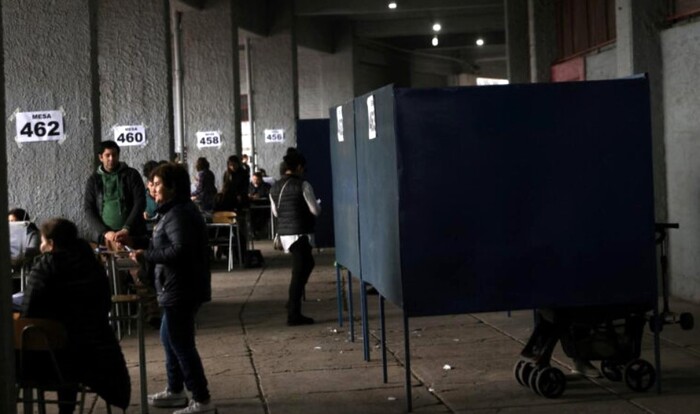
The numbers are clear: invalid votes, blank votes, and non-participation far outweigh all other options, with each of these possibilities increasing compared to the previous mandatory voting, both numerically and proportionally. Specifically, the growth of invalid votes was spectacular: from 1.54% in 2022 to 16.98%. This time, more people decided not to vote, despite state penalties; more people decided not to express any opinion; and many more people decided to invalidate their ballots. In total, almost 5 million people refused to be part of a process imposed from above for the benefit of those at the top [7].
This absolute majority had a very strong and clear voice. A surprisingly precise campaign in its content and approachable in its presentation. A winning campaign, in short. It built upon the knowledge gained from the 2022 Annulment Campaign [8] , almost exclusively anarchist, and expanded upon it: a multiplicity of voices and spokespeople, no central direction. Multiple perspectives on the issue, represented by the statistical possibilities offered by the process: annulling, abstaining, leaving a blank ballot.
Committed to the strategy of political annihilation of the revolutionary process that erupted in October 2019, the press attempts to silence this victory by hiding behind the statistical nature of the null vote: it is a possibility, not a name with a surname, not a candidacy to be captured as part of the institutionalist narrative. Therefore, the response has been to silence this victory of the null vote in various ways, from ceasing to mention it or considering it a statistical anecdote, to persistently denying it unity, coherence, and political direction, even by the most alternative analysts [9].
The President said what everyone clearly understands: that this constitutional process is a dirty business from which the same people as always profit (ah! How the shares of Chilean companies rose the Monday after the elections [10] !) that aims to give us another 30 years that will be the same but with a new right wing to replace the old one and a new coalition to replace the one that is dying, not as slowly as they would like.
The political capacity represented in the Anulo is in a true commitment to the economic, sociocultural and ecological situation of the people and territories that make up Chile, a commitment that is made effective in instances of direct and community action [11] , of class pride and identity, of solidarity and affection, thousands of organizational experiences that have not waited for anything from the State to solve what the State, Capital and patriarchy produce: a permanent plunder legalized through their constitutions.
That the "Annulment" option is included in the "Reject" campaign for the 2023 exit plebiscite is logical and without any contradiction. Pinochet's constitution and the transition it established are already defunct. They fell in October 2019, and although they remain in place under an institutional guise, it is precisely this institutional framework that is struggling to change its appearance without trauma and without giving space to the revolutionary process. For this very reason, the Boric government will not easily join the "Reject" campaign; it will try to salvage the "boring" process at all costs.
*Member of the CLACSO Working Group on collective memories and resistance practices.
[1] Source of my accounts: Servel https://www.servelelecciones.cl/#/participacion/pais/8056 (the Chilean electoral service)
[2] https://www.elciudadano.com/columnas/chile-voto-y-anarquismo-una-opinion-proactiva/05/07/
[3] https://www.desdeabajo.info/actualidad/internacional/item/chile-y-el-giro-reaccionario-del-proceso-constituyente.html and https://www.youtube.com/watch?v=8FSvKZt1qCw among many
[4] https://www.df.cl/mercados/bolsa-monedas/bolsas-hoy-mepce
[5] https://www.clacso.org/la-primavera-andina-florece-en-pandemia/
[6] https://www.elmostrador.cl/noticias/pais/2023/05/08/presidente-boric-pide-a-republicanos-no-ser-partisanos-mientras-su-coalicion-aparece-muy-disminuida/
[7] https://www.elciudadano.com/chile/chile-capitalismo-contra-neoliberalismo/01/20/
[8] https://www.elciudadano.com/chile/analisis-anarquista-del-momento-plebiscitario/09/09/
[9] https://www.clacso.org/la-influencia-anarquista-en-constituyente-en-chile-analisis-con-ojos-acratas/
[10] https://www.clacso.org/chile-sus-pueblos-y-el-placer-de-derrotar-a-un-facho/
[11] https://www.elciudadano.com/columnas/chile-contra-la-rebeldia-antielectoral-el-voto-obligatorio/06/18/

