
“The French state proposes to reduce social security and public services”
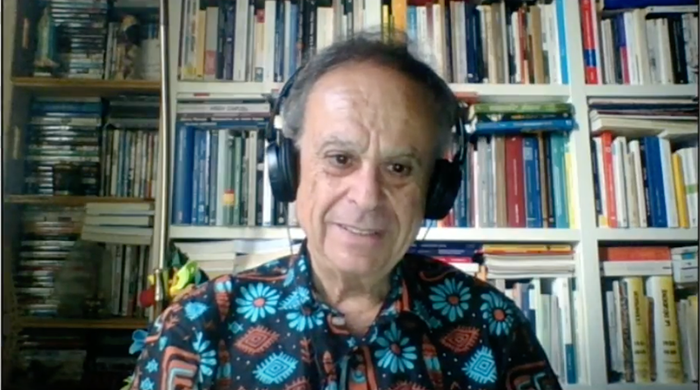
In the InfoCLACSO of May 31, 2023, «The right to social security"He spoke with CLACSO.tv Jeans Jacques Kourliandsky, Director of the Latin American Observatory of the Jean Jaurés Foundation in Paris on the reform of the pension law in France.
To try and draw some comparisons with other mobilization processes that have occurred in the past, understanding that the demonstrations in France are very strong at both the union and popular levels, what do these street mobilizations imply? Specifically, what has happened recently in France, and why have the streets erupted so strongly against this reform by decree that raises the retirement age?
– It was a brutal reform, but not by decree. The French Constitution has the peculiarity of allowing a great deal of leeway to make decisions without the weight of Parliament. In the Constitution of the Fifth Republic, which has quite a history, there is an article, 49.3, that was used countless times in the past by many governments when they were in trouble.
It was brutal because it was an unnecessary measure. The system is balanced, and people are happy with it as it is. The fight is still going on in the streets and in Parliament. There was a bill proposed by a parliamentary group to overturn the law, arguing that it had to be repealed, but that can't be done in the coming weeks. The proposal was rejected using another article of the Constitution, Article 40, which states that Parliament cannot propose a law that would impose an additional financial burden on the government. We now have the figure for this burden: it would be 5 billion euros.
Since the system is balanced, this means that the government's objective, which did indeed foresee a likely deficit over a three- or four-year period, doesn't currently exist. But the government needs money because President Macron, since taking office, has prioritized a supply-side rather than a demand-side economic policy, which involves giving tax breaks to businesses. Therefore, the state budget is running a deficit. This is partly due to the pandemic, but also partly due to these tax breaks given to companies. Furthermore, the government has a project to boost climate action by supporting certain companies working on this issue. So, this seemed like one of the quickest paths to take.
It's important to remember that this movement follows another, more recent one, from 2018/2019, during Emmanuel Macron's first presidency: the Yellow Vest movement. This movement comes after further cuts to the state budget, replacing civil servants with digital ones: closing post offices, tax offices, schools, and small hospitals. This is done by telling people that a small hospital can't provide adequate care, so they have to go to a hospital 30 km away, or that paying taxes and other paperwork can be done online.
At a certain point, people begin to realize they're in a kind of trap, and that what the State is proposing is to dismantle everything that was achieved between 1933, under the first Popular Front government, and 1945, after World War II. There was a program back then that created social security, that created the entire welfare state system in France, and which other presidents, but especially this one, are dismantling by disguising it with the word 'reform.' People now understand this as losing certain rights and the quality they once enjoyed. So, the current struggle is situated within this context. It's not something to be examined in isolation, but rather integrated into this global movement to dismantle the state. Every day we read about new developments, such as the progressive privatization of the Paris transport system.
– This path you're describing sounds like the standard neoliberal playbook anywhere in the world, doesn't it? Reducing the size of the state and transferring money from the working class to the business sector. It seems like the playbook we saw in many parts of Latin America as well.
Yes, it's the Washington Consensus that's spreading to almost every part of the world. But we have a particular nuance: we have a Brussels Consensus in Europe. By this I mean that the state of 2023, whether French, German, Italian, or Belgian, is not the state of the 50s. We are bound by rules—sometimes called the European Constitution—that stifle any genuine progressive alternative initiative from member states.
This translates into a loss of democratic substance from the moment, for example, they can no longer devalue the currency. Because it's a currency controlled by an independent central bank, as are tariffs. We also have rules that prevent states from having a deficit, inflation, or debt exceeding certain levels, all monitored by the European Commission. And the Commission tells states, when they deviate from the established guidelines, that they should change their policies.
So we're in a system under the Brussels Consensus, which makes it much harder to imagine other progressive alternatives when you have rules that progressively reduce the chances of a real alternative. This helps explain the violence of some demonstrations, from the Yellow Vest protests in 2018 and 2019 to the recent violence and large numbers of protests against pension reform.
Along this path, we have seen that, faced with hopelessness and the discrediting of politics, the right and far right are gaining ground. We saw this in several places in Latin America with considerable force and at a worrying level. Do you understand that behind these measures, French society is shifting to the right, or did the protests allow us to understand how conservative sectors transfer power to those in positions of authority, distributing money, and that this leads to a deeper debate about how the right, in many cases, ends up transforming these measures into the removal of benefits within democracies?
The political and social consequences of the movement, which continues—there is a demonstration, the 14th, planned for June 6, and the opposition in Parliament remains mobilized—are twofold. The first: unlike the Yellow Vest movement, which had no leader, no structure, no organization, and disappeared as suddenly as it appeared, this movement was unexpectedly channeled by the labor movement.
Traditionally, the French labor movement is divided. There are three major unions: the CGT, historically linked to the Communist Party; the CFDT, of Christian Social origin but self-managed, with a different culture; and Force Ouvrière, a splinter group from the historic CGT formed during the Cold War. These unions have always had difficulty coordinating. In this instance, they formed an Inter-Union Council, organized demonstrations that clearly captured the people's demands, and agreed to dialogue with government representatives to explain their position. The government tried to divide them; it was unsuccessful.
And these demonstrations were peaceful. Violence is another, less common, issue, brought about by anarchist groups at the end of the union demonstrations. Then, polls were conducted at the end of the first phase of the protests: 58% of the French population approved of the Trade Union Movement, which clearly articulated what the people wanted and also adopted a democratic strategy: protesting in the streets, but without violence, organized, and willing to engage in dialogue with the government. Without making concessions, but engaging in dialogue to say, “No, we want something else.”
Politically, at a general level, support for political parties is at 14%. And the only party, the only personality, that emerges strengthened from the movement is the leader of the National Front, Marine Le Pen. As you said, this isn't specific to France; Sweden has a far-right government, as does Italy, and in the last local elections in Spain, the traditional right gained significant ground, as did the far right with Vox. This is the consequence of the left's failure to respond to the Brussels Consensus.
The identity of the left in European countries shifted to societal issues, the LGBTQ+ community, environmental problems, and discrimination, neglecting social issues because they don't know how to maintain what people already have. Therefore, the only ones who at least verbally say "all this has to stop" are the far-right parties. In France, they've uniquely placed issues of immigration, discrimination, and migrants behind a veil called national preference. And they've captured the votes of traditional communist or socialist voters.
Marine Le Pen's main strongholds are northern and eastern France, the former industrial regions hit hard by the crises of recent years. She has thus emerged as a champion of the people's rights by sidelining the traditional far right, which was represented by the historic National Front.
The political landscape is obviously very complex, but it doesn't seem too different from what's happening in other parts of the world. If you had to do a longer-term analysis, 55 years after May '68, what's the common thread you find in the street protests, the social mobilization, and the impact of these issues? And what lessons from May '68 can be learned to reflect on the present?
It was a different context. In '68, there was a nationalist, patriotic right wing with De Gaulle, which had a sense of nationhood, of the state, that has since disappeared. I would say it's symbolic that, to make people forget this whole movement, the President's party passed a very curious law, one that nobody asked for, which requires all municipalities with around 1000 or 1500 inhabitants to display the European common market flag on the facades of their buildings. This reflects the social conflict that exists in France. There are those who are comfortable with globalization and those who practice what is called social separatism, which is an increasingly serious problem among the upper classes, who send their children to private schools to separate themselves from the children of migrants or from people of lower socioeconomic status.
We are in a context that didn't exist in '68, where there was still a strong public service and state presence. Now we are in a different moment, especially after the expansion of the common market and the European Union, with different definitions.
I would say that the best definition of what is happening in Europe now was given by US Secretary of Defense David Rumsfeld in 2003, when France, Germany, and Belgium rejected the US invasion of Iraq at the UN Security Council. That is going to change; it's the old Europe. With enlargement, a very different new Europe will emerge. The left, unlike in the 70s, has no vision; it is completely paralyzed by the obstacle of laws that prevent any form of alternative that would also represent a real change—not just a change of faces, but a genuine transformation.
People are starting to see it now. In last year's parliamentary elections, there was a 53% abstention rate. Because people realize that we're going to elect representatives who have a very nice car with a good steering wheel, but no engine: the engine is in Brussels. So, this fosters an ever-widening gap between the voters, the people, and the authorities. Who are the authorities? They are the multinationals, the European Commission, which retains the power to pull the strings, and the representatives we are asked to elect. That's why the current government crisis is also a crisis of democratic governance.
Finally, Europe today seems trapped in a very complex situation, deeply dependent on energy issues, but also embroiled in an armed conflict. And it's very difficult to escape. What is Europe's situation, after everything you've told us, in the context of the conflict in Ukraine?
– At one point, with Donald Trump, Europe had a window of possible autonomy. Trump had decided to withdraw his troops from Europe to focus on the conflict with China. With Biden came a different kind of policy. He returned to Europe through the conflict between Russia and Ukraine and managed to NATO-ize it. Two European Union countries that had allowed Europe a degree of external autonomy, Finland and Sweden, have now applied for NATO membership. There are two European countries that are illiberal: Hungary and Poland. Nothing is being said about it.
The conflict generates many contradictions. The only winners in this conflict are China and the United States. In the case of Europe, the United States, which managed to regain control of the small degree of autonomy Europe had achieved. Now, the gas and oil that Europe used to buy from Russia, it buys partly from the United States. Military autonomy disappeared with the integration of Sweden and Finland into NATO. And European armed forces buy a lot of military equipment from the United States. Last week, Germany announced it would buy 50 helicopters. Half a dozen European countries purchased 75 aircraft. And there is much less talk about a defense aircraft project using European technology.
To those who say that Europe is strengthened by this conflict: no. Europe is fulfilling David Rumsfeld's 2003 prophecy. Increasingly subordinate to the United States—militarily, of course, but also economically. The media debates surrounding this conflict are very weak. There's more talk about weaponry, about whether the German tank is better than the American or Russian one, than about why this very dangerous war is happening and how to get out of it. Because Russia is a state with a very strong nuclear arsenal, and we have a risk of escalation. So, how do we stop this?
Some African and Latin American countries are trying to reach an agreement: proposals for dialogue, but these have no chance of coming to fruition at the moment. From what we can see, the United States decided that the pressure had to be maintained. And Russia, for its part, doesn't want to withdraw from the part of Ukraine it invaded.
Interviewed by Gustavo Lema.
Feminisms, work and trade union action: dialogues between Europe and Latin America
If you would like to receive more information about CLACSO's training programs:
[widget id=”custom_html-57″]
to our email lists.

