
Advanced Diploma in Reconfigurations of Work in the Contemporary World: Subjects, Processes, and Legal Frameworks. A Comparative Perspective
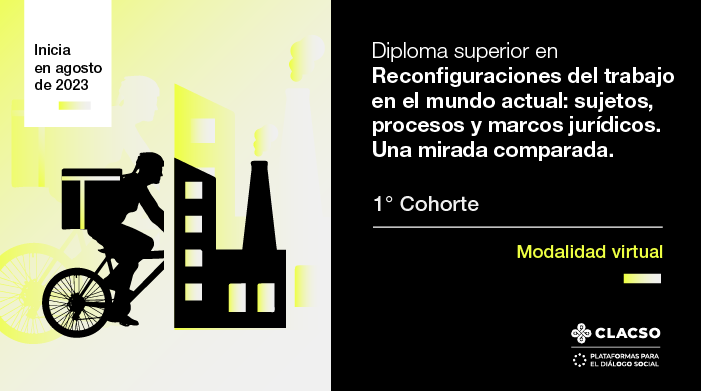
1th Cohort | Virtual Modality
ACADEMIC COORDINATION
Nora Judith Goren (National University of José C. Paz and National University of Buenos Aires, Argentina) and Adoration Guaman Hernandez (University of Valencia, Spain)
PROFESSORS
Antonio Baylos Grau (University of Castilla-La Mancha, Spain), Adoration Guaman Hernandez (University of Valencia, Spain), Nora Judith Goren (National University of José C. Paz and National University of Buenos Aires, Argentina), Nicholas Dzembrowski (National University of José C. Paz, National University of Buenos Aires and CONICET, Argentina), Sayonara Grillo (Federal University of Rio de Janeiro, Brazil), Cayetano Núñez González (University of Valencia and University of Talca, Spain), Raúl Lorente Campos (University of Valencia, Spain), Johanna Maldovan Bonelli (National University of José C. Paz and CONICET, Argentina), Elisa Lanas Medina (Andean University Simón Bolívar – Ecuador Headquarters), Andrés Boix Palop (University of Valencia, Spain), María Rosaria Barbato (Federal University of Minas Gerais, Brazil), Guillermo Gianibelli (University of Buenos Aires, Argentina), Soledad Stoessel (CONICET and National University of La Plata, Argentina), Hugo Barretto Ghione (University of the Republic, Uruguay) and Nasser Ahmad Allan (Federal University of Rio de Janeiro, Brazil)
Virtual format | August to December 2023
The Diploma in “Transformations of Work in the Contemporary World: Subjects, Processes, and Legal Frameworks” is a training program designed to create a space for study, reflection, and debate on the world of work from a multidisciplinary perspective. Its fundamental objective is to offer an analysis of the main transformations in work, combining sociological, economic, and legal analysis. To this end, over five modules and with the guidance of 15 professors, participants will compare normative models, subjects, and processes of change occurring in various Latin American and European countries. The Diploma is geared towards individuals interested in the world of work from the perspectives of research, academia, government institutions, social organizations, or unions. The methodology is based on ongoing dialogue among professors from diverse fields of expertise. The program's structure facilitates participation by allowing for flexible scheduling tailored to individual needs.
Work and its transformations have been a recurring theme in the social sciences since their inception. The changes occurring in the world of work stem primarily from technological shifts, particularly digitalization and automation, the global productive reconfiguration marked by processes of decentralization and offshoring, and an ever-increasing trend toward capital concentration.
Work today constitutes one of the main drivers of inequality in the world. The number of people engaged in activities outside the formal employment contract has increased, generating value under miserable working conditions, with high risks to their lives and incomes insufficient for basic needs. Furthermore, a substantial portion of those who remain in employment are increasingly affected by various forms of job insecurity. This inequality in income distribution translates into low wages and compensation for the workforce, extending not only in Latin America and the Caribbean but also to all labor systems worldwide. Moreover, understanding work today requires analyzing all of the above alongside the renewed "great threat" that, according to some literature, looms over wage labor, prophesying its demise. We are referring, of course, to widespread automation or robotization and its differential impact according to class and gender.
All these issues permeate current reflection on work, and the concern regarding its configuration, modes of organization, conditions, representation, and regulation is constitutive of social thought and occupies a central place in academic, political, and legal debate. This highlights that political practice (in the broadest sense) in contemporary societies largely revolves around work, with common ground for debate and action in the form of fundamentally important public policies. Even though the reality of work and its transformations is largely defined by national contexts, it is undeniable that the current moment of globalization reveals common problems and transformations. Therefore, it is necessary to develop both comparative analyses and proposed solutions, particularly labor regulations, that stem from debate and an understanding of the diverse realities present in Latin America and Europe and that propose common solutions. Similarly, the analysis of social mobilization and the organization of the collective subject of labor beyond state borders is evident as a necessary step so that the balance of power with a transnational antagonist can give rise to fruitful negotiation scenarios that allow for the adequate protection of workers.
In addition, there are new and common problems, linked to the sustainability of life, the rights of the Planet, the fight against gender inequalities and against expanding phenomena such as modern slavery, which undoubtedly require joint analysis and action, not only between countries but, in particular, in the field of supranational organizations, both regional and international.
Above all, this course aims to analyze, review, and critically examine the changes and potential futures of work, reflecting the accelerated transformations it has undergone in recent decades. It seeks to train participants to act as agents of social transformation in the socio-labor sphere, whether through collective action, the promotion of public policies, regulatory guidance, or work within international institutions and organizations, so that achieving decent work becomes a reality in Latin America and the Caribbean.
GENERAL PURPOSE
- To provide a situated critical analysis of the transformations of work in different countries of Latin America and the Caribbean and Europe, from the point of view of the subjects, the collective actors involved, the comparative legal models and their evolution, in order to offer a theoretical framework that allows thinking and designing public policies aimed at achieving decent work.
SPECIFIC OBJECTIVES
- To promote a space for analysis on the reality of work in Argentina, Colombia, Ecuador, Brazil, Chile and Spain from a sociological perspective.
- Analyze the legal and labor frameworks of the aforementioned countries, paying particular attention to the most relevant issues at present, such as platform work, informal work, and gender discrimination, but also addressing classic issues that remain fundamental, such as the regulation of labor contracts, dismissal, and collective bargaining.
- To offer a diachronic perspective on the evolution of labor markets in the aforementioned countries, in order to comparatively assess the points of convergence and divergence between them and to enable the formulation of common solutions.
- Study the labor reforms of the chosen countries from a historical perspective, assessing the political moment, the content, the responses of social actors and their effectiveness and impact on the well-being of working people.
- To equip students with the necessary tools for the design of socio-labor advocacy positions or legal-labor public policies, at the national and supranational levels.
- To analyze the performance of international and regional organizations with an impact on the world of work, to assess their performance from a critical perspective, and to propose initiatives that can be developed from a supranational point of view.
- To strengthen students' abilities to search for and use resources that allow for the analysis and study of the labor market.
The Advanced Diploma in Reconfigurations of Work in the Contemporary World: Subjects, Processes and Legal Frameworks. A Comparative Perspective is aimed at undergraduate and postgraduate students; teachers at all levels; activists and members of trade unions, social movements and political parties; public officials; members and managers of non-governmental organizations and professionals interested in the topic.
The program consists of 5 modules of 3 weekly classes each, taught consecutively and linked together.
Total workload of 128 hours.
The modules that comprise the Higher Diploma are:
Class 1: Work and its transformations
Teacher in charge: Antonio Baylos Grau
Conceptual summary of the class
Work is a historically evolving category that, in our time, is undergoing an accelerated transformation stemming from the convergence of factors such as technological changes, the demands of transnational capital, the new international division of labor, the ecological crisis, and the issue of care work. All these vectors intersect while, as the ILO indicates, the global labor market is experiencing a rapid deterioration of working conditions, with the precariousness of millions of jobs, the trend toward informalization of the formal sector, the worsening of child labor and forced labor, the blatant absence of social protection for large segments of the population, and the resurgence of the link between work and poverty.
Given this situation, there is no doubt that, despite the heterogeneity of the situations described in each country, the aforementioned vectors of transformation allow for comparative analyses and common diagnoses, enabling us to diagnose, debate, and build alternatives at the national, regional, and international levels. Specifically, there is an ongoing dialogue between collective labor actors and the regulatory frameworks that govern labor in the various Latin American countries and in Spain.
Class 2: Work and its transformations from a legal feminist perspective
Teacher in charge: Adoration Guaman Hernandez
Conceptual summary of the class
Legal feminism teaches us that law is an androcentric superstructure with a patriarchal foundation that persists today and sustains a series of normative frameworks that not only differentiate the recognition and development of rights based on sex/gender, but also maintain and perpetuate sex-gender subordination. This scheme is particularly evident in labor law, which has a history linked to the struggles of the working class and its anti-hegemonic demands, but which at the same time has maintained its original androcentric character. This is because, in its development, the subject of rights and obligations was taken to be a man, who did not provide care and who accumulated in his person the labor power of the women around him.
As Federici recounts, this invisible care work displaced (and continues to displace) certain costs generated by the capitalist market into the domestic sphere, expanding the unpaid portion of the workday by using men's wages to accumulate women's labor. This relationship of subordination and domination, which Fraser describes and details, was codified in labor laws that recognized rights for a model of wage earner (upon which the capitalist construction of labor rights was thus based) who did not "need" to combine their paid work with their reproductive labor. Meanwhile, to enter the patriarchal labor system (after long struggles and demands), women have had to adapt their access to labor citizenship to their reality as caregivers. Thus, the only path has been (is it?) access to paid work through temporary contracts, part-time work, leaves of absence, long periods of inactivity, performing paid work without a contract or social security contributions, etc. Over time, labor law has been refined, but this evolution has not led to a complete correction of inequality.
Class 3: Work from a feminist perspective: Current debates and union agendas
Teacher in charge: Nora Goren
Conceptual summary of the class
The aim is to reflect on feminist contributions to understanding the world of work, taking into account existing debates and their connection to the labor movement. We begin with the premise that the work of the future has already arrived, meaning that the past is present and the future is under construction, situating us simultaneously in the past and present. In this vein, we will examine the interpretive frameworks that allow us to approach explanations for the strong persistence of the gendered division of labor and the resulting social injustice. This will be done through a review of the various approaches that seek to explain these issues and that form the basis for proposals for action and public policy. We will consider the agendas present at the intersection of trade unionism and feminism, asking which of them can be most effective in addressing gender injustices within the privileged sphere of action of labor organizations: "work." We begin by considering that work is not a socially neutral space, on the one hand, and that gender relations are inscribed and transformed within the very organization of the technical and social division of labor, in which production and reproduction can only be understood as two moments of the same relationship. Thus, the contributions made by feminism in introducing the category of gender as a structural social category—which refer us to the social construction of femininity/masculinity/diversity/sex assignment and to the subjective and objective ways in which society defines responsibilities and identities—permeate all critiques and proposals. In short, we will review the different frameworks that seek to explain socio-labor inequalities, with particular emphasis on those proposed by feminist economics, and we will also address the issues present on feminist trade union agendas.
Class 4: Work under scrutiny: Decent Work in the debate on the labor crisis
Teacher in charge: Nicholas Dzembrowski
Conceptual summary of the class
The aim of this class is to explore the concept of decent work as a response to the global labor crisis, a topic of debate brought to the forefront by the ILO towards the end of the last century (1999). Decent work is broadly defined as productive employment that is fairly remunerated and carried out under conditions of freedom, equity, security, and respect for human dignity. In this sense, it demonstrates a broad concern for all workers in promoting their rights and opportunities. Considering the concept of decent work at its intersection with fundamental labor rights, employment, social protection, and social dialogue will be a core exercise in our work. From this starting point, we will delve into the analysis of the issues, taking into account the interpretations offered by labor institutions, which translate into debates and interventions. We will also explore the emergence of the idea of decent work on the international stage, as a perspective that seeks to introduce a comprehensive work paradigm that addresses the challenges facing work today and in the future. This requires situating the discussion on Decent Work within the context of actual working conditions and the indicators proposed for its measurement, taking into account regional and local specificities. Following those who championed the term, the importance of this reflection lies in moving beyond discussions of current labor legislation to address it from a broader, multidimensional perspective, considering its ethical component. Thus, the various contributions that help us problematize the concept of Decent Work will allow us to broaden our perspective on the determinants of work within the context of the current global agenda for discussion and action on this issue.
Class 5: Labor reforms in Latin America and job insecurity
Teacher in charge: Sayonara Grillo Coutinh
Conceptual summary of the class
As a result of adjustment programs promoted by international financial institutions, many Latin American countries have undertaken labor reforms that have subverted the basic principles of labor law, with changes in how regulations are created, especially those derived from collective bargaining, as well as in contractual formulas and systems of dismissal and compensation. The objective of this class is to present the central aspects of these labor reforms, relating them to the growth of vulnerability and job insecurity.
Class 6: Occupational safety and health: a perspective from Spanish and Latin American law
Teacher in charge: Cayetano Núñez González
Conceptual summary of the class
This class aims to delve deeper, in an analytical way, into the study of the legal framework for occupational risk prevention in Spain and Chile, with some references to other Latin American countries, as well as its role in the productive world.
Occupational risk prevention, also known as workplace safety and health, is not an end in itself.
Firstly, because it is necessary to situate the legal system within its own context. This requires a certain degree of introductory multidisciplinarity that allows the connection of the legal dimension with the other social dimensions, enabling an understanding of its current regulation and the formulation of future proposals. Therefore, it is essential to connect this class with the rest of the module of which it is a part.
Secondly, because it is necessary to highlight the relevance of its action as the set of rights and obligations intended to protect life and personal integrity in the productive world, also investigating the mechanisms of administrative and judicial protection.
Third, it should be noted that the content analysis of this class aims to provide new tools for independent learning. This means that priority will be given to learning how to use legal and technical instruments, enabling students not only to understand the most relevant rights and obligations, but also the most prominent legal issues and the solutions proposed by legal scholars and case law.
The entire analysis must consider a gender perspective, examining whether and how existing preventive regulations incorporate it. It will undoubtedly be essential to assess what adjustments the legal framework for prevention needs to achieve this fundamental objective in the world of work.
Class 7: Links and differences in labor informality in Mediterranean European societies (specifically the Spanish Levant) and Latin America
Teacher in charge: Raúl Lorente Campos
Conceptual summary of the class
The proposed lecture, entitled “Connections and Differences in Labor Informality in Mediterranean European Societies (specifically the Spanish Levant) and Latin America,” addresses the similarities and differences between the phenomenon of labor informality in Southern European or Mediterranean societies and that in Latin American societies. Through the studies of Enzo Mingione, Enric Sanchis, Albert Recio, and Josep Antoni Ybarra, among others, the lecture delves into the phenomenon of informality in Southern European societies, and more specifically in the Spanish Mediterranean. This phenomenon has a long tradition, given that these societies have a family-oriented welfare system (Esping-Andersen), and is widespread in traditional sectors such as footwear, textiles, cleaning services, construction, etc., and in relatively new and expanding sectors, often manifested through the use of bogus self-employment or "self-employed workers," collaborators, and other similar arrangements. The characteristics of informality are addressed and compared with the phenomenon in Latin America, where it is three or four times more widespread, depending on the country, and takes on a much broader range of forms. The importance of the development of the Welfare State in reducing or mitigating the extent of informality is analyzed, along with the potential social and economic policies applicable to formalization, in line with various national strategies for reducing informality, developed over time by several European and Latin American countries, as well as those of international organizations, such as the ILO's FORLAC strategy.
Class 8: Unpaid work, informality and precariousness: theoretical and practical challenges for collective organization in a heterogeneous world of work
Teacher in charge: Johanna Maldovan Bonelli
Conceptual summary of the class
The changes that have occurred in the world of work, marked by the erosion of wage security and the spread of various forms of precarious employment, have raised a series of questions about the role of trade unions as organizations representing workers and their sectoral interests, as well as their role as drivers of social transformation. These questions are particularly relevant in Latin America, given the dynamics that labor markets and labor relations have acquired in recent decades.
The structural heterogeneity that characterizes much of the region's labor markets presents a series of challenges for designing strategies to represent a significant portion of the working class. This segment is characterized by: being outside the capital-labor relationship; being engaged in occupations and activities where the boundaries between work and personal life are blurred and where various household members participate; having limited history of unionization; and, for the most part, being excluded—partially or totally—from the various labor and social security protection frameworks. The spread of informal employment relationships across various sectors has raised numerous questions about the possibilities of building union representation for these workers and the potential avenues for their organization.
In this class we propose to reflect on these problems, taking into account the main challenges in theoretical and practical terms faced by organizations representing non-salaried workers.
Class 9: The regulation of self-employment
Teacher in charge: Elisa Lanas Medina
Conceptual summary of the class
The class aims to generate debate about the need for the law to protect self-employment, and to create mechanisms that promote the formalization of informal work in different legislations.
In principle, this legal effort should be carried out in each country; however, having international regulations, especially from the International Labour Organization, is very timely.
Traditionally, legislation has regulated and protected dependent employment, creating mechanisms for detection, control, and sanctions in cases of labor relations where minimum regulatory standards in labor law are not met. However, in Latin America, a high percentage of the population works independently, and of that group, the majority do so under precarious and informal conditions.
Therefore, the paradigm of salaried work has not been a reality in Latin America, and it is increasingly questioned in other parts of the world where it was the rule; consider in that case what has happened with work with intensive use of ICT, which in principle has been categorized as collaborative work, but which in many cases is a new version of dependent work with technological mechanisms, sometimes autonomous, that exert control over the worker.
In this scenario, legislation must make creative efforts to broaden the protective framework of the right to self-employment, and to reduce levels of informality, both in independent and dependent work.
With the intention of having a broad overview of what is happening in various regions of the world, we will attempt to review the legislation of three countries: Spain, Argentina and Ecuador, on self-employment and reflect on the major challenges and difficulties to overcome when considering the possibility of regulating self-employment.
Class 10: Digital economy and platforms: regulation, controls and protection of competitors, workers and consumers
Teacher in charge: Andrés Boix Palop
Conceptual summary of the class
This study examines the transformations brought about by the digital economy, and in particular the emergence and consolidation of an increasing number of markets mediated by digital platforms, and the growing need for public regulation in diverse areas to ensure the best possible protection for consumers, workers, and competitors themselves (which sometimes includes some of the platform's clients, who may also compete with it in some aspects of its business). To this end, the following issues will be analyzed:
- Technological and economic foundations of digital intermediation and platform-mediated markets. Two-sided markets, concentration, economies of scale, natural monopolies, and contestable markets. Legal and regulatory consequences of these defining characteristics.
- The transnational regulatory strategy and the regulatory model based on competition authority controls and their limitations. Effects of vertical and horizontal integration and the position of clients or parties in these markets. The more economic approach and the guarantee of consumer welfare and its limitations. The European Digital Markets Act. Platforms as gatekeepers and the obligations of those considered as such in the European market. Guarantees for consumers.
- Data protection and transnational data markets. The GDPR and the Privacy Shield. CJEU case law on the matter. Use of AI by platforms and controls over these tools. The European proposal for an artificial intelligence regulation and the limitations introduced for platforms operating in the European market.
- Brief reference to the problems generated by platforms for workers and the gig economy.
Class 11: Decent work in the platform economy
Teacher in charge: María Luisa Barbato
Conceptual summary of the class
In just over 10 years, digital platforms have become a central topic in the labor law debate and a major challenge to achieving decent work. According to ILO data (2022), the number of platforms providing work has increased from 142 in 2010 to 777 in 2020. The majority of these (383) operate in the delivery sector, followed by online platforms (283) and those in the taxi sector (106). This is undoubtedly a very dynamic sector, and the number of platforms is likely to continue growing.
As is well known, digital labor platforms use automated systems to match labor supply and demand, and this "algorithmic management" has a significant influence on working conditions. It often masks the existence of a relationship of subordination and control that the digital labor platform exerts over the people performing the work. Among many other factors with socio-labor impact, it is worth noting that the potential sexist stereotypes and discrimination transmitted through algorithmic management also risk amplifying inequalities between men and women.
This course analyzes this phenomenon from the perspective of the instruments that labor law is developing to prevent digital platforms from evading labor regulations regarding their workforce. To this end, it will review the solutions offered in the Spanish and Italian legal systems, both in terms of legislation and case law, also considering proposed regulations within the European Union. The Brazilian case will be analyzed as a point of contrast. In all these contexts, the relevant legal doctrine, judicial and administrative decisions, and recently approved or proposed regulations will be examined.
Class 12: Work and Platforms: another twist on the appropriation and organization of work
Teacher in charge: Guillermo Gianibelli
Class 12: Conceptual synthesis of the class
The platform economy, understood as a new form of work organization, poses numerous problems and challenges for labor relations. Among these is the consideration of the individuals involved and the role that should be assigned to each within the network of relationships that bind them. Beyond the profound implications it entails, the discussion about its magnitude, its structural or relative nature, and the fact that platform work is part of a broader trend, consistent with a restructuring of capitalism. In terms of the individuals involved, this trend is characterized, among other things, by new forms of mediated and contingent employment, which deepen the dualization of the labor market. Therefore, the first step is to contextualize and focus on the characteristics and types of employment that emerge from the platform economy. This determines the relevance of studying the relationships between individuals in terms of the forms of work organization or the control of the work process. The importance of this analytical category is evident in the fact that the various forms of the gig economy largely disrupt the subjects of the typical employment relationship, shifting the discussion not only to atypical forms of work but also to the varying degrees of precarity that this entails. While functional explanations are offered regarding the contribution of technology to justify these new forms of work—in this case, the use of digital platforms—and even the benefits in terms of flexibility, time management, or extra income that these platforms supposedly provide to a new type of employable subject, the truth is that, from a structural point of view, these forms of work organization do not escape the classic definition of control over the work process and capital's desire to make labor power or its cost absolutely variable.
Class 13: Trade unionism in its labyrinth: traditions, configurations, debates and tensions
Teacher in charge: Soledad Stoessel
Conceptual summary of the class
The class aims to introduce students to the "union world" as it is particularly understood in Latin America, by examining unions and the labor movement on three levels: as bodies representing workers, as spaces for constructing social demands that are not necessarily limited to labor and wage issues, and as tools for developing oneself as a political subject. The class presents the content through the intersection of political sociology and the sociology of work, following these three analytical frameworks.
The class is divided into two parts. The first part is dedicated to a brief overview of the emergence and history of the Latin American labor movement, the union models that arose under liberal development models, followed by statist models, inward-looking development models with strong state intervention, and finally neoliberal models. The second part addresses the transformations that the labor movement underwent from the 90s onward, following labor reform and structural adjustment policies that presented challenges to unions as they adapted to new contexts in a new phase of capitalism. It also covers the transition of unionism within the framework of the "leftward" or progressive shift and the debates surrounding "union revitalization." The class explores new forms of union organization and struggle, the role of gender in the labor movement, and potential alliances between unionism and feminism. Finally, the current challenges facing local, regional, and transnational trade unionism are explored within the framework of structural changes towards the "gig economy," platform work, the "uberization" of work, the growing gap between the formal sector and the (so-called) informal sector, as well as the precarization and flexibility of work deepened by the pandemic.
Class 14: Trade unions and freedom of association in the face of the reconfiguration of the world of work (technology, work culture, supply chains)
Teacher in charge: Hugo Barretto Ghion
Conceptual summary of the class
Trade unions and their procedures (negotiation and strikes, primarily) have been the main autonomous “inventions” generated in the field of people who are underpowered in the face of the authority and economic power that made contractual freedom and property rights the two fundamental axes of the new form of employment of labor in capitalist production.
The scheme of exploiting labor was reproduced in different national contexts and gave rise to diverse responses from the law, originating a unique regulation with respect to the "common law", whose prow in Latin America was the Mexican Constitution of Querétaro and the subsequent codification work built in almost the entire continent.
Ermida Uriarte pointed out that labor regulation in Latin America was marked by a kind of double track; on the one hand, labor legislation aimed to protect dependent work (also based on a legal culture that made the "Principles" of Labor Law a supporting structure for that objective); on the other hand, that same regulation has been persistently limiting freedom of association, collective bargaining, and the right to strike, as evidenced by the observations and recommendations that the ILO has made to the countries of the region, according to criteria that have recently been taken up by the IACHR Advisory Opinion 27/21.
The evolution of capitalism in recent decades presents challenging scenarios for that triad of unions/negotiation/strike (Mario de la Cueva): the use of new technologies impacts traditional definitions of subordinate work, also affected by a growing individualistic culture fostered by proposals of the “entrepreneurial” and “autonomous” type; the recognition of the right to strike is questioned by employers and the three dimensions of collective labor relations are contested by transnationalization.
Class 15: Freedom and autonomy of trade unions: a brief overview in Latin America
Teacher in charge: Nasser Ahmad Allan
Conceptual summary of the class
This proposal focuses on outlining the main aspects of freedom of association and union autonomy in several Latin American countries, including Argentina, Brazil, Mexico, and Peru. The class will first pay particular attention to the persistence of authoritarian vestiges in the legal systems under discussion, in order to explain freedom of association from these perspectives. Second, it will analyze how freedom of association and union autonomy interact with collective bargaining models, providing a snapshot of the current situation in these countries. Third, and as a cross-cutting theme, it will explain the impact of neoliberal legislative reforms in the aforementioned countries.
- Antonio Baylos Grau (University of Castilla-La Mancha, Spain)
- Adoration Guaman Hernandez (University of Valencia, Spain)
- Nora Judith Goren (National University of José C. Paz and National University of Buenos Aires, Argentina)
- Nicholas Dzembrowski (National University of José C. Paz, National University of Buenos Aires and CONICET, Argentina)
- Sayonara Grillo (Federal University of Rio de Janeiro, Brazil)
- Cayetano Núñez González (University of Valencia and University of Talca, Spain)
- Raúl Lorente Campos (University of Valencia, Spain)
- Johanna Maldovan Bonelli (National University of José C. Paz and CONICET, Argentina)
- Elisa Lanas Medina (Andean University Simón Bolívar – Ecuador Campus)
- Andrés Boix Palop (University of Valencia, Spain)
- María Rosaria Barbato (Federal University of Minas Gerais, Brazil)
- Guillermo Gianibelli (University of Buenos Aires, Argentina)
- Soledad Stoessel (CONICET and National University of La Plata, Argentina)
- Hugo Barretto Ghione (University of the Republic, Uruguay)
- Nasser Ahmad Allan (Federal University of Rio de Janeiro, Brazil)
| In one payment by 15/08 | In one payment after 15/08 | Payment in 3 installments | |
| CM Pleno | $175 | $230 | USD 315 (3 x USD 105) |
| CM Associate | $300 | $360 | USD 540 (3 x USD 180) |
| No link | $300 | $360 | USD 540 (3 x USD 180) |
To participate, you must register using the online form by clicking here. Registration will be open from May 8 to August 20, 2023.
Upon completion of the registration process, you will receive a confirmation in your email.
Classes will begin in August and will conclude in December 2023.
All registered participants will receive the necessary instructions to access the classes, bibliography and discussion forums through the CLACSO Virtual Training Space.
Accessing and navigating the Virtual Learning Environment is very simple and user-friendly. In any case, a technical and academic support team will always be available to you.
Exceptional criteria: In exceptional cases, and within the first month of the start of the Advanced Diploma program, students may request to withdraw from the cohort and rejoin the following year. In all cases, the reasons for the request must be submitted in writing. After that period of time has elapsed since the start of the course, no requests will be accepted.
Money paid will only be refunded in cases where the organizing institutions decide to cancel the activity.
| In one payment by 15/08 | In one payment after 15/08 | Payment in 3 installments | |
| CM Pleno | $175 | $230 | USD 315 (3 x USD 105) |
| CM Associate | $300 | $360 | USD 540 (3 x USD 180) |
| No link | $300 | $360 | USD 540 (3 x USD 180) |
Payment can be made in one installment by credit card, bank deposit, or bank transfer. We also offer the option of paying in 3 installments.
Yes. There will be discounts for students belonging to CLACSO Member Centers and CLACSO Associated Centers, for CLACSO Associate Researchers, and for all those who pay within the discount period.
Queries: WhatsApp: +54 9 11 3880 – 1388
E-mail: [email protected]

