
Our memory of resistance builds the forgetting of Pinochet
Pelao Carvallo*
There was a libertarian resistance to Pinochet's military (and civilian) dictatorship. Anarchists, anarcho-syndicalists, and various libertarian sensibilities resisted throughout the long 17 years of the dictatorship. They weren't many, but at the same time, they weren't so few that we can't remember them today, on the occasion of this 2022 plebiscite on the possibility of a new Constitution to replace the one that, moribund, has governed the country since 1980. It suffices to point out that there was this anarchist resistance to that dictatorship; the details are a matter for historians [1].
This resistance did not conform to the forgetful domestication of the transition. Like other intransigent movements, the anarchism of 1987/88 refused to participate in legitimizing Pinochet's Constitution and did not vote in the Yes/No plebiscite. It understood, among other things, that this plebiscite was merely a discussion about changing the regime or government, not the type of state, which had already been changed through bombings, executions, disappearances, concentration camps, exile, and privatizations since the military coup against Allende's government. Therefore, the libertarian resistance to the dictatorship continued as a libertarian anti-Pinochetism and a libertarian resistance to the transition.
The deals with the dictator, reaffirmed after numerous police interventions [2] , liaison exercises, and phone calls, did not end even with his confinement in London [3] . The Concertación's anti-union stance while in government, as well as its reluctance to release political prisoners from the dictatorship and the "office" (a reference to the practice of extermination and corruption), are examples of the effects of these deals on the transitional government's agenda. Resistance to this transition, from an anarchist perspective, also exhibited characteristics of anti-neoliberalism, anti-militarism, social dismantling of Pinochet's policies, and social and territorial autonomy, connecting with the demands of the labor movement, Indigenous peoples, feminist movements, and secondary and university student movements.
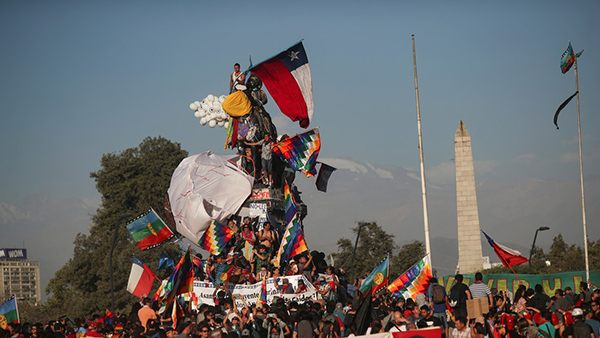
This libertarian resistance to the transition, with its anti-Pinochet component, was one of the threads that wove together the fabric that made possible the revolutionary process inaugurated in October 2019, which ultimately killed Pinochet's Constitution. The state institutions, at risk, did everything possible to save the presidency, and it was thanks to these efforts that Piñera was able to finish his term. The social abolition of Pinochet's Constitution was sanctioned in the 2020 plebiscite, as an institutionalizing and co-opting means of the revolutionary process that gave rise to it, but which also marked the constituent assembly that followed the plebiscite [4].
One of the key elements of libertarian anti-Pinochetism is memory. Memory of the struggle, of the victims, of the harm done, of the violations of human rights, and also of economic, social, and cultural rights, as a means of building social reparations for those who suffered these damages, directly or indirectly, because social harm is perpetuated as an inheritance if it is not properly addressed. Therefore, both the 2020 plebiscite and the one coming up on September 4th are seen as a form of social reparation [5] insofar as they put an end to and definitively dismantle the Constitution of horror.
One difference in this reparation—which involves a plebiscite to end the harmful Constitution (Pinochet's 80 Constitution)—is that the upcoming plebiscite paves the way for forgetting the dictator. Paradoxically, the memory of the resistance is best achieved through the material, symbolic, and political forgetting of what was resisted. It means that what was resisted barely persists as a historical footnote, and that its social, economic, cultural, and territorial effects—in other words, its strategic agenda—are completely consigned to oblivion.
The exit plebiscite will allow for this forgetting by constructing it. A just social damnatio memoriae , built through a long resistance to the dictatorship and the transition shaped by it. This social reparation will require many anarchists to participate in the plebiscite by doing something we politically oppose: being part of the electoral system. It is not pleasant, but it is necessary as an act of memory and social reparation: to place the tombstone of social and symbolic oblivion on Pinochet's defunct constitutional legacy. Because it is about consigning the names of evil to oblivion while simultaneously providing reparation to its victims. Memory of the resistance that brings about the forgetting of what was resisted.
For this libertarian anti-Pinochetism, then, the issue is not so much the new Constitution (which we have already discussed at length [6] ), but rather consigning the old, forced, coup-era one to oblivion. Approving it is a way to consign Pinochet to oblivion.
August 6, 2022 Hiroshima, we will not forget you
*Member of the CLACSO Working Group on collective memories and resistance practices.
[1] https://www.cnt.es/noticias/los-anarquistas-bajo-la-dictadura-de-pinochet-en-chile/ and https://www.todoporhacer.org/historia-anarquismo-chile/
[2] http://www.memoriachilena.gob.cl/602/w3-article-92406.html#:~:text=In%201993%2C%20the%20judicial%20investigation,it%20was%20called%20the%20Boinazo%22.
[3] https://www.ciperchile.cl/2018/10/22/la-detencion-de-pinochet-en-londres-y-la-democracia-semi-soberana/
[4] https://www.clacso.org/la-influencia-anarquista-en-constituyente-en-chile-analisis-con-ojos-acratas/
[5] https://www.clacso.org/chile-lo-que-hacen-los-pueblos/
[6] https://www.facebook.com/pelao.carvallo/videos/366006832328315
If you would like to receive more information about CLACSO's training programs:
[widget id=”custom_html-57″]
to our email lists.

