
Chile, what the people do
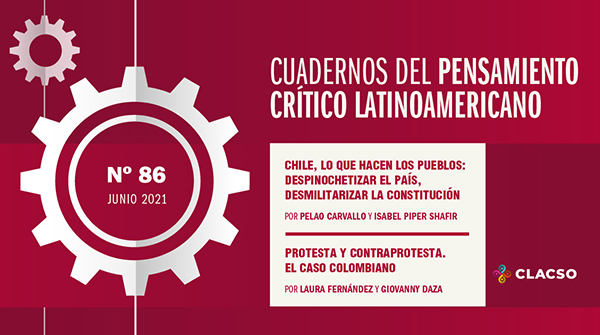
Within the collection of “Notebooks of Latin American Critical Thought”, CLACSO presents “Chile, what the people are doing: de-Pinochetizing the country, demilitarizing the constitution”, by Pelao Carvallo and Isabel Piper Shafir. And “Protest and counter-protest. The Colombian case”, by Laura Fernández and Giovanny Daza.
Chile, what the people do: de-Pinochetize the country, demilitarize the constitution
Pelao Carvallo*
Isabel Piper Shafir**
The constituent process and the end of Pinochet's constitution are both part and effect of the social revolt
The recent Chilean election of representatives to the Constitutional Convention (CC), held concurrently with municipal and regional elections, powerfully demonstrated the momentum of the social uprising in Chile, a year and a half after its beginning in October 2019. Its strength and enduring relevance were evident in several ways. First, in the resounding defeat of the right wing, abandoned by its electorate in favor of left-wing representation. Second, in the anti-party option represented by the equally resounding victory of independent candidates for the constituent assembly and local governments. This was accompanied by the surge of anti-electoralism, which reached levels exceeding half of the electorate. Thus, we can see that the constituent process—including the CC—contains at least two constituent elements of anarchist memory and proposals.[1]These sentiments have become common sense among the people of Chile: anti-party sentiment and anti-electoralism. The elite's control over political parties and the electoral system is recognized and denounced, and both are considered significant contributors to our problems and imposed limitations on the country's transformation. Elections are barely considered more than a statistical confirmation of the state of affairs in contemporary revolutionary Chile.[2]Gender parity in the Constitutional Convention was an expression of the struggle of women and feminist movements, while the seats reserved for Indigenous peoples reflected the struggles of those peoples. In the latter case, the limitations imposed by the right wing resulted in significant constraints, as evidenced, among other things, by the parity achieved for the proportional representation of constituent assembly members. The struggle of Indigenous peoples also influenced the process, albeit with significant limitations imposed by the right wing. Despite these achievements, numerous struggles, demands, and groups remain excluded from the Constitutional Convention. Nevertheless, the Constitutional Convention represents the most realistic political representation ever seen in Chile in a formal state-level process, a testament to the revolutionary momentum generated by the Chilean social uprising.
The defeat of Pinochet's constitution in October 2019 was an unavoidable political consequence of the social uprising. It was sacrificed to prevent the overthrow of President Piñera through a pact between government and opposition parties—the so-called Pact for Peace and a New Constitution—which unsuccessfully sought to channel the revolutionary process. However, we know that the opposite occurred: the energy of the revolutionary process paved the way for the constituent process.[3] And it pushes to overcome the institutional limitations created under the pact. This is what we observed in the coordinated and coherent triumph of revolutionary anti-party and anti-electoral positions in the recent elections.
The death of Pinochet's constitution, ratified by 78,3% of the vote in the October 2020 plebiscite, is a victory for the memory of the resistance against the violence perpetrated by the dictatorship and the governments that followed. On a symbolic level, it can be understood as a great collective act of social reparation.
The multiple resistance movements against the dictatorship, which sought to rid themselves of Pinochet, his institutions, and his legacy, were defeated by the transition, whose component of dictatorial continuity was vastly greater than its component of change. Impunity for repressors, torturers, murderers, and informers remains a constant. The transition created and managed a democratic institutional framework to repress, imprison, exile, and murder. The political operations to quell protests, the strengthening of the business sector's economic power, the enormous tolerance and even legitimacy granted to the military party—led by Pinochet, commander-in-chief of the army until 1998—as well as the seizure of 10% of the revenue from public copper mining to be handed over unconditionally to the Armed Forces, perpetuated the military dictatorship and were made possible by the continued repression of any form of dissent.
The social uprising denounced and resisted this militarized transition with its slogan, “It’s not about 30 pesos, it’s about 30 years.” It reclaimed the memory of past struggles as a form of social reparation for those who were persecuted, imprisoned, tortured, and/or murdered for actively opposing the transitional pact. It recovered an uncomfortable, thankless, yet victorious history, which found its greatest visibility in the student struggles that began with the 2001 student protests.[4].
Conscientious objection in the new constitution: a form of social reparation and a guarantee of Never Again
The establishment of the right to conscientious objection in the constituent process and in its constitutional product is an action of social reparation for the repressive violence exercised during the dictatorship, the transition and the social revolt.
The right to refuse to obey orders to violate human rights—to torture, murder, illegally detain, or enforce disappearance—will make two things possible. First, it will prevent people from lending themselves to inflicting social harm in the name of any authority or written or regulated order that serves that purpose. Second, it will ensure that no public official can use the despicable excuse of “obeying orders” to justify committing crimes against humanity.
Clearly, simply, and precisely defined, the constitutional right to conscientious objection provides support for disobeying orders that violate the rights of others, including limitations on the exercise of social, economic, cultural, and environmental rights. By recognizing the limits of one's own conscience as a boundary against orders contrary to human dignity, each person assumes an unavoidable and inexcusable responsibility when consenting to (or withholding) such orders, thus obeying them. Constitutional conscientious objection will ensure, on the one hand, the ability to prevent harm by not collaborating in its occurrence. On the other hand, if harm does occur, it will ensure a more expeditious pursuit of truth and justice by removing the shadow of forced collaboration.
Ending impunity, establishing the truth, and achieving social redress for the human rights violations committed during the dictatorship, the transition, and the uprising are social and political necessities and constitute the only possible guarantee of non-repetition. Conscientious objection is part of this process.
The OC cannot be an excuse to violate women's rights
Currently in Chile, the right to consent is being used to restrict the right to abortion, allowing healthcare workers—including those in the public system—to invoke it to refuse to perform abortions. In other words, they are denying women the right to decide about their motherhood.
The right to conscientious objection must be explicitly, simply, directly, and broadly established in the constitution. Given that human rights violations involve not only the military but also civilians, conscientious objection must extend beyond the specificity of conscientious objection to military service.
The right to object is an individual right that protects against human rights violations, and this is the fundamental clarity of its translation as a constitutional norm. As we have said, it refers to mandatory norms and, above all, mandates that violate the rights of others. This implies that it cannot be used as an argument to restrict the rights of others, and that it is in no way an institutional, collective, or group right.
The OC and Human Rights are part of the demilitarization of the constitution
The human right to conscientious objection must form a harmonious and coherent part of a constitution based on human, economic, social, cultural, and environmental rights. Viewed as a comprehensive set of rights, it will serve as both the starting and ending point, guaranteeing the protection of other rights and allowing it to be exercised as an autonomous practice independent of any institution. Its mere exercise acts as a safeguard for all other human rights and economic, social, cultural, and environmental rights enshrined in the constitution, ensuring a coherent and, above all, demilitarized constitution.
The militarization of society is the way in which states—all of them, even those that define themselves as democratic—abandon the defense of human rights in favor of the logic of the tactical, strategic, and professional exercise of armed violence, which is by definition anti-democratic. The militarization of society implies the abolition of human rights, political participation, and social empathy, and undermines the social construction of free, self-determined, empathetic, participatory, and supportive communities. It allows states to use the armed forces as a socio-cultural brake on self-managed practices. The military hand is the permanent and sustained resource of its economic reflection: the predatory neoliberal capitalism of our time, which acts symmetrically with logics of abolishing rights (including the right to property—except for that of large landowners).
Building a demilitarized constitution, with the right to conscientious objection as a cornerstone, will allow for the persistence of processes of community self-determination and effective, supportive, and empathetic political participation. This revolutionary exercise echoes the events unfolding on the streets of Chile since October 2019.[5]From a solidarity and internationalist perspective, it will be a contribution from the peoples who inhabit Chile to Latin American-Caribbean and world human rights jurisprudence, expanding the current definition that restricts it to Compulsory Military Service.[6] (SMO), which is an expression of the influence of militarism in the region.
The political problem of a demilitarized constitution
Unfortunately, the CC of Chile includes a former admiral, representatives of parties and organizations of the militaristic status quo, and other actors who do not have a clear position regarding the anti-democratic nature of militarism.
Reports of theft, scams, and corruption among military and police personnel in recent years[7] They have revealed the privileges and impunity inherent in military influence in the Chilean republic. Thefts and embezzlements have a greater impact on public opinion than crimes committed within those institutions.[8].
The military in Chile is a de facto power that will assert its privileges in the constitutional assembly. Equipped with personnel, resources, networks, and contacts, military institutions lobby through their control of parts of academia, a strategy echoed in the press.[9]Seeking to control the constitutional agenda, they have contributed to creating a culture and a common sense that legitimizes their role in society and masks their anti-democratic nature. The military budget will be used to grease the wheels of this militaristic lobbying around the constitutional assembly in order to maintain, albeit updated, the decisive place it occupies to this day in the Chilean state, a place that acts as a brake on moving beyond anti-democratic practices. It is not only a matter of preventing anyone with interests in military matters—whether as an active participant, retiree, or advisor to the Armed Forces—from debating and deciding on these issues, but also of remaining vigilant against the temptation to take for granted, to consider as natural and logical, the existence of armed and repressive forces in Chile.
This is taking seriously the idea of a constitution that starts from a blank sheet of paper.
In Chile, demilitarization is carried out by the people.
The constituent assembly must follow the demilitarizing example of the people of Chile. The revolutionary process that began with the social uprising of October 2019 is simultaneously a process of demilitarization and of social reparation for the victims, survivors, and those who resisted that militarization, even in the face of the enormous violence deployed by the Piñera government through the armed forces and police.
Currently, with the pandemic serving as a legitimizing argument for a state of emergency that has already lasted 15 months, the active militarization maintained by this government ensures a strong military presence throughout the country, including at the borders, where they are controlling a fabricated migration crisis. Another aspect of this militarization is the acute militarization of the Carabineros (Chilean police force), both in their operations in Wallmapu (Mapuche territory) and in response to urban protests, with the urgent acquisition of new weaponry. The pandemic has also been used to whitewash the repressive nature of the military by utilizing military aircraft for the transport of patients.
Despite all this, the government has been unable to stop the social uprising, nor has it been able to prevent the electoral defeat of the right wing and the parties that controlled the transition and the continuation of militarism. The resistance to police conscription began with the October 2019 uprising, drawing on and expanding a long history of Chilean antimilitarist resistance.[10]The fall of Pinochet's constitution is the first demilitarizing achievement of the revolutionary process underway in Chile, and the constituent assembly must decide whether or not to be part of that process by establishing conscientious objection as a right that is articulated around the construction of truth, justice, reparation and non-repetition for the vast majority of Chile's inhabitants.
The demilitarization of the Chilean constitution is a process taking place in all spaces of real, concrete, non-hierarchical, non-competitive, non-patriarchal, and non-sexist political participation. That is to say, it is cooperative and collaborative, like territorial assemblies, the groups fighting in the streets and squares, community kitchens, and all the community-based, mutual-support organizing experiences that are currently being created and recreated in these territories.
* Chilean writer. Member of the CLACSO Working Group on Collective Memories and Practices of Resistance.
** Representative of the CLACSO Steering Committee. Co-coordinator of the CLACSO Working Group on Collective Memories and Practices of Resistance. Professor and researcher in the Department of Psychology, Faculty of Social Sciences, University of Chile.
Protest and counter-protest. The Colombian case
Laura Fernández*
Giovanny Daza**
According to the sociologist Max Weber, we speak of protest or social struggle when it is a collective action that intentionally expresses demands and/or pressures the State, at its various levels, private entities or individuals for solutions. Similarly, according to the Ideas for Peace Foundation (FIP), social protest is a legitimate means for the vindication and promotion of fundamental rights of any kind, which are constitutionally and legally protected, such as peaceful association or assembly, freedom of expression and strike.
Therefore, I take as a reference and support the two concepts previously presented, with the purpose of highlighting and briefly recounting the different social demonstrations that have taken place in Colombia to understand, to a great extent, the problem or the so-called vicious circle of manipulation and oppression in which we citizens have found ourselves for more than 60 years, a product of the distorted political and democratic vision of the current government which, through unfeasible and aimless projects, undoubtedly continues to structure and position the country as an unequal and exclusionary scenario for the population in general. However, there is no doubt that, thanks to social participation and the mobilization of the people, the history of Colombians has been changed to a greater or lesser degree.
Social protest as a means of guaranteeing rights since 1900
In this vein, this article aims to analyze and connect the background of social demonstrations with the current situation in Colombia, which, for many years, has been marred by inequality, violence, and a lack of development. Ironically, this has occurred within a social state governed by the rule of law, where "social" and "law" are intertwined and complementary, yet ultimately, their fulfillment remains a utopia in Colombia. Therefore, the origins of these demonstrations can be traced back to 1900, expanding and gaining momentum during the period known as La Violencia (The Violence), which lasted from 1946 to 1958. This period was marked by political mismanagement that shaped the behavior of Colombians, and can be divided into two distinct phases: the first, from 1902 to 1917, focused on socioeconomic, labor, and political issues; and the second, beginning in 1918, was characterized by the predominance of workers' economic discontent. salaried workers in the countryside and the city, due to the lack of guarantees and benefits to perform their work in a dignified manner.
As an example of the power, reach, and positive effects that can arise from collective actions and mass demonstrations against their leaders, March 13, 1909, is remembered as one of the beginnings of democracy and citizen participation in Colombia, where students were the protagonists in the city of Bogotá by raising their voices in order to seek the recall of the then President of the Republic, General Reyes, for attempted political persecution and dictatorship.
Now, given the persistence of these kinds of destabilizing events, what other outcome was expected? How did the government of that time intend for the people to react? Perhaps they expected the same submission that we have endured, and in some ways accepted, for so many years? But, since history answers each of these questions, it would be redundant to say what the true effect was.
The social resistance that began to emerge from citizens at that time confirms the strength, power, and reach that arises from collective unity to demand and/or raise their voices in unison, leading to the assertion and realization of equality and well-being in participatory settings, in order to counteract the effects of those who seek to undermine and control what belongs to everyone. Therefore, with good reason, it is valid to shake up and disrupt these types of events, described in every possible way as anything but positive. It is impossible not to be exasperated, because in the same way that the achievements obtained thanks to the people's constant voices being heard against a government that plays with and manipulates what is supposed to be untouchable and respectable, such as life, rights, opportunities, development, and the very democracy of the country, are remembered, the protests that have culminated in massacres, such as the case of the workers, day laborers, and peasants of the banana-growing region of the Magdalena department, are not forgotten, accepted, excused, or left out of memory. Tired of the harsh conditions imposed by the United Fruit Company, they protested to demand improved economic conditions. Far from any hint of negotiation or agreement, the strike was broken at any cost, resulting in the deaths of thousands of Colombian workers.
From my perspective as a Colombian citizen and young person, the failure to achieve inclusive, collective social goals—which, by their very nature, should be the hallmark of those who govern—is overwhelming, distressing, and ultimately disheartening. However, due to the pervasive demagoguery with which some leaders have sought to govern for decades, they continue to distort and transform the essence of politics into a euphemism for anti-social politicking. This allows them to surreptitiously continue failing to build a nation, understanding the nation as a unified social community that, working together through spaces of participation, dialogue, and consensus, can strengthen social equality. Ultimately, this would allow citizens to be the protagonists of guaranteed economic, political, environmental, and educational rights, supported by an exercise of power aimed at a sustainable and fruitful management system where everyone contributes and benefits, where civic equality prevails, and where the true act of governing begins with equity and the promotion of minimizing social and, above all, economic inequalities.
Reform? Or deform?
Speaking of issues where the government has quietly tried to mislead society with proposals that, according to them, the population is incapable of understanding, both positively and negatively, it is truly difficult to comprehend the shameful way in which President Iván Duque presents the Sustainable Solidarity Tax Reform, the pension reform, and the healthcare reform. It is contradictory to propose such unequal laws, especially considering that the Tax Reform was intended to mitigate the negative effects of the COVID-19 pandemic by increasing the VAT on certain basic necessities, such as food, healthcare, education, and clothing, as well as other taxes like income tax and VAT on public services for higher income brackets, using this as a strategy to eliminate poverty. It is irrational to launch these kinds of projects in a country where, according to the National Administrative Department of Statistics (DANE), the percentage of people classified as poor in 2021 was 42.5%.
I include myself in the debate, both in discussion and in rejection, initially of the name they use to present a project to "sustain" the country. They have sought to control and largely seize control of the commons, ultimately becoming the protagonists of empty and unfounded proposals and actions. This begins with attributing and focusing this tax-economic law on a social approach, when their distorted and flawed way of governing is incompatible with, and even less suited to, social and egalitarian issues. Therefore, it is not difficult to see that this social approach is the ultimate and least considered purpose of the reforms, represented by President Iván Duque and his influencer Alberto Carrasquilla for Colombia.
It would be wonderful if, among the various proposals presented, a middle ground could be found between the poor, the rich, and the middle class. Undoubtedly, these proposals tend to fall into extremes: either seeking strategies to protect the poorest in order to alleviate their economic crises and precariousness, or continuing to line the pockets of the rich so they can hoard money and feel privileged. But what about the middle class? Where does that leave the people who work every day to earn a basic wage, and then stretch it to the limit for education, food, debt, healthcare, and housing?
I reiterate my opinion regarding the background of the Tax Reform, understanding that the way it is presented goes in an opposite and unbalanced direction with respect to its meaning, which is to improve, amend, or gradually transform a system, therefore, this proposal instead of rebuilding and strengthening, deforms and alters.
The role of young people in the demonstrations
The current national strike began on April 28th and has lasted for almost 2 months, during which, according to official data, 111 cases of disappearance have been reported, while social organizations denounce 340.
The role of youth social organizations has been crucial because, unlike other strikes in Colombia, it has been young people who have remained steadfast in their demands against a government unwilling to engage in dialogue but prepared to militarize the main centers of unrest in the country. Various organizations have reported that, in the context of the National Strike protests, more than 340 young people have been detained by the police, and their whereabouts remain unknown. For its part, the Attorney General's Office states that it has activated the special search mechanism for 111 missing persons and is investigating three cases of enforced disappearance.
Young people protesting, young people who refuse to be silenced, young people taking action and reacting, wish to express their discontent with the actions of the Duque administration, beyond the acts of vandalism attributed to them and which have on several occasions been attributed to the state itself through paramilitary groups. The conflict is so serious that even UN members reported being attacked by the police while carrying out verification tasks. Similarly, the Human Rights Commission was denied entry by the government, which claimed that the Commission should not enter Colombia until President Duque's administration had the situation under "control."
Political action transcends the ballot box, goes beyond political parties, and breaks free from the strict limitations of traditional politics. This has been clearly evident in both planned and unplanned demonstrations across Colombia. Young people have taken to the streets without any political affiliation, yet with the power to generate significant changes within the institutional structures built by the old guard of the country's two-party system.
The state's response, beyond a few failed attempts at dialogue with the youth strike committee, has been the use of force. The most serious incident occurred on May 5th. That day, in Pereira, a group of unknown assailants opened fire on protesters, seriously wounding three people. One of those wounded was Lucas Villa, who died days later from his injuries.
The strike committee responds to the state riot police in various ways, including the use of street art as a means of expression. Naturally, this also includes outbreaks of violence against the state, the repercussions of which are widely covered by the mass media, which are biased by state regulations.
The mural “Living with the State,” created on May 22nd in the Poblado neighborhood of Medellín, was almost immediately destroyed by approximately 150 people who covered it with green and white stripes, referencing the official flag of Antioquia. At the same spot, graffiti artists painted a new phrase: "The people will not surrender, damn it."
The democratic framework is far more fragile when faced with direct challenges from citizens who are not necessarily politically engaged, or whose political engagement operates outside the channels of traditional institutions. The desire to find new possible worlds mobilizes protesters, and thus art (murals, music, festivals, street competitions) is produced and reproduced as a response to state oppression.
In this landscape of largely youth-led citizen mobilization, another historically relevant sector in Colombia, known for its mobilizations, struggles, and dissent, has joined the demonstrations against the Duque government: Indigenous communities. A collective of Indigenous organizations from across Colombia has been mobilizing in the city of Cali to join the wave of demonstrations that have swept the country since the protests began.
The march is known as Minga, an indigenous word that can imply a gathering of diverse actors, knowledge, and tools in search of a common goal, but in its most recent context means resistance or protest in search of the vindication of rights.
This Sunday, violence escalated when, according to Indigenous sources, civilian groups attacked participants in the minga (collective action) with firearms. The civilians, for their part, claim they were the victims of machete attacks and vandalism against their property. The truth, as always, tends to be diluted and manipulated according to the power that shapes it and manages to impose it through the media.
The members of the Minga - with their staffs of command on their shoulders and a cumbia anthem that says "defend our rights even if it means we die" - confronted all governments, but with significant peaks of tension: in 2008, with Álvaro Uribe in power, in 2020 and now, with his political ally, Iván Duque.
Margarita Martínez, co-director of Robatierra, a documentary about the Minga, agrees that the demands of the indigenous people, with their march to the capital, align with those of the National Strike: "Coming to Bogotá goes beyond meeting with Duque: what they seek is to help raise awareness in urban Colombia, which has been so far removed from the war, of what they experience in their territories."
The Duque administration has been gradually withdrawing the proposals that sparked the national strike. The public was informed of the withdrawal of the tax reform and the healthcare reform. In addition, the administration announced the forgiveness of funds awarded to 223 students with doctoral scholarships.
In this context, and with 44 days of protests in Colombia, the National Strike Committee may announce in the coming hours an end to the marches and blockades across the country. “There may be a change in what we do; there won't be an emphasis on marches, but there will be other types of events,” said Oscar Gutiérrez, a member of Dignidad Agropecuaria in Colombia.
* Social communicator. Member of the CLACSO Working Group Collective memories and resistance practices.
** Member of the CLACSO Working Group on Indigenous Peoples, Autonomies and Collective Rights. Member of the CLACSO Research Area team.
[1] https://www.elciudadano.com/columnas/el-anarquismo-en-la-region-chilena-ante-el-plebiscito-de-abril-si-es-que-se-hace/03/16/
[2] We discussed this at length some time ago, in case anyone wants to delve deeper, in the conference "The Anarchist Influence on the Chilean Constitutional Process" https://www.facebook.com/1421886927880165/videos/289913749531895
[3] https://www.eldesconcierto.cl/opinion/2020/10/13/la-constituyente-esta-sesionando-desde-octubre-de-2019-en-la-calle.html
[4] https://www.eldesconcierto.cl/opinion/2021/05/09/mochilazo-2001-un-camino-que-no-se-cierra-en-la-constituyente.html
[5] https://www.elciudadano.com/columnas/por-que-la-gente-votara-en-chile-en-abril/02/24/
[6] Regarding the current state of the OC https://www.corteidh.or.cr/tablas/r31649.pdf https://www.ohchr.org/Documents/Publications/ConscientiousObjection_sp.pdf and a guide to the practice of law: https://co-guide.org/es/gu%C3%ADa-del-sistema-internacional-de-derechos-humanos-para-objetores-de-conciencia
[7] https://www.ciperchile.cl/2019/03/08/otro-lunar-en-las-platas-del-ejercito-el-turno-de-los-millonarios-fondos-para-la-vivienda/ y https://www.latercera.com/nacional/noticia/fraude-carabineros-llega-28-mil-millones/128295/ just as examples
[8] https://www.chvnoticias.cl/reportajes/padres-de-conscripto-exigen-justicia-a-20-anos-de-su-muerte_20161214/ y https://www.antimilitaristas.org/Velaton-por-la-Matanza-de-Antuco.html
[9] https://www.elmostrador.cl/destacado/2021/05/29/donde-estamos-en-defensa-seguridad-y-relaciones-exteriores/
[10] https://wri-irg.org/es/articulo/2017/ni-casco-ni-uniforme-20-anos-1997-2017
If you would like to receive more information about CLACSO's training programs:
[widget id=”custom_html-57″]
to our email lists.

