
Collective memories, human rights and resistances
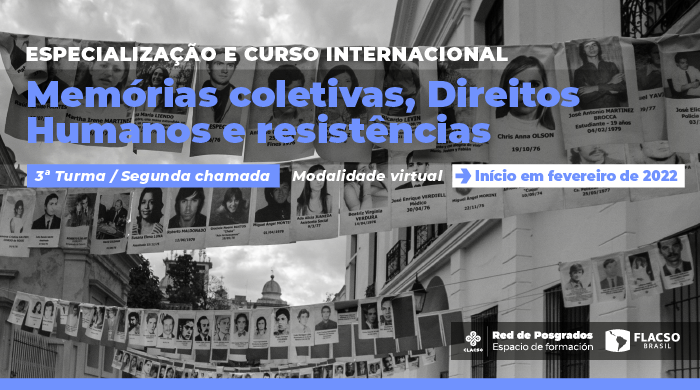

3rd Tour (2021-2022) | Second call
VIRTUAL MODE
Specialization: 40 credits, 360 hours/cadeira
International course: 9 credits, 90 hours/cadeira
Duration: February to December 2022
The certification of the Specialization and the International Course will be carried out by the Latin American Faculty of Social Sciences (Flacso Brasil) and the Latin American Council of Social Sciences (Clacso).
GENERAL COORDINATION
Isabel Piper Shafir (Universidade do Chile)
ACADEMIC COORDINATION
Belén Rojas (LCSP, Paris Diderot University, France)
ACADEMIC COMMITTEE
Andrea Azevedo (Flacso, Brazil), Isabel Piper Shafir (Universidade do Chile and CLACSO), Pilar Calveiro Garrido (Universidade Autônoma da Cidade do México) and Peter Winn (Tufts University, United States)
PEDAGOGICAL COORDINATION
Belén Rojas (LCSP, Paris Diderot University, France)
Andrea Azevedo (Flacso, Brazil)
A concern with collective memory arises in societies that seek to leave behind the violence of a war, of armed confrontations or of a struggle to build democratic forms of coexistence. Collective memory is proposed as part of the transition device, as a reparation strategy for the damage caused by violence, and as an element that would allow violence to never occur again. Therefore, in the XXI century, the concern with the topic is dislocating the reflections on violence and its traumatic effects, in order to search for the understanding of the present from its articulation with the past. The central concern is not exclusively in the recovery of the memory of victims of human rights violations, but in the multiplicity of voices that create stories about the past, in the recovery not only of human experiences, but above all of struggles and resistance, and their articulation with processes such as gender relations and migratory processes.
We start from the assumption that collective memory constitutes a field of conflict where what is in question is not just the interpretations of the past, but the meanings of who we are as a society and our possible futures. The symbolic force of memory lies in its character as a producer of subjects, relationships and social imaginations, a power that becomes a potential source of resistance, instability and transformation. More or simply the fact of naming or sketching certain events does not guarantee their transformative character, but depends on the capacity of their practices to emphasize the hegemonic verses in force in a given social order. Taking on this challenge, in this training space we seek to jointly analyze the actions in which we are engaged in the world, problematizing the past verses that they produce and, at the same time, promoting the construction of new interpretations and meanings that encourage different and mobile ways of producing social subjects. The resurgence of authoritarian regimes in Latin America becomes urgent not only to remember the violence that they exercise in our recent history, but also to understand those elements that contribute to their restoration.
Always using memory as a key to understanding, we will explore its articulations with the political struggles that are not present. Let's do a critical reflection on the construction and political uses of memory spaces, the category of forced disappearance and its current uses, as well as the phenomenon of contemporary migrations. We invite you to think about the possible relationships between memory and gender, from a feminist perspective.
GENERAL OBJECTIVES
Know and understand contemporary debates on collective memory, its policies and practices; as well as the relationships between this and contemporary violence, especially those related to political action, gender violence and those related to migratory processes.
SPECIFIC OBJECTIVES
Discover and analyze experiences of development and implementation of memory policies, human rights and practices of resistance in Latin America.
Critically reflects on:
1. The articulations between collective memory processes and political struggles in Latin America.
2. The potentialities that the memory spaces have to intervene do not debate two current dilemmas that involve new violence or forms of violation of rights.
3. To articulate the field of memory and gender and feminist perspectives, I tend to consider the theoretical, methodological and political consequences of this framework.
4. The transformation and analytical possibilities of the category of disappearance from its transnationalization and current uses in various contexts.
5. The potentialities of analysis inserted between collective memories and migrations to emphasize the traditional understandings of both phenomena and open spaces for their reconsideration.
6. The articulations between political struggles and the elaboration of memories in Latin American art
The Specialization in Collective Memories, Human Rights and Resiliences will last annually and require certification to carry out an intensive seminar, an international course and two virtual seminars eletivos of the curricular offer, a support office for the elaboration of final work and the elaboration of a work final monograph.
The students of specialization and the international course will have the support of tutors and academic tutors who will accompany the virtual seminars and guide them in carrying out their final work.
Once two seminars have been completed, the students will have a period of four months to deliver their final work. If you are pending the conclusion of credits, you will also have this deadline to fulfill them.
A Credential Specialization 360 hours in the International Course or total of 90 hours.


The virtual seminars will be offered equally in Spanish, Portuguese or English. The bibliography may be offered in the three official languages of the course, according to availability. As two students intervene in the discussion forums, they can also be used in different languages. The final monographic work may be in Spanish, Portuguese or English.
Current Debates on Collective Memories, Gender and Human Rights
This curricular unit aims to dialogue the knowledge and experiences produced around two processes of collective memory, practices of resistance and Human Rights. It will feature the participation of thinkers who, from various disciplines and contexts, will address the analysis of two processes of collective memory in relation to public policies, gender and feminism, art and culture, migratory processes, Human Rights, political violence, practices of resistance, museums, places of memory and monuments.
Coordination
Isabel Piper Shafir (University of Chile, Chile)
Summary: In Latin America, the concept of collective memory has been linked to reflection on the political violence of wars, armed confrontations and military dictatorships in recent decades. The confrontation of violence in the past has resulted in the development of memory policies, understood as both State policies and political actions of social organizations or political groups involved in the process of re-remembering the political conflicts experienced in their local contexts. We are going to focus on some emblematic cases in our region, such as Nicaragua, Colombia, Argentina and Chile.
We will see how, in current contexts, in different regions and countries of Latin America, the various practices of resistance to the current scenarios of exploration, expropriation, concentration of wealth and public and private violence, go back to a memory that recovers the different knowledges of political struggle, becoming an active memory. Not a global context, resistance tends to be local. We will do a review and analysis of resistance experiences in Mexico and the Andean interior of Peru, Argentina and Chile.
A critical analysis of the memory policies implemented in different Latin American countries leads us to argue that, with significant contributions made to understand the authoritative processes, dictatorships and political transitions in the region, as well as to confront and elaborate the consequences that these have in society and in people, it is a great challenge to understand. decode or establish links with the new sociopolitical realities that are developing in the region, as new developments in political violence and forms of resistance are articulated.
However, analyzing experiences of resistance in which memory is transformed into a political resource to act non-present will help us to rethink memory as an agent that contributes to transformation.
Coordination: Isabel Piper (University of Chile)
Summary: The course addresses the relationship between gender and memory, emphasizing two ways of understanding this articulation: on the one hand, understanding collective memory constructed by gender subjects, and on the other, exploring different feminist approaches present in this field of study. From this perspective, we analyze the memories prepared by activists, guerrillas, victims and other social agents in relationships with their non-present and non-past gender positions; bem as the continuities and discontinuities of two fathers and gender dynamics that occur in significant events that they narrate.
Through these analyses, the aim is to analyze exercises of countermemory (ARFUCH, 2013; LUONGO, 2013) or subaltern memories that emphasize themes and perspectives little explored in hegemonic memories: for example, to visualize how gender orders are destabilized or preserved in the construction of these memories, or how hybrid processes of emotion, political action and resistance to re-remembering certain events and contexts are structured. It is necessary to understand that the subjects of memories are multipositional agents that are articulated by means of events/spaces (ZALAQUET, 2011).
Finally, the course will analyze various studies of the collective memory of Ibero-American countries that precisely reflect a gender perspective in understanding two processes of construction of collective memory, in order to make visible the experiences – of victimization and/or political resistance – that are silenced by a memory masculinized and heterossexist hegemonic, or to install understandings of gender from the past through a critical reading of forms as different episodes são narrated from the present.
Coordination: Marisela Montenegro (Autonomous University of Barcelona, Spain) and Caterine Galaz (University of Chile)Summary: The objective of this curricular unit is to dialogue with the processes of collective memory and migration, in the interest of illuminating new contours that allow us to better understand the complexity of each one, in the context of globalization and advanced capitalism.
In this sense, we will address the particular nuances of two problems considered fundamental to memory studies such as places and commemorations; disputes between official reports and informative reports; museificação and patrimonialização. Also with the objective of examining dynamics such as memories without a place or “no place” of migrations; to interrogate two imaginations of exclusion and the limits of belonging; Cultural initiatives are alternatives for managing political tensions, their conflictive character and also their potential.
In the same way, we are going to confront ourselves with problems that we do not study in contemporary migrations, such as diaspora and transnational spaces; The subjectivity of migrants and the impacts of mobility regimes in their future. It attempts to analyze the tension of national borders as the contours of collective memory and the potential of memories and countermemories in the configuration of resistance to subordination and articulations of differences (BRAIDOTTI, 2006), during the migratory trajectories.
Coordination: Belén Rojas (University of Utrecht, Netherlands)
Summary: The course reflects on the genealogy, transformation and analytical possibilities of the category of disappearance. Used for the cases of Argentina, Chile or Uruguay in the 70s, in Mexico or Colombia today, and we have forgotten it for a long time in the Spanish Civil War, in Nazi Germany in the 40s, in Cambodia in the Khmer Rouge in the 70s or in Bosnia in the war in the 90s. cases that are called disappearances and disappearances.
Coordination: Gabriel Gatti (University of the Basque Country, Spain)
Summary: This seminar seeks to reflect on the ways in which Latin American societies face political violence in the past, such as turmoil or internal armed conflicts that they have experienced throughout the 20th century and part of the 21st century, for example two memory processes undertaken by different social actors. Through this seminar we will address the public forms of memory that are built on past violence, critically analyzing the memory processes implemented in different countries in the region, such as Argentina, Brazil, Chile, Colombia, Peru and Uruguay, questioning the present of these societies, in particular about new violence and current conflicts.
Coordination: Ana Gugliemucci (University of Buenos Aires, Argentina) and Loreto López (University of Chile)
Summary: This seminar seeks to reflect on the ways in which Latin American societies face political violence in the past, such as turmoil or internal armed conflicts that they have experienced throughout the 20th century and part of the 21st century, for example two memory processes undertaken by different social actors. Through this seminar we will address the public forms of memory that are built on past violence, critically analyzing the memory processes implemented in different countries in the region, such as Argentina, Brazil, Chile, Colombia, Peru and Uruguay, questioning the present of these societies, in particular about new violence and current conflicts.
Coordination: Ana María Barletta and Emmanuel Kahan (National University of La Plata, Argentina)
Summary: This course aims to address the memory of history and popular struggles in Latin American aesthetic production in its different forms: in visual arts, in popular music, in poetry, in literature, in cinema and in theater.
Coordination: Ana Rüsche (Flacso, Brazil)
The office is a training space intended to guide the preparation of final specialized monographic work. Students will receive accompaniment and guidance in the elaboration of the object of analysis, in their translation into a practical study problem, in the construction of a working plan, in the development of argumentative networks and in the definition of analytical conclusions. These tasks will be carried out individually and collectively by means of exchange between peers and as a professor responsible for the office, through the discussion forum. The objective of the office is to produce the outline of the final work of the specialization. The final monographic work may be in Spanish or Portuguese.
| SPECIALIZATION AND INTERNATIONAL COURSE - 3rd TURMA | Second call (2022) | ||||||||||
| feb-22 | Intensive seminar | |||||||||
| Mar 22 | Elective Seminar I "Disappearances: a transnationalized Latin American category" | Elective Seminar I "Space and memory: pasts of political violence in Latin America" | Elective Seminar I "Recent history, public uses of the past and collective present" | Elective Seminar I "Lutas and memory in Latin American art" | ||||||
| abr-22 | International Course “Current Debates on Collective Memories, Gender and Human Rights” | |||||||||
| May-22 | ||||||||||
| Jun-22 | ||||||||||
| Jul-22 | ||||||||||
| ago-22 | ||||||||||
| Sept-22 | Support office for preparation of final work | Elective Seminar II "Collective memories and political struggles" | Elective Seminar II "Collective memories and feminist perspectives" | Elective Seminar II "Migrant Memories" | ||||||
| oct-22 | ||||||||||
| nov-22 | ||||||||||
| dic-22 | ||||||||||
CM Pleno: You belong to a Plenary Member Center of CLACSO
CM Associate: You belong to a Center Associated with CLACSO.
No affiliation: You do not have any links to CLACSO.
| Payment in a plot until 01/21 |
Payment on a parcel after 01/22 |
Payment in 3 parcels | |
| CM Pleno | $400 | $570 | USD 750 (3 x USD 250) |
| CM Associate | $530 | $700 | USD 1020 (3 x USD 340) |
| No connection | $660 | $960 | USD 1290 (3 x USD 430) |
In all cases, payment may be made by letter of credit, deposit or bank transfer.
The certification of the Specialization and the International Course will be carried out by the Latin American Faculty of Social Sciences (Flacso Brasil) and the Latin American Council of Social Sciences (Clacso).
CM Pleno: You belong to a Plenary Member Center of CLACSO.
CM Associate: You belong to a Center Associated with CLACSO.
No affiliation: You do not have any links to CLACSO.
| Payment in a plot until 01/21 |
Payment on a parcel after 01/22 |
Payment in 3 installments | |
| CM Pleno | $115 | $230 | USD 315 (3 x USD 105) |
| CM Associate | $175 | $290 | USD 360 (3 x USD 140) |
| No connection | $240 | $360 | USD 450 (3 x USD 180) |
In all cases, payment may be made by letter of credit, deposit or bank transfer.
The International Course Specialization is intended for undergraduate and post-graduation students; teachers of all ages; activists and activists of union organizations, social movements and political parties; public officials and legal area agents, day laborers, communicators and press consultants; members and leaders of non-governmental and professional organizations interested in the matter.
To participate, you must register on the website.
Registration will be open between December 12 and February 11.
Upon completion of the registration process, you will receive confirmation by e-mail.
If any of the mandatory training sessions are not completed, in all cases, an additional amount must be paid to recover the aforementioned credit.
If a student decides not to take the Specialization or International Course before its formal start, he or she may request a refund of the registration fee. CLACSO will calculate the amount equivalent to 10% of the administrative allowances.
Exceptional criteria: In exceptional cases, in the first two months of the start of the specialization, someone may request to leave the tour and resume it the following year. In all cases, the reasons justifying the request must be presented in writing. Two months after the start of the course, it will no longer be possible to request this procedure.
If a student decides not to take the International or Specialization Course before its formal start, he or she may request a refund of the registration fee. CLACSO will calculate the amount equivalent to 10% of the administrative allowances. After all, no refund will be made.
The classrooms will begin in February 2022 and will be completed in December 2022.
All registered participants will receive the necessary instructions to access the classrooms, bibliography and discussion forums through the CLACSO Virtual Training Space.
The navigation access to the Virtual Training Space happens in a simple and clear way. In any case, a technical and academic support team will always be at your disposal.
You must certify the International Course, two (2) eletive Virtuais Seminars, a support office to carry out the final work and carry out the final work.
To obtain the title of the Specialization, you must conclude a final monographic work. The support office for the completion of final work is required and will assist you in the process.
You must participate in the classrooms and activities proposed by the teachers and do the final monographic work.
However, the International Course Specialization requires certificates for Flacso Brazil and CLACSO.
The specialization has a total workload of 360 hours and an international course of 90 hours.
The submission of the declaration of conclusion will be done digitally and is completely free. Likewise, in physical format, it can be obtained free of charge at CLACSO headquarters, in Buenos Aires or at Flacso headquarters in Brazil (Brasília, Rio de Janeiro or São Paulo).
The international Specialist diploma is issued by the Secretary-General of the Flacso, located in Costa Rica. The values and procedures for issuing and sending the international diploma can be consulted on the Flacso Brazil page: https://flacso.org.br/?page_id=24376
The Specialization in the International Course requires credentials from Flacso Brazil and CLACSO.
The international Specialist diploma is issued by the Secretary-General of the Flacso, located in Costa Rica. The values and procedures for issuing and sending the international diploma can be consulted on the Flacso Brazil page: https://flacso.org.br/?page_id=24376.
See the table of prices and modalities, available above.
If the international certification is not issued by the General Secretary of the Flacso, an additional fee must be paid.*
*The issuance of the printed diploma, together with the grade history, costs USD 200,00 (two dollars). The value includes the sending of two printed and assigned documents for the student's residential address. The procedures for issuing and sending the international diploma can be consulted on the Brazil Flacso page: https://flacso.org.br/?page_id=24376.
Any other doubts between contacting us via e-mail [email protected] o [email protected]
Ou envie um WhatsApp para + 5491138801388
For discounts for groups and institutions, you can contact us. [email protected]
More specializations and international courses
If you would like to receive more information about CLACSO's training programs:
[widget id=”custom_html-57″]
to our email lists.

