
Memory in Action in Argentina
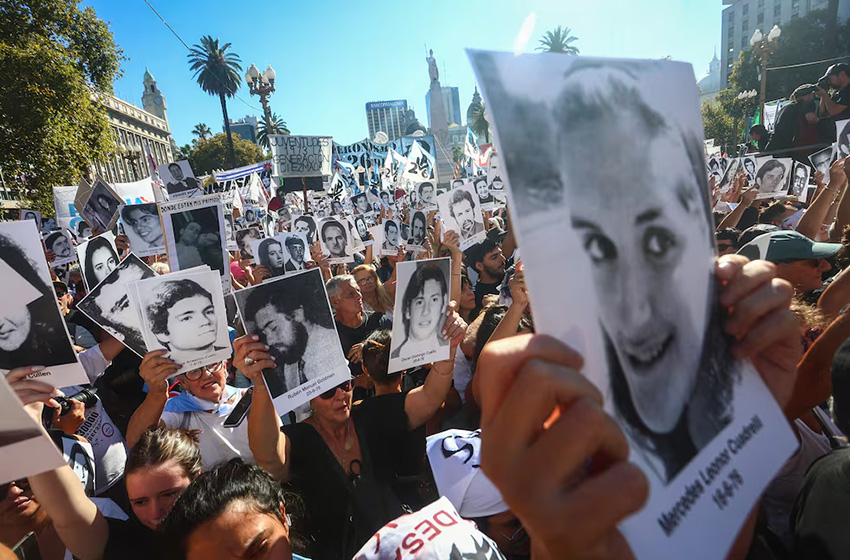
Fifty years after the last civic-military coup, on March 24th, the streets were filled with protesters chanting “Tell us where they are.” Faced with the repeated downplaying of the genocide by Javier Milei's government and amid rumors of a pardon for its perpetrators, 26 demonstrations took place across the country, drawing hundreds of thousands of people.
Within this framework, the teaching staff and students of Workshop on Research on Social Change of the Sociology Program at the University of Buenos Aires He conducted a survey of protesters, polling 317 participants over the age of 16 in the mobilization in the City of Buenos Aires, the scene of the main event.
Regarding this, the chair director, Julian Rebon, a member of the CLACSO Network, analyzed that “The mobilization for memory, truth, and justice demonstrates the existence of moral reserves within society that are activated in response to the government's relativization of the genocide. It also expresses the existence of a political culture and a democratic-popular struggle with a great capacity for mass mobilization. However, the tendency toward relative political and social homogeneity within this social force also reveals its limitations: it is a specific sector that is outraged and mobilized in response to the relativization of 'Never Again.' Many other sectors generally share the democratic consensus surrounding truth, memory, and justice, but they probably do not grant it the same hierarchy or relevance as this sector.”
The report concludes that those who participated in the march did so primarily accompanied by friends, family, and coworkers (75%). The event mobilized a wide range of participants. With greater female participation (58%) and a high level of education (49% with completed higher education), the march drew diverse generations, with three out of four respondents having been born in a democratic society. Chanting “Memory, Truth, and Justice,” the demonstrators characterized the mobilization not only as a commemoration but also as an act of resistance.
The demonstration reflected a long-standing culture of struggle: over 90% of the marchers had participated in previous mobilizations. The vast majority also took part in the Federal University March held on April 23, 2024, another massive protest against the Milei government. The overwhelming majority of the protesters are opposition supporters who view the current administration very negatively (93%). With relatively defined political identities, nearly half of the demonstrators identify with Kirchnerist Peronism and 12% with non-Kirchnerist Peronism. A significant 25% also identify with left-wing parties. Only 9% do not feel represented by any political force.
When asked which government had done the most for human rights since the return to democracy, Néstor Kirchner (78%) was by far the most frequently mentioned. He was followed by Cristina Fernández de Kirchner (10%) and, in third place, Raúl Alfonsín (7%). On the other hand, demonstrators strongly believed that Javier Milei (75%) had been the most reactive on the issue. Along these lines, 63% maintained that human rights are not respected in present-day Argentina.
In this context, almost half of the protesters expressed dissatisfaction with the state of democracy in the country. Among the main shortcomings or deficiencies they cited were the lack of justice, inequality, the demand for answers regarding the disappeared, and discontent with the current government. Their main achievements included freedom of expression, the popular vote, human rights, and justice. The latter, therefore, was revealed as both a victory and an outstanding debt.
Democratic dissatisfaction can be linked to the question of who holds the most power in the country. Among the responses, large corporations stand out (52%), followed by the United States government and the IMF (35%). Despite its institutional legitimacy, the Argentine government is identified by only 3% as holding this power, a figure that speaks volumes about the perception of its subordinate position compared to other actors.
As discussions about recent history are reignited and interpretations reviving the "two demons" theory resurface, political actors are placing the debate about who was tried and how to ensure their sentences are carried out at the center of the agenda. When asked whether military personnel over 70 should serve their sentences at home, the majority of protesters (87%) disagreed. The situation was different when they were questioned about the need to prosecute the guerrillas who committed crimes, where no consensus was reached. Similarly, there were differing opinions regarding whether the majority of society was complicit with the dictatorship; 40% agreed with this statement.
In times of controversy, it is also relevant to know the opinions on what the objective of the 76 coup was:
Six out of ten protesters believe the coup's main objective was to impose a new economic model. Among these, a majority believe it achieved this goal. On the other hand, among those who acknowledge that the primary objective was to discipline society, a majority believe it did not.
Amid firm consensus and open dissent, the march reaffirmed a sustained collective will in the face of attempts to undermine "Never Again." The massive turnout expresses the vitality of the moral reserves that reside in our society even in times of democratic backsliding. These reserves nourish the defense of hard-won rights, becoming a source of identity and generating legitimizing notions that promote collective action. Half a century after the civic-military coup, the struggle continues.

