
Laura Rovelli – UNLP-IdIHCS-CONICET and FOLEC-CLACSO

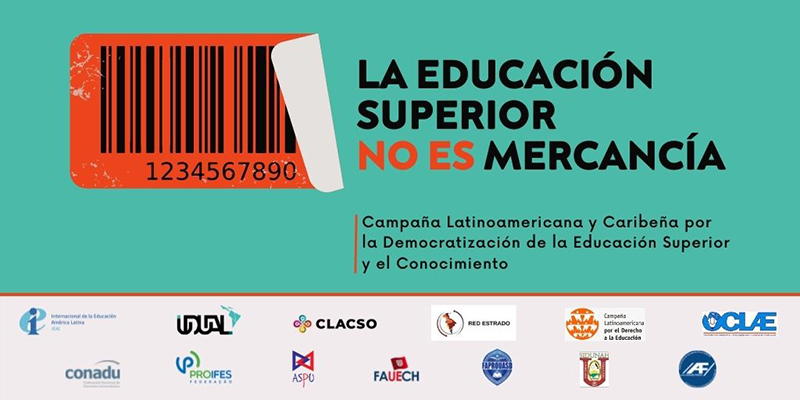
Within the framework of the “Latin American and Caribbean Campaign for the Democratization of Higher Education and Knowledge: Higher Education is Not a Commodity”, which is sponsored by numerous educational institutions for whom higher education is a social public good, a universal human right and a responsibility of the states, Laura Rovelli , a teacher-researcher at UNLP-IdIHCS-CONICET and coordinator of FOLEC-CLACSO, was interviewed.
The regional campaign, which is taking place on the road to the World Conference on Higher Education (WHEC2022) to be held in Barcelona, Spain, from May 18 to 20 and organized by UNESCO, was launched with the purpose of defending public higher education as a right and heritage of our peoples.
How is the hegemonic system of evaluation, accreditation, circulation, and communication of science configured globally?
In evaluating career paths, institutions, and research, we can observe a quantitative shift in recent decades that generates various distortions. The use of metrics based on journals and publications—what is known as the journal impact factor, or H-index—has produced many transformations in the realm of research and its practices. This is also true for university rankings: most of these rankings are also based on these journal and publication metrics, with criteria and methodologies established by commercial companies external to the university. And if we look at the career paths of those working in universities and research centers, there is greater emphasis, through modest rewards, on research achievements, at the expense of teaching and/or outreach. Specifically, the number of papers or publications of research results is considered the primary measure of research output or career development. What we see is a use and abuse of this type of evaluation metrics that has negative effects on quality and on the economic impact of science, because publication in these international commercial circuits, which is quite predominant in some disciplines, implies that part of the public funds for research are allocated to commercial publication, it pays.
How do center-periphery relations, inequalities between regions but also within each region, affect this scheme?
What all these evaluation practices do is limit the autonomy of research agendas that seek to connect with local issues or national development priorities, which may not be represented in journals or in commercial publishing opportunities within the mainstream circuit. Clearly, there is a disincentive to open access practices—a deeply rooted tradition, for example, in our region of Latin America and the Caribbean—because access to reading and publishing is restricted. Many researchers prioritize publishing in these mainstream, commercial circuits because it subsequently receives greater recognition in evaluations. All of this is a major distortion of a system that is predominantly public in its structure and funding sources. It also distances research from the demands of socio-productive sectors and immediate environments because the agendas are driven by an international discussion that is fundamentally disciplinary in nature.
What are the core elements of the most open, democratic and –it should also be said– popular system of knowledge production and circulation?
In general, I would say that it is necessary to redefine the notion of excellence, replacing it with a notion of excellence that is based on high-quality research, but also on research that is diverse, equitable, and socially relevant. There has been some progress, but much remains to be done to truly redefine this notion in the academic and scientific sphere, in cultural terms. We must also aim for a more qualitative evaluation, one that can be supported by the design and use of research-responsible, contextualized indicators that adequately reflect the output published in journals, as well as in books and institutional repositories of universities or science and technology organizations, so that this broader output can be used for evaluation. We also need a science free from payment restrictions for publication and circulation. The goal should be to prioritize or value collaborative knowledge production processes in evaluation, rather than, as is currently the case, a science measured by results, which is more individualistic.
In what sense should the idea of excellence be reformulated?
The dominant or hegemonic idea of excellence is more of a consensus reached by an academic community within a specific discipline. We are talking about a much broader concept of excellence, one that recognizes how science is enriched and strengthened by the diversity of local knowledge, but also by the diverse trajectories of different individuals who can participate in the process and whose participation and collaboration improve the processes of knowledge production and dissemination. It is about being able to consider excellence, or the quality of research, in interaction with society, in addressing relevant problems in its immediate environment at the national level, and in making that knowledge accessible through participation or interaction with non-academic actors when appropriate.
What experiences exist in Argentina, in the region, and in the world, where different evaluation and accreditation criteria are being established?
What we've seen in the last 10 years is an international and regional agenda, if you will, where a more organized questioning of all these criteria we were discussing is beginning. There are various international initiatives, such as the San Francisco Declaration on Research Assessment (DORA) and the Leiden Manifesto, which specifically criticize this quantitative shift in the evaluation of careers and research. In Latin America, since 2019, among other initiatives, there has been the Latin American Forum on Scientific Evaluation of CLACSO, which has been working for years to mobilize this issue in the region. There was a lot of discontent among teachers, researchers, and extension workers regarding this academic culture, so this sector was mobilized through various awareness-raising activities, establishing a common agenda for dialogue, and developing additional intervention tools for the design of responsible evaluation policies as instruments for improvement. We believe this is one of the initiatives for reaching a consensus. While there is no single model, there are some principles, such as those I mentioned earlier, of responsible academic assessment practices that we want to align with other stakeholders in the region. Their implementation will require further adjustments that take into account the historical context of each country's scientific and university system, but we believe in the possibility of establishing a common agenda, which is already quite well-defined, to reach an agreement on a regional transformation of academic assessment.
What is the international landscape of this dispute in political and institutional terms?
The outlook is quite favorable, in that many international science and technology organizations have incorporated responsible evaluation reform into their research agendas. It's a time of proliferating initiatives, declarations, diagnostic groups, and studies on this issue. Obviously, in parallel, the actions of international commercial publishers are also very strong, lobbying to enforce their metrics and to make minor adjustments so that nothing changes regarding what is published in their journals and their impact. Therefore, the challenge is enormous; it's a global, regional, national, local, and institutional transformation. Many scales and levels must be addressed simultaneously, where these small but substantial changes need to be made to generate a different research culture, to foster greater well-being within the academic system, to make our work relevant, and to restore meaning to academic activity in dialogue with society, especially in Latin America and the Caribbean, where this is urgent and necessary.
How does this type of configuration affect academic and teaching work?
This affects us greatly. In fact, CONADU has been producing a great deal of reflective material on evaluation within universities. Recognition of teaching is largely invisible, and the production of knowledge related to it is also relegated—something that would be invaluable to make available, disseminate in open repositories and national journals, and then incorporate into career evaluations. It's not just the teaching activity itself, but also the reflection on that work. The same applies to outreach: the co-production of knowledge, because it doesn't quite fit the traditional format of academic publication in articles, is relegated and rendered invisible in this discussion of more internationalized circuits. Therefore, I think the great challenge is to expand the infrastructure that makes this production, this knowledge, visible and to ensure it is prioritized in research evaluation processes. Institutional repositories play a key role here, fostering a culture of depositing these productions in open access so that they can then be revalued during the evaluation process.
What should happen at the World Conference on Higher Education in this field?
I believe we need to strengthen the Latin American perspective, trajectory, and reflection on these issues of academic and research evaluation, as well as on open access and open science. In a way, we need to discuss our trajectory, which prioritizes knowledge as a common good, managed non-commercially by communities. We must put into practice the idea that evaluation practices should foster a research culture that recognizes collaboration, openness, and commitment to society, and that offers opportunities for diverse career paths and diverse—if you will—talent within academia.
See : Higher education is not a commodity
If you would like to receive more information about CLACSO's training programs:
[widget id=”custom_html-57″]
to our email lists.

