
Inequalities in Latin America: tensions, debates and proposals
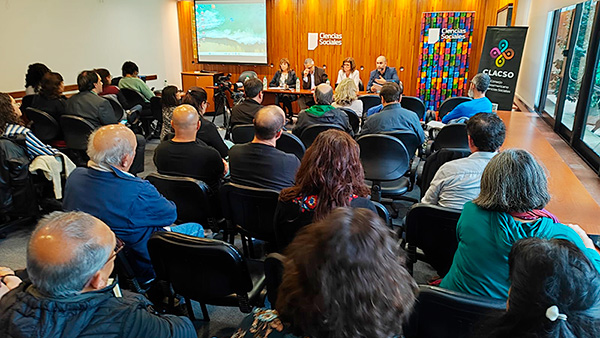

Tbroadcast of the Forum on Inequalities
INTERNATIONAL FORUM
Inequalities in Latin America: tensions, debates and proposals
16 al 18 April | City of Montevideo, Uruguay
Faculty of Social Sciences of the University of the Republic
Platform for Social Dialogue | Inequalities and poverty in Latin America and the Caribbean
Inaugural table


International Postgraduate School on Inequalities in Latin America and the Caribbean – Training Workshop 1: Social and Ecological Territorialities: Inequalities, Extractivism, and Development. Coordinator: Eduardo Gudynas (Uruguay)


Panel organized by the CLACSO Working Group "Poverty and social policies: Socioeconomic inequalities and social expectations"

Dialogue Table 1: Gender-based inequalities and public policies: key elements for a more equal future

Presentation of Rosario Aguirre's Essential Anthology: Care on the Agenda. Gender, Work and Time Use

Training workshop 2: Exclusion, inequality and informality in Latin America

Workshop 3: Can the tools of democracy dismantle the stronghold of gender inequality?

Dialogue Table 2: Inequalities in digital transitions. Debates on access to and appropriation of digital technologies

Dialogue Table 3: Addressing the challenges of work in the era of inequalities

Training workshop 4: Ethnic-racial discrimination and social inequality

Meeting of Platforms for Social Dialogue
Inequalities in Latin America: tensions, debates and proposals – Dialogue Table 4
Inequalities in Latin America: tensions, debates and proposals – Dialogue 5
Latin America and the Caribbean is the most unequal region in the world. Extremely high levels of wealth and opportunity concentration exacerbate poverty and create a web of multidimensional inequalities manifested in phenomena such as exclusion, discrimination, and oppression. These conditions stifle economic growth, threaten democracy, and negatively impact other dimensions of full citizenship.
This trend was only partially reversed during the first decade and a half of the 21st century, with the so-called leftward shift and the rise of progressive and populist governments. However, this process has now stalled due to the global hegemonic crisis and the rise of regressive, authoritarian, and far-right forces in various countries of the region.
El International Forum Inequalities in Latin America: tensions, debates and proposals It is part of the Platform for Social Dialogue Inequalities and poverty in Latin America and the Caribbean, which CLACSO has been promoting since 2022. The objective of this proposal is to achieve the production of evidence-based, critical, situated knowledge with a high impact on policy definition, public opinion formation and the positive transformation of the living conditions of the most vulnerable populations.
This International Forum seeks to bring together members of Latin American and Caribbean academia, social movements, organizations and collectives, and public policy decision-makers to develop transdisciplinary responses and multidimensional and multi-actor public policy recommendations to counteract growing inequalities.
The event will include various activities:
- International Graduate School on Inequalities in Latin America and the Caribbean
- Training workshops
- Social dialogue tables
- Book presentations
These spaces are designed as instances of training, exchange and social dialogue, where axes will be presented that energize the debates on the central theme of the Forum among a diversity of participants such as researchers, public policy decision-makers and members of social organizations.
INTERNATIONAL GRADUATE SCHOOL – TRAINING WORKSHOPS
DIALOGUE TABLES SOCIAL BOOK PRESENTATION
La International Graduate School on Inequalities in Latin America and the Caribbean, This intensive, in-person, postgraduate-level training program, focused on comparative and regional perspectives, aims to equip students with the skills to critically understand and analyze inequalities from diverse approaches and dimensions. Its purpose is to provide tools for debating and influencing public policy, thereby advancing the understanding of conflicts arising from inequalities.
This training proposal is expected to contribute to strengthening the dialogue between representatives of academia, social movements and public policymakers on the subject.
The School Postgraduate studies in Inequalities in Latin America and the Caribbean It will take place in the Faculty of Social Sciences of UDELAR.
The School's activities are free of charge (transportation, accommodation, and food will not be covered).
To approve the International Graduate School on Inequalities in Latin America and the Caribbean you must to take the 3 workshops of the academic program (April 16, 17 and 18) and participate in the forum activities (See the full program of activities).
Digital certificates of participation will be issued (CLACSO).
The workshops can also be taken individually (they are free with limited places).
- Tuesday, April 16 - 9.00 p.m. to 12.00 p.m.
Training Workshop 1
Social and ecological territorialities: inequalities, extractivism and development
Coordinator: Edward Gudynas (Uruguay) - Wednesday 17 for April - 9.00 p.m. to 12.00 p.m.
Training Workshop 2
Exclusion, inequality and informality in Latin America
They coordinate: Azael Carrera (Panama) and Jessica Lorena Pla (Argentina)
Training Workshop 3
Can the tools of democracy dismantle the stronghold of gender inequality?
They coordinate: Verónica Serafini (Paraguay) and Montserrat Sagot (Costa Rica) - 18 Thursday April - 9.00 p.m. to 12.00 p.m.
Training Workshop 4
Ethnic-racial discrimination and social inequality
They coordinate: Tania Pierre Charles (Haiti) and Lia Pinheiro Barbosa (Brazil)
If you have any questions about the workshops, you can contact us by email: [email protected]
Or write via WhatsApp: +5491138801388
GENERAL PROGRAM OF THE INTERNATIONAL FORUM
Training Workshop 1
Social and ecological territorialities: inequalities, extractivism and development
Hall L1 - Basement Mezzanine
Faculty of Social Sciences of the UDELAR
Coordinator: Edward Gudynas (Uruguay)
Latin American Center for Social Ecology (CLAES)
Roundtable organized by the CLACSO Working Group on Poverty and Social Policies
Socioeconomic inequalities and social expectations
Coordinator: Carmen Midaglia
Room B1 - First floor
Faculty of Social Sciences of the UDELAR
Participate
- Flavio Gaitán (Brazil): Analysis of income transfer policies in Mercosur countries
CLACSO Working Group on Poverty and Social Policies - Carlos Fidel (Argentina): Current dilemmas and challenges of democracy in Argentina and their impacts on social policies
CLACSO Working Group on Poverty and Social Policies - Guillermo Fuentes y Carmen Midaglia (Uruguay): Citizen preferences regarding the provision of welfare in Uruguay
CLACSO Working Group on Poverty and Social Policies
Welfare Group, Faculty of Social Sciences, Udelar - Gonzalo Salas (Uruguay): Perceptions and beliefs about the origin of inequality and redistributive policies
Institute of Economics, Faculty of Economic Sciences and Administration, Udelar
Welfare Group, Faculty of Social Sciences, Udelar - Aldo Marchesi (Uruguay): Between the poor and the workers: Political variations in social policies in the 20th century
Faculty of Humanities and Education, Udelar
Welfare Group, Faculty of Social Sciences, Udelar
Opening Ceremony
Luisa Cuesta Conference Room - Basement Mezzanine
Faculty of Social Sciences of the UDELAR
Participate
- Rodrigo Arim (Uruguay)
Rector of the University of the Republic - Carmen Midaglia (Uruguay)
Dean of the Faculty of Social Sciences
University of the Republic - Karina Batthyány (Uruguay)
Executive Director of CLACSO - Mauricio Tubío (Uruguay)
Department of Social Sciences, Northern Coastal Regional University Center
University of the Republic
Representative of the CLACSO Steering Committee
Moderator:
Pablo Vommaro (Argentina)
Academic Secretary of CLACSO
Dialogue Table 1
Gender-based inequalities and public policies: key elements for a more equal future
Luisa Cuesta Conference Room - Basement Mezzanine
Faculty of Social Sciences of the UDELAR
Participate
- Andrea Tuana (Uruguay)
Director of the NGO El Paso
Specialization in Gender-Based Violence, FLACSO Uruguay - Cecilia Tomassini (Uruguay)
Academic Unit of the Sectoral Commission for Scientific Research
University of the Republic - Valentina Perrotta (Uruguay)
Faculty of Social Sciences
University of the Republic
Co-coordinator of the CLACSO Working Group on Care and Gender - Montserrat Sagot (Costa Rica)
Center for Research in Women's Studies
Costa Rica university
Moderator:
Ana Laura Cafaro Mango (Uruguay)
Department of Social Work, Faculty of Social Sciences
University of the Republic
Presentation of the Essential Anthology of Rosario Aguirre
Care on the agenda. Gender, work and time use
Buenos Aires: CLACSO
Luisa Cuesta Conference Room - Basement Mezzanine
Faculty of Social Sciences of the UDELAR
Book available in open access at the Latin American Social Sciences Bookstore of CLACSO:
https://libreria.clacso.org/publicacion.php?p=3224&c=24
Participate
- Rosario Aguirre (Uruguay)
Department of Sociology, Faculty of Social Sciences
University of the Republic - Karina Batthyány (Uruguay)
Executive Director of CLACSO
Moderator:
María Fernanda Pampín (Argentina)
Director of Publications at CLACSO
Training Workshop 2
Exclusion, inequality and informality in Latin America
Hall L1 - Basement Mezzanine
Faculty of Social Sciences of the UDELAR
coordinate
Azael Carrera (Panama)
Justo Arosemena Center for Latin American Studies
Jessica Lorena Pla (Argentina)
Gino Germani Research Institute, Faculty of Social Sciences
University of Buenos Aires
Co-coordinator of the CLACSO Working Group on Inequalities, Social Structure and Policies
Training Workshop 3
Can the tools of democracy dismantle the stronghold of gender inequality?
Room F2 - Second floor
Faculty of Social Sciences of the UDELAR
coordinate
Verónica Serafini (Paraguayan)
Center for Analysis and Dissemination of the Paraguayan Economy
Latindad
Montserrat Sagot (Costa Rica)
Center for Research on Women's Studies at the University of Costa Rica
Dialogue Table 2
Inequalities in digital transitions. Debates on access to and appropriation of digital technologies
Conference hall Luisa Cuesta - Basement Mezzanine
Faculty of Social Sciences of the UDELAR
Participate
- Adriana Barros (Uruguay)
President of the National Human Rights Commission and representative of the Human Rights Thematic Unit
Broad Front - Ana Laura Rivoir (Uruguay)
Department of Sociology, Faculty of Social Sciences
University of the Republic - Martín Martínez (Uruguay)
Faculty of Information and Communication
University of the Republic - Lucila Finkel (Spain)
Vice President of the Spanish Federation of Sociology
Faculty of Political Sciences and Sociology
Complutense University of Madrid - Luis Bonilla-Molina (Venezuela)
International Research Center Other Voices in Education
Co-coordinator of the CLACSO Working Group on Digital Capitalism, Educational Policy and Critical Pedagogy
Moderator:
Mauricio Olivera (Uruguay)
Faculty of Information and Communication
University of the Republic
Dialogue Table 3
Addressing the challenges of work in the age of inequality
Conference hall Luisa Cuesta - Basement Mezzanine
Faculty of Social Sciences of the UDELAR
Participate
- Alejandra Picco (Uruguay)
Cuesta Duarte Institute
PIT-CNT - Marcelo Boado (Uruguay)
Department of Sociology, Faculty of Social Sciences
University of the Republic - Paola Mascheroni (Uruguay)
Department of Sociology, Faculty of Social Sciences
University of the Republic
Co-coordinator of the CLACSO Working Group on agricultural work, inequalities and ruralities - Viviana Barreto (Uruguay)
Director of projects
Friedrich-Ebert-Stiftung - Gabriel Kessler (Argentina)
Institute for Research in Humanities and Social Sciences
National University of La Plata - CONICET - Jessica Lorena Pla (Argentina)
Gino Germani Research Institute, Faculty of Social Sciences
University of Buenos Aires
Co-coordinator of the CLACSO Working Group on Inequalities, Social Structure and Policies
Moderator:
Juan Romero (Uruguay)
Department of Social Sciences, Northern Coastal Regional University Center
University of the Republic
Training Workshop 4
Ethnic-racial discrimination and social inequality
Hall L1 - Basement Mezzanine
Faculty of Social Sciences of the UDELAR
coordinate
Tania Pierre Charles (Haiti)
Research and Training and Social Center for Development
Lia Pinheiro Barbosa (Brazil)
Graduate Program in Sociology, State University of Ceará
Work meeting
CLACSO Platform for Social Dialogue: Inequalities and Poverty in Latin America and the Caribbean
Faculty of Social Sciences of the UDELAR
Dialogue Table 4
Territory, agri-food systems and environmental justice: towards building a fairer and more sustainable model
Luisa Cuesta Conference Room - Basement Mezzanine
Faculty of Social Sciences of the UDELAR
Participate
- Edward Gudynas (Uruguay)
Latin American Center for Social Ecology (CLAES) - María Inés Gazzano Santos (Uruguay)
Latin American Faculty of Social Sciences
Co-coordinator of the CLACSO Political Agroecology Working Group - Pablo Leandro Díaz Estévez (Uruguay)
Faculty of Humanities and Educational Sciences
University of the Republic
Co-coordinator of the CLACSO Working Group on Critical Studies of Rural Development - Lia Pinheiro Barbosa (Brazil)
Postgraduate Program in Sociology
Ceara state University - Ramiro Segura (Argentina)
Interdisciplinary School of Advanced Social Studies
National University of San Martín (UNSAM)
Co-coordinator of the CLACSO Working Group Latin American urban processes: (in)justices and (dis)equalities - Alberto Riella (Uruguay)
Department of Sociology, Faculty of Social Sciences
University of the Republic
Moderator:
Mauricio Tubío (Uruguay)
Department of Social Sciences, Northern Coastal Regional University Center
University of the Republic
Dialogue Table 5
Social inequalities and democracy: navigating the contradictions and challenges for building fairer societies
Conference hall Luisa Cuesta - Basement mezzanine
Faculty of Social Sciences of the UDELAR
Participate
- Marcela Schenck (Uruguay)
Faculty of Psychology and Faculty of Law
University of the Republic - Gerardo Caetano (UrUruguay)
Faculty of Social Sciences
University of the Republic
Co-coordinator of the CLACSO Working Group Decentralizing International Relations - Azael Carrera (Panama)
Justo Arosemena Center for Latin American Studies - Manuel Rivera (Guatemala)
School of Political Science
University of San Carlos of Guatemala - Paula Boniolo (Argentina)
Gino Germani Research Institute, Faculty of Social Sciences
University of Buenos Aires
Co-coordinator of the CLACSO Working Group on Comparative Social Inequalities: Social Classes, Gender and Ethnicity
Moderator:
Magdalena Broquetas San Martín (Uruguay)
Faculty of Humanities and Educational Sciences
University of the Republic
The Forum includes general questions that will guide all activities. Similarly, each dialogue includes a series of questions designed to spark discussion.
GENERAL QUESTIONS
- What are the multiple dimensions that constitute the web of inequalities in Latin America and the Caribbean? How do these dimensions connect and reinforce each other in the emergence of new inequalities and the persistence of existing ones?
- How have the political economies of inequality and concentration that determine the dynamics of accumulation in the region and its countries been shaped, and how is it possible to transform them?
- In institutional terms, how have unequal regimes been established, and what can be done to promote regimes oriented towards social justice?
- What are the experiences and practices of resistance and social and political organization that confront the social reproduction of inequalities and propose policies towards equality?
Dialogue Table 1
Gender-based inequalities and public policies: keys to a more equal future
- What are the multiple challenges that Latin American and Caribbean countries face in promoting equality and recognizing diversity?
- What has been the impact of public policies implemented in the region aimed at counteracting the inequalities experienced by women and diverse groups in Latin America and the Caribbean?
- What is the overall assessment of the struggles of feminist movements in the countries of the region, and what are their main challenges and opportunities?
Dialogue Table 2
Inequalities in digital transitions. Debates on access to and appropriation of digital technologies
- What actions are the governments of Latin America and the Caribbean taking to reduce inequalities in connectivity, access and social appropriation of digital technologies?
- Considering the dimensions of gender, class, ethnicity, and territory that permeate the contexts of production, circulation, and use of digital technologies, what are the limitations for public policies that seek to end these digital divides?
- What are the challenges in developing alternative forms of technological appropriation that transcend the prevailing ways in which digital technologies are produced, circulated, and used?
Dialogue Table 3
Addressing the challenges of work in the age of inequality
- What are the main labor inequalities we currently face? How do they impact the labor market?
- What role do public policies play in reducing workplace inequalities? What strategies can be implemented to promote inclusion and equity in the workplace? What role can trade unions and other labor organizations play in reducing workplace inequalities?
- How do new technologies and automation affect employment and labor inequalities? What are the future prospects for addressing the challenges of work in a context of growing inequality?
Dialogue Table 4
Territory, agri-food systems and environmental justice: towards building a fairer and more sustainable model
- How are agri-food systems related to the different uses and meanings of the land? What impact do they have on environmental justice at the local and global levels?
- What are the social, environmental, and economic implications of different food production and consumption models? What public policies can promote fairer and more sustainable agri-food systems that contribute to food and nutritional sovereignty for the population?
- What is the role of social movements and local communities in transforming current agri-food systems into fairer and more sustainable models? What experiences can be highlighted as examples to follow?
Dialogue Table 5
Social inequalities and democracy: navigating the contradictions and challenges for building fairer societies
- How are the contradictions between growing inequalities and democracies resolved in the region?
- How can we strengthen democracies to face the challenges of inequality and build fairer and more equal societies?
- What are the challenges that social movements pose to current democracies in the region at a time of the rise of the so-called new right?
- Political agroecology
- Anti-capitalisms and emerging sociability
- Appropriation of digital technologies and intersectionalities
- Digital capitalism, educational policy and critical pedagogy
- Care and gender
- Contemporary Right-Wing Movements: Dictatorship and Democracy
- Decentering International Relations
- Dinequalities, social structure and policies
- Comparative social inequalities: social class, gender and ethnicity
- Emancipatory feminist economics
- Critical studies of rural development
- Childhoods and youth
- Poverty and social policies
- Latin American urban processes: (in)justices and (in)equalities
- Agricultural work, inequalities and rural life
- Violence, governments and democracies
Organized by


support
Master's Degree in Contemporary Latin American Studies from the Department of Sociology at UDELAR

