
Justice for Berta Cáceres
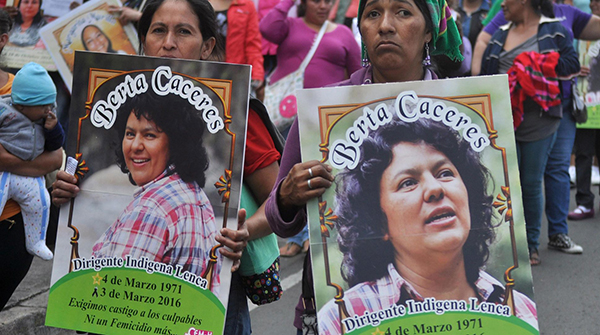

Four years ago, on the night of March 2-3, 2016, Berta Cáceres, a leader of the Lenca indigenous community, human rights activist, and environmentalist from Honduras, was assassinated in her home in La Esperanza, the capital of the southwestern department of Intibucá. The Honduran government had ignored a 2009 order from the Inter-American Commission on Human Rights to provide her with police protection due to repeated threats against her life.
A mother of four, Berta Cáceres, head of the Civic Council of Popular and Indigenous Organizations of Honduras (Copinh), had led the movement that in 2013 and 2014 succeeded in getting the World Bank and the Chinese construction company Sinohydro to abandon the construction of a hydroelectric dam on the western Gualcarque River, considered by the Lenca people as sacred and crucial to their survival.
“Berta Cáceres was such a significant figure for the Lenca people, for the Honduran people, that even though a criminal act was committed against her, she is always invoked in territorial disputes, in the collective imagination of resistance, in the need to transform the country due to militarization, corporate dispossession, corruption, and widespread violence,” her daughter, Bertha Zúñiga, current General Coordinator of COPINH, stated in an interview with the Argentine newspaper Página 12. She added: “It’s about saying that Berta will continue to sprout in many struggles, in new generations, in the struggles of women, which are so urgent and have a strong presence. That is what the legacy of Berta Cáceres means to us.”
Zúñiga denounced the impunity enjoyed by her mother's murderers and stated: “We must focus on preventing further crimes, on continuing to defend the rights of communities, the right to free, prior, and informed consultation, which is being threatened. And we must see how to confront the extractive model more forcefully, because it continues to advance… The control of communities is advancing through the control of water. Privatizations, projects in response to the scarcity that is already beginning to be felt in many places. Dams, the use of water for mining, large tourism projects, limitations on artisanal fishing and the promotion of industrial fishing. So many things are happening around water.”

Honoring the struggle and teachings of the Honduran leader, in 2017 CLACSO established the Berta Cáceres Prize and Scholarship, which highlight “the struggle of women for equality in Latin America and the Caribbean.” The aim is to recognize and promote the dissemination of the scientific work of women who investigate the processes that produce discrimination, inequality, and gender injustice in their various manifestations, such as femicide, segregation, and other forms of violence against women.
See also Berta Cáceres Award: Mesoamerican Women in the Defense of Territories and Collective Rights
If you would like to receive more information about CLACSO's training programs:
[widget id=”custom_html-57″]
to our email lists.

