
“The sexual division of labor continues to operate very strongly in Latin America and the Caribbean”
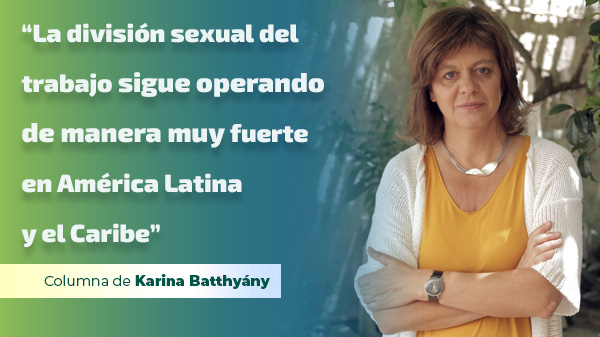
Transcript of Karina Batthyány's Column
en InfoCLACSO – July 19, 2023
Today, we will talk about childhood and youth in relation to one of the dimensions that structure our work in the Platforms for Social Dialogue (PDS), which are inequalities, where we have the generational dimension but it intersects with the gender dimension, the territorial dimension, the one linked to the processes of democracy and political and social participation of young people and the recognition of rights.
In short, we are working around the central theme of inequality that underpins our Platforms for Social Dialogue project at CLACSO. First and foremost, the centrality of this issue is very clear, as is the need for all voices to be included in the discussion surrounding it.
When I say all voices, I mean knowledge in its many forms, public policy, social movements, and organizations. Particularly in the area of childhood and youth, it is important that these voices are present, expressed, heard, and have an impact. And that is what is happening within the framework of the 5th Latin American and Caribbean Biennial, with various mechanisms for dialogue, panels, interaction, and cultural representations to demonstrate the importance of this issue.
– What is the importance of situating and addressing the task of care in the V Biennial for Our America?
– First, we are raising the issue of care work to discuss gender inequalities, but also social inequalities in the broadest sense. Second, we believe that this offers a path to the future in terms of new proposals for social organization that are more inclusive, fairer, and more democratic, and that talking about care work means talking about all of the above.
It is also important to discuss the profound cultural transformation that Latin America and the Caribbean need, one that recognizes the importance of care for life. The pandemic demonstrated this very clearly: without care, there is no life.
Furthermore, how the sexual division of labor continues to operate very strongly in Latin America and the Caribbean, determining that those of us who have to take care of things are women throughout our lives: taking care of our sons, our daughters, our fathers, our mothers, in general the domestic and private sphere.
We must not normalize this situation and think that “it’s always been this way.” You men also have much to contribute in the field of caregiving, and we need to redistribute the private sphere regarding caregiving responsibilities. This also holds a key political dimension for transformation: the possibility of generating transformative public policies based on the political potential of everyday life, but also within the broader context of the social structure.
– What was the significance of the Summit meeting between the European Union and CELAC?
– As CLACSO, we participated alongside civil society and academia in the space prior to the start of the Summit of Presidents of the European Union and CELAC, where the aforementioned topics were on the table.
We held several working meetings about how to advance the care society in Latin America and the Caribbean with CLACSO's strategic allies at the regional level, such as the Economic Commission for Latin America and the Caribbean (ECLAC), particularly its Gender Affairs Division, UN Women, and Oxfam. At the Summit, we analyzed the progress made and what has been achieved at the regional level.
The issue has gained visibility, meaning that 18 countries in our region are now discussing care work, and some progress has been made in terms of regulations and policies. Furthermore, discussions focused on strategies for placing care work at the forefront of public discourse and the resources needed to make this happen.
– New meetings are coming to South America, Central America and other places…
– Yes, indeed. It's somewhat the structuring axis of our actions at CLACSO these past few years. We're going to continue with the Social Dialogue Platforms (PDS) cycle, building on the 40-50-50 Cycle with a new chapter on the topic of democracies, specifically the right wing in Latin America and the Caribbean. This will take place in Montevideo, Uruguay, with a seminar discussing the role of the new right wing in our region today. Also within the framework of this 40-50-50 initiative, we have the Chile chapter, corresponding to September 2023, where we'll have several forum-style activities.
In addition, there are other activities on the agenda related to migration, environment, and climate change. This particular event will take place in Central America, specifically in Honduras. We always envision an instrument designed to promote social dialogue in Latin America and the Caribbean, based on the conviction that it is through this interaction between academia, social movements, and public policy that we can have a real impact and bring about transformation toward more democratic, just, and inclusive societies for our region.
Interviewed by Gustavo Lema.
If you would like to receive more information about CLACSO's training programs:
[widget id=”custom_html-57″]
to our email lists.

