
Forensic science as a source of knowledge about human rights violations
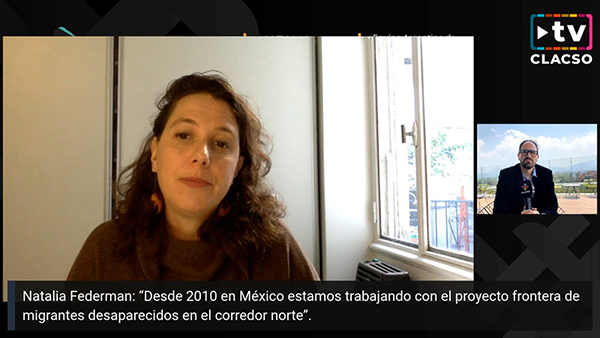
The lawyer specializing in Human Rights, Natalia FedermanThe newly appointed executive director of the Argentine Forensic Anthropology Team (EAAF), Federman, participated in the InfoCLACSO event on Wednesday, May 4th. She has 20 years of experience investigating and combating impunity for crimes committed during Argentina's last civic-military dictatorship, working with both civil society organizations and various government agencies. She has also investigated the identification system, the administrative management of unidentified deceased individuals, and its impact on enforced disappearances in contemporary Argentina. Federman has collaborated with the EAAF on both of these issues in the past.
Interviewed by Gustavo Lema
-What is your personal impact and how do you interpret this great moment as the new executive director of the Argentine Forensic Anthropology Team?
First, it's a personal challenge, because leading an organization comprised of professionals from different fields than my own, despite my close ties to the team in the various places I've worked, means I can collaborate with or draw upon the expertise of the EAAF. I must say that I've always worked in multidisciplinary groups, but this is the first time I'm the only lawyer. Second, it's another challenge for the organization, which opted for an executive director who isn't from the team, hasn't been part of the organization in its 37-year history, and has always been led by founding members. And in this new phase, with Luis Fondebrider leaving to take up a position at the International Committee of the Red Cross, it was decided to launch an open application process for the executive director position. This decision demonstrates the organization's historical strength and its ability to navigate a change in leadership with considerable stability and institutional maturity.
In Argentina, the presence of the Argentine Forensic Anthropology Team is very strong and impactful in its work, and the same is true in Mexico… Could you tell us a bit about the wide variety of projects carried out in different countries that provided a high level of experience and, above all, fieldwork in places with very diverse realities, but also where the logic of investigation and collaboration with the justice system—your work—was fundamental in ensuring that justice was served in many cases? There are emblematic cases in Argentina, but also in Mexico with relatively recent and very dramatic cases. What are the most representative cases today?
Throughout its history, the Team's objective has always been to collaborate with the justice system, recognizing that even when justice is not possible, forensic science can still contribute. This means considering forensic science beyond the judicial process, also as a tool for generating knowledge and information about human rights violations. In this sense, it also strengthens the demands of civil society and family organizations regarding their claims for justice and the violence they suffered. The EAAF's intervention in the El Mozote massacre in El Salvador brought to light the scale of the massacre, revealing that many of the victims were children and adolescents. This forensic dimension, which brings to light the demands for justice and the denunciations of families, and the attempts to deny this reality by claiming it's all conspiracies or political maneuvering, is where forensic science lends weight to the claims. Not because the claims themselves were inherently sound, but because forensic science demonstrates that the facts are not irrefutable. In that sense, for example, during the period when impunity laws were in effect in Argentina, the Team continued working to identify the victims. This also made it clear over time that society could no longer tolerate that level of impunity, because these crimes had occurred and these people were missing. Therefore, continuing to work in a context of impunity strengthened the demand for justice. This approach illuminated the work throughout the region, and even in other countries we worked with very different perspectives and realities, sometimes in a post-war context, identifying fallen soldiers. An example of this is the work done in the Falkland Islands, with the support or intervention of the International Committee of the Red Cross and a dialogue between the Argentine and British governments to identify fallen soldiers who had been buried without names. This work also moves beyond the traditional human rights framework and into the realm of international humanitarian law. In Mexico, in particular, we have been working since 2010 on the Border Project, identifying missing migrants in the northern corridor. The Border Project has been operating for 12 years, involving collaboration with civil society organizations and government agencies in the United States, Mexico, El Salvador, Guatemala, and Honduras. We have documented approximately 1640 missing migrants and have already assisted in the identification of 261. It is a massive collaborative effort, as it involves working with forensic facilities in the United States and Mexico, with organizations representing families of missing migrants, and attempting to address this new phenomenon of disappearances among migrants.
-At CLACSO, we have a very specific case: Eric Domergue, a producer on our program, recovered his brother's remains thanks to the concrete work of the Argentine Forensic Anthropology Team (EAAF). Therein lies a personal and social dimension that is not only irrefutable, but also incredibly powerful, especially in terms of personal and familial resolution, transforming the EAAF's investigation into a pacifying force within the family. And with the enduring demand for the search for their disappeared relatives, for example, in Argentina during the military dictatorship, and elsewhere as well, it becomes something truly terrible, one of the most diabolical aspects of Latin American dictatorships. How does the EAAF address these personal processes within the context of the long-lasting damage caused by Latin American dictatorships?
-I'm aware of Eric Domergue's story… Indeed, the EAAF was created to provide answers to the family in that regard, with the conviction that the objective was to work very closely with the families' claims and ensure that the forensic work would provide them with answers. When notifying an identification, it's necessary to inform them that there's nothing more that can be done in certain cases or that there's no more evidence to gather to prove a particular situation. Particular attention is always paid to being clear with the family and considerate of their feelings. I believe that Argentina, in particular (not only in post-dictatorship processes but also in other post-conflict processes), demonstrates that the identification of individuals and the restitution of remains to their families is essential for lasting peace. Part of the explanation for why Argentine democracy is so strong in its commitment to the "Never Again" movement, or why there is so much cohesion around it, has to do with the fact that forensic science has demonstrated that this happened, and that becomes unacceptable to society as a whole. There may be a very small or extreme minority that considers these deaths justified, but the vast majority, upon learning of a person who was tortured, murdered, and buried unidentified, consider these things unacceptable for democratic coexistence. I believe that this relationship between forensic science, identification, and the right of families to grieve is part of what must be considered in post-conflict and post-dictatorship processes to build something lasting and solid.
-In this context, what are the expectations for this meeting in the master dialogue on Memory and Human Rights?
The opportunity to meet, discuss things together, and listen to each other is always welcome. I also think these past two years have allowed me to reflect a great deal. The pause (during the pandemic) allowed me to think about some aspects more deeply, for example, the right to mourn. When the pandemic meant that in many countries people were buried without being able to say goodbye to their families, the way the victims of the pandemic were treated in overflowing morgues, the designated areas in cemeteries—a number of things that suddenly, for many months of the pandemic, brought the issue of death and the right to mourn to the forefront. Even the Inter-American Human Rights System issued specific recommendations on the matter. So, meeting after two years and talking about memory and the peace process, particularly as it relates to us at the EAAF, for example, the right to mourn, is an opportunity to share what we have reflected on during these years.
In this context, the issue of femicides, with its many facets, encompasses not only violence against women but also the erratic way in which many media outlets reported on the murders of women in different parts of the world. But undoubtedly, the issue of investigation and justice is paramount: how is it handled, what is the overall situation regarding femicides, and what kind of collaborative investigations are specifically undertaken in the pursuit of justice?
In 2010, in Mexico specifically, we began working on what later became known as the Campo Algodonero case. Based on the documentation of that case, the Inter-American Court of Human Rights issued its 2010 ruling (the events occurred before that year), which obligated states to adopt specific measures regarding the deaths of women when they were gender-related. That experience made the EAAF a leading authority in forensic science and homicide investigations. In Argentina, at that time, the Ministry of Security promoted a crime scene protocol for femicides or deaths that could be presumed to be femicides. Now, times are changing, and the agenda is expanding. It's no longer just about specific protocols for the deaths of women, but also for transfemicides and gender-based violence, and we are seeking to broaden that scope. We work daily; we have a Latin American School for Forensic Sciences and a specific one for femicides. We work training state agencies and police officers in crime scene intervention. We are considering how to expand this work to other scenarios involving gender-based violence and how to adapt to this new reality. We also need to work more with civil society to provide training on what constitutes a proper investigation, how to demand it, and how to strengthen the demand for justice.

DOCUMENTARY The Traces of Death and Anthropology
If you would like to receive more information about CLACSO's training programs:
[widget id=”custom_html-57″]
to our email lists.

