
Afro-Latin-American and Caribbean Studies
4th Tourma | Virtual modality (2022-2023)
MODE: VIRTUAL
Specialization: 40 credits, 360 hours / classrooms
International course: 9 credits, 90 hours / classrooms
Duration: October 2022 to September 2023
The credential and certification of Specialization and the International Course will be carried out by the Latin American Council of Social Sciences (CLACSO) and the Latin American Faculty of Social Sciences (FLACSO Brazil)
GENERAL COORDINATION
Mara Viveros Vigoya, Nilma Gomes and Rita Segato
ACADEMIC COORDINATION
Karina Bidaseca
ACADEMIC COMMITTEE
Salete Valesan Camba, Mara Viveros Vigoya, Nilma Gomes, Rita Segato and Karina Bidaseca
The International Specialization Course in Afro-Latin American and Caribbean Studies is a proposal for intensive post-graduation training that aims to disseminate current research and debates on the history, trajectories and social dynamics of the Afro-descendant population of Latin America and the Caribbean within a critical decolonial, Afro-Latin American perspective, Afro-Caribbean and Afro-feminist. It also constitutes a space that seeks to interweave academic, political, educational, and aesthetic reflections and promote the creation and strengthening of the field of studies.
In Latin America and the Caribbean, coloniality is two constitutive and specific elements of a pattern of power in which the imposition of an ethnic-racial classification of its population plays a fundamental role. Becoming aware of the coloniality of power that operates in both the macrosocial, microsocial and subjective spheres requires addressing the epistemes of non-African identity and the racial quest as a colonial historical invention whose effects continue to affect the social destiny and daily existence of those who inhabit this region. At the same time, reconstitute power as a network of relations that indissociatively intertwines at least three systems of oppression – “race”, gender and class – and the different matrices that compose the “historical alterities” derived from racialization. In every nation, this implies offering a new perspective on these relationships and promoting more effective actions, based on the specificities of Afro-Latin American and Caribbean thought and creativity. Finally, it implies understanding and confronting the processes of discrimination, exclusion, criminalization, genocide, feminism and youth of Afro-descendant populations and participating in the creation of conditions for the production of own knowledge about these processes and adequate combat strategies to confront these forms. of violence.
In the last decade we witnessed in the region that we could take an anti-racist turn to designate this change that occurred in the way in which attention is given to racism in the public sphere and its effects, in a work perspective. At the same time, in the last two years, the processes of racist oppression and violence that constitute coloniality have become evident – as expressed by the disproportionate ethnic-racial distribution of victims of the Covid-19 pandemic, the global movement of protest and awareness of racism caused by police violence and the deaths of George Floyd, in Minneapolis, and other racialized young people in various countries in the region. Além disso, in many contexts, this movement is promoted – with different levels, intensity, magnitude and results – to the elaboration and implementation of public policies to combat racism.
This training program seeks to account for the non-academic growth of the intellectual and political organization of black Latin American and Caribbean women and men and of an Afro-oriented theoretical and intellectual production that is investigating and confronting racism in its multiple dimensions and levels, from a critical and emancipatory perspective.
- Disseminate and promote research on theories, histories, philosophies, knowledge, arts and cosmologies of African heritage on the Latin American and Caribbean continent.
- Provide conceptual and historical elements that allow us to address, from critical and intersectoral perspectives, the processes of racialization of Afro-descendant populations and their effects in social and daily life.
- Promote intersectoral and situated analyzes that make it possible to understand the complexity of the existence of Afro-descendant women, men and LGBTQIA+ and elevate the recognition of their rights.
- Train and train for the development, support and endorsement of actions and policies aimed at guaranteeing the human rights of Afro-descendant populations in the face of criminalization, genocide, feminicide and black youth.
- Analyze the conventions, agreements and international resolutions that reconhecem and safeguard the rights of Afro-descendant populations in the scope of the International Decade of African Descent.
The specialization and International Course is intended for undergraduate and post-graduation students; teachers of all ages; activists and activists of Afro-descendant organizations, unions, social movements and political parties; public officials; printing workers; members and managers of non-governmental and professional organizations interested in Afro-Latin American and Caribbean studies.


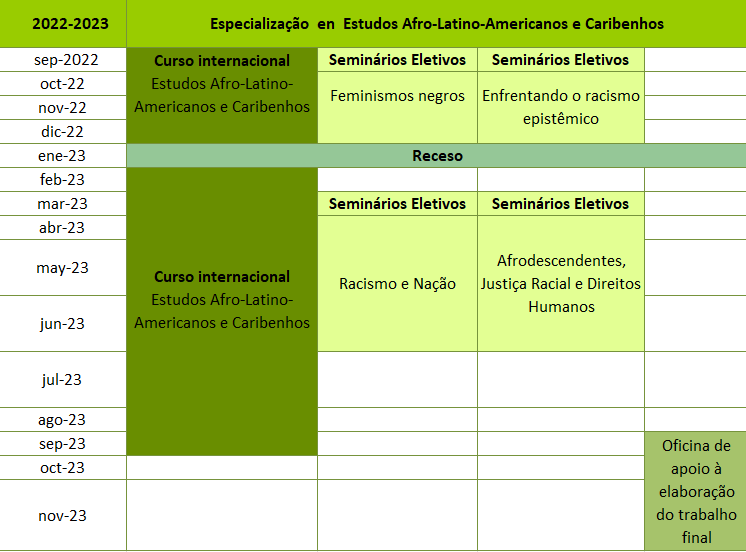
The specialization in Afro-Latin American and Caribbean Studies will last 12 months and for the certification to be required: the completion of an international course, two virtual seminars eletivo in the curricular structure, a support office for the drafting of final work and the elaboration of the final work.
The International Course is composed of lectures by two Program Coordinators and the teaching team. For certification, the completion and approval of a final work is required, in addition to participation in at least 80% of the activities and tasks proposed by teachers.
The International Course Specialization will take place between September 2022 and August 2023.
The students of Specialization and the International Course receive the support of academic tutors who will accompany the realization of two virtual seminars and guide the production of the final work.
Once the seminars are completed, the students will have a period of four months to submit their final work. If you are pending the conclusion of credits, you will also have this deadline to fulfill them.
The International Course Specialization requires CLACSO and Flacso Brazil certificates.
The Specialization has a total workload of 360 hours in the International Course 90 hours.
CLARIFICATION
To register for a complete Specialization, you do not need to register separately for the International Course.
The courses can be taught in Spanish or Portuguese interchangeably, both of which are official languages of CLACSO and Flacso.
The virtual seminars will be offered in both Spanish and Portuguese. Likewise, the bibliography may be offered in the two official languages of the course. As two students intervene in the discussion forums, they can also be used in different languages. The final monographic work may be in Spanish or Portuguese.
Summary: Thinking about Latin America and the Caribbean is thinking about race completely outside of multiculturalism and the political identities of the globalized spectrum, which constructs the myth of “race” as an ethnicity or substantive cultural difference founded on separation. A “race” on our continent is a product of racialization of colonial origin that varies according to different national contexts. There are three main eixos hairs that the father of capitalist power classifies as people: work, sex and race. However, the race category is the structuring center of coloniality-modernity. Starting from this common base, the main conferences will address questions related to Afro-descendants in Latin America and the Caribbean in the fields of history, philosophy, religion, arts, law, gender relations, politics, violence and education, among others.
Summary: Thinking about Latin America and the Caribbean is thinking about race completely outside of multiculturalism and the political identities of the globalized spectrum, which constructs the myth of “race” as an ethnicity or substantive cultural difference founded on separation. A “race” on our continent is a product of racialization of colonial origin that varies according to different national contexts. There are three main eixos hairs that the father of capitalist power classifies as people: work, sex and race. However, the race category is the structuring center of coloniality-modernity. Starting from this common base, the main conferences will address questions related to Afro-descendants in Latin America and the Caribbean in the fields of history, philosophy, religion, arts, law, gender relations, politics, violence and education, among others.
Coordination: Rosa Campoalegre Septien (CIPS, Cuba) and Claudia Miranda (Universidade Federal do Estado do Rio de Janeiro, Brazil)Summary: The concept of race, as a socially constructed attribute in time and space, still functions as a parameter for the allocation of people in the social structure. These affirmative actions emerge as a strategy to combat racism and can be implemented practically in all spheres of civil society, mainly aimed at dismantling the social structure that places Afro-descendants in disadvantaged economic and symbolic positions. The course is based on the epistemological approach of Afrocentricity, in which the people of Africa and the diaspora must be the center of the study of two social phenomena, therefore, the protagonists of their own history.
Coordinator: Anna Canavarro Benite (Universidade Federal de Goiás, Brazil) and Anny Ocoró Loango (Flacso Argentina)
Summary: The racialization of power relations between the new social and geocultural identities attributed was supported by the fundamental legitimizing reference of the Eurocentric character of the pattern of power, material and intersubjective. Only the elites who produce the hegemonic discourses that shape the matrix of otherness that constitutes the nation.
Coordinator: Santiago Arboleda Quiñónez (Universidade Andina Simón Bolívar, Ecuador) and Saúl Hernández Rosales (Escola Nacional Superior Autônoma de Belas Artes do Peru, Venezuela).
The seminar aims to discuss the current debates on Afro-Latin American and Caribbean history from critical perspectives with a focus on racial justice and human rights. Reconstructing the three systems of oppression "race", gender and class, and the different matrices that comprise "historical alterities" derived from the racialization of bodies places justice at the center of the dinner. He knows how to understand and confront the processes of discrimination, exclusion, criminalization, genocide, feminicide and youth murder of Afro-descendant populations and participate in the creation of conditions for the production of his own knowledge on these processes and strategies of struggle and emancipatory pedagogies against esses necropolitical systems.
Coordinator: Jackeline Aparecida Ferreira Romio (Universidade de São Paulo, Brazil), Tarsila Flores, (National Mechanism for the Prevention and Combat of Torture, Fiocruz, Escola Nacional de Saúde Pública, Brazil), Cidinalva SCNeris (Universidade Federal do Maranhão, Brazil) and Katia Regis (Universidade Federal do Maranhão, Brazil). Brazil)
The office is a training space intended to guide the preparation of final specialized monographic work. Students will receive accompaniment and guidance in the elaboration of the object of analysis, in their translation into a practical study problem, in the construction of a working plan, in the development of argumentative networks and in the definition of analytical conclusions. These tasks will be carried out individually and collectively by means of exchange between peers and as a professor responsible for the office, through the discussion forum. The objective of the office is to produce the outline of the final work of the specialization. The final monographic work may be in Spanish, Portuguese or English.
CM Plenary: you belong to a Plenary Member Center of CLACSO
Associate CM: You belong to an Associated Center of CLACSO.
Without link: You do not have any links to CLACSO.
|
Payment in a parcel until 10/10 |
Payment in a plot on 10/10 |
Payment in 3 parcels | |
| CM Pleno | $400 | $570 | USD 750 (3 x USD 250) |
| CM Associate | $530 | $700 | USD 1020 (3 x USD 340) |
| No connection | $600 | $960 | USD 1290 (3 x USD 430) |
In all cases, payment may be made by letter of credit, deposit or bank transfer.
The certification of the Specialization and the International Course will be carried out by the Latin American Faculty of Social Sciences (Flacso Brasil) and the Latin American Council of Social Sciences (Clacso).
CM Plenary: You belong to a Plenary Member Center of CLACSO.
Associate CM: You belong to an Associated Center of CLACSO.
Without link: You do not have any links to CLACSO.
| Payment in a parcel until 10/10 | Payment in a plot on 10/10 | Payment in 3 installments | |
| CM Pleno | $115 | $230 | USD 315 (3 x USD 105) |
| CM Associate | $175 | $290 | USD 420 (3 x USD 140) |
| No connection | $240 | $360 | USD 540 (3 x USD 180) |
In all cases, payment may be made by letter of credit, deposit or bank transfer.
The International Course Specialization is intended for graduates and post-graduation students; teachers of all ages; activists and activists of union organizations, social movements and political parties; public officials and legal agents, day laborers, communicators and press consultants; members and leaders of non-governmental and professional organizations interested in the matter.
To participate, you must register through the website.
Registration will be open between July 26 and October 13.
Upon completion of the registration process, you will receive confirmation by e-mail. On the start day of the course, access data to the virtual platform will be sent.
If any of the mandatory training sessions are not completed, in all cases, an additional amount must be paid to recover the aforementioned credit.
Exceptional criteria: In exceptional cases (health, family or humanitarian questions) in the first two months of the start of the Specialization, someone may request a leave of absence and resume it the following year. In all cases, the reasons justifying the request must be presented in writing. Two months after the start of the course, it will no longer be possible to request this procedure.
It will only be possible to refund the payment value in cases where CLACSO and Flacso Brasil cancel the holding of some seminar.
The classrooms will begin in October 2022 and will be completed in September 2023.
All students will receive the necessary instructions to access the classrooms, bibliography and discussion forum through the CLACSO virtual platform.
The navigation access to the Virtual Training Space happens in a simple and clear way. In any case, a technical and academic support team will always be at your disposal.
You must approve the International Course, two (2) eletive virtual seminars, the support office to carry out the final work and carry out the final integrative work.
Without exception, to receive the specialization certificate all training spaces must be completed and approved.
To obtain the Specialization certificate, you must complete a final monographic work. The support office for the completion of final work is required and will assist you in the process.
You must participate in the classrooms and activities proposed by the teachers and carry out the final monographic work.
However, the International Course Specialization requires certificates for Flacso Brazil and Clacso. The specialization has a total workload of 360 hours and an international course of 90 hours. The sending of the certificate of completion will be done digitally and is completely free. The international Specialist diploma is issued by the Secretary-General of the Flacso, located in Costa Rica. The values and procedures for issuing and sending the international diploma can be consulted on the Brazil Flacso page: https://flacso.org.br/emissao-de-diplomas-certificados-e-historicos-de-notas-2/
The Specialization in the International Course requires credentials from Flacso Brazil and Clacso. The international Specialist diploma is issued by the Secretary-General of the Flacso, located in Costa Rica. The values and procedures for issuing and sending the international diploma can be consulted on the Brazil Flacso page: https://flacso.org.br/emissao-de-diplomas-certificados-e-historicos-de-notas-2/
See the table of prices and modalities, available above.
If the international certification is not issued by the General Secretary of the Flacso, an additional fee must be paid.*
*The issuance of the printed diploma, together with the grade history, costs USD 222,00 (two and twenty dollars). The value includes the sending of two printed and assigned documents for the student's residential address. The procedures for issuing and sending the international diploma can be consulted on the Brazil Flacso page: https://flacso.org.br/emissao-de-diplomas-certificados-e-historicos-de-notas-2/
Please feel free to contact us through two e-mails [email protected] and [email protected]
Send a WhatsApp to +5491138801388
For discounts for groups and institutions, you can contact us at [email protected]
More specializations and international courses
[widget id=”glob_block_5_widget-136″]

