
Afro-Latin American and Caribbean Studies
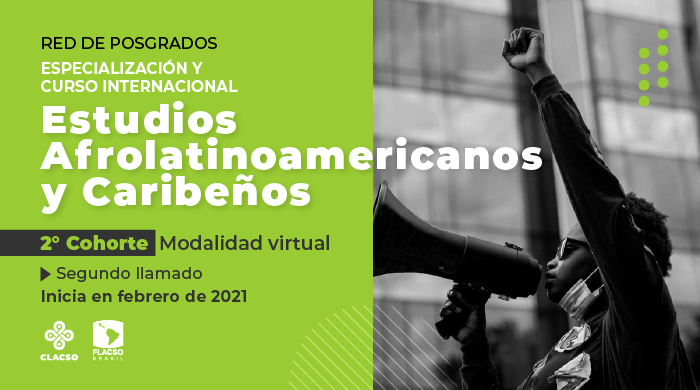
2nd Cohort (2020) – Second call
VIRTUAL MODALITY
Specialization: 40 credits, 360 lecture hours
International course: 9 credits, 90 hours/lecture
Duration: February to December 2021
The accreditation and certification of the Specialization and the International Course will be carried out by the Latin American Council of Social Sciences (CLACSO) and the Latin American Faculty of Social Sciences (FLACSO Brazil)
GENERAL COORDINATION
Mara Viveros Vigoya (National University of Colombia)
Nilma Gomes (Federal University of Minas Gerais, Brazil)
Rita Segato (University of Brasilia, Brazil – National University of San Martín, Argentina)
ACADEMIC COORDINATION
Karina Bidaseca (University of Buenos Aires and National University of San Martín, Argentina)
ACADEMIC COMMITTEE: Salete Valesan Camba (FLACSO, Brazil), Mara Viveros Vigoya (Unal, Colombia), Nilma Gomes (UFMG, Brazil), Rita Segato (UnB, Brazil and UNSAM, Argentina), Karina Bidaseca (CLACSO, UBA and UNSAM, Argentina)
The Specialization and International Course in Afro-Latin American and Caribbean Studies is an intensive postgraduate training program that seeks to disseminate current research and debates on the history, trajectories, and social dynamics of the Afro-descendant population of Latin America and the Caribbean from critical decolonial, Afro-Latin American, Afro-Caribbean, and Afro-feminist perspectives. It also constitutes an academic, political, educational, and aesthetic space, as well as a platform for the creation of a collective within this field of study.
In Latin America and the Caribbean, coloniality is a constitutive and specific element of a power structure in which the imposition of an ethno-racial classification on its population played a key role. Becoming aware of this coloniality of power, which operates in macro-social, micro-social, and subjective spheres, requires addressing the epistemologies of Afro-America and the racial question as a colonial historical invention whose effects continue to influence the social destiny and daily lives of those who inhabit this region. In turn, recognizing power as a web of relationships that inextricably intertwines at least three systems of oppression—race, gender, and class—and the various matrices that shaped the “historical alterities” derived from racialization in each nation, implies adopting a new perspective and undertaking more effective actions based on the specificities of Afro-Latin American and Caribbean thought and creativity. Likewise, it involves understanding and confronting the processes of discrimination, exclusion, criminalization, genocide, femicide and juvenicide of Afro-descendant populations and participating in the creation of conditions for the production of knowledge about these processes, and of strategies to fight against these forms of violence.
The processes of oppression and racist violence affecting people of African descent in the African diaspora have been confronted and combated by the organizational strength of Black women and men. Black movement organizations, Black women, and collective actions undertaken by Afro-Latin Americans and Afro-Caribbeans have brought racism and racial oppression to light. In some contexts, with varying levels, intensity, scope, and outcomes, these movements have driven the development and implementation of public policies to combat racism. This training program aims to reflect the academic growth of the intellectual organization of Black Latin Americans and Caribbeans, generating Afro-oriented theoretical and intellectual production that investigates and confronts epistemic racism and is committed to the development of emancipatory knowledge.
- To publicize and promote research on theories, histories, philosophies, knowledge, arts and cosmologies of African heritage in the Latin American and Caribbean continent.
- To provide conceptual and historical elements that allow for critical and intersectional approaches to addressing the racialization processes of Afro-descendant populations and their effects on social and daily life.
- Promote intersectional and situated analyses that allow understanding of the complexity of the existence of Afro-descendant women, men and LGBTIQ people and encourage the recognition of their rights.
- To train and empower for the design, monitoring and evaluation of actions and policies aimed at guaranteeing the human rights of Afro-descendant populations in the face of criminalization, genocide, femicide and black youth murder.
- Analyze the international conventions, agreements and resolutions that recognize and protect the rights of Afro populations within the framework of the Decade for People of African Descent.
The Specialization and the International Course are aimed at undergraduate and postgraduate students; teachers at all levels; activists and members of Afro-descendant organizations, trade unions, social movements and political parties; public officials; press workers; members and managers of non-governmental organizations and professionals interested in Afro-Latin American and Caribbean studies.


The Specialization in Afro-Latin American and Caribbean Studies will last one year and requires for its accreditation the completion of: an intensive seminar, an international course and two optional virtual seminars from the curriculum; a writing support workshop; and the preparation of a final monograph.
The international course consists of lectures given by the program coordinators and the teaching team. Accreditation requires the completion and approval of a final project, as well as participation in at least 80% of the activities and assignments proposed by the instructors.
The specialization and international course will take place between February and December 2021.
Students in the specialization and international course will have the support of academic tutors who will accompany them through the virtual seminars and guide them in completing their final projects.
Once the seminars have concluded, students will have four months to submit their final project. If they still need to complete a credit, they will also have four months to do so.
The specialization and international course are certified by CLACSO and FLACSO Brazil.
The specialization certifies 360 hours/chair of work; the international course 90 hours/chair.
“Afro-Latin American and Caribbean Studies”
Summary: The intensive seminar will feature six lectures by intellectuals in the field, addressing some of the main debates that have arisen from the theoretical perspective of “intersectionality” in different academic and research contexts.
The Black Movement will also be analyzed as a social movement, a key player in anti-racist and democratic struggles and processes of social emancipation in Latin America. In the 21st century, this movement is organized in different ways and operates in various spheres: political, social, academic, artistic, religious, and others.
The critique of political identities during the multicultural period will be presented, along with the impact of the decolonial perspective and the thought of Aníbal Quijano, with his formulation of the invention of race and his definitive attribution of historicity to the racial theme.
Finally, the concept of Africanism as a political-cultural category will be debated, allowing us to glimpse an Afro-American feminism and intersectionality as a methodological proposal of the multiple and plural processes of resistance and also of insurgent epistemologies.
Coordination: Karina Bidaseca (National University of Buenos Aires and National University of San Martín, Argentina)
“Afro-Latin American and Caribbean Studies”
Abstract: Thinking about Latin America and the Caribbean means thinking about race completely outside the framework of multiculturalism and the political identities of the globalized spectrum, which constructed the myth of “race” as ethnicity or substantivized cultural difference founded on separation. “Race” in our continent is a product of racialization of colonial origin that varies according to different national contexts. There are three main axes through which the capitalist power structure classifies people: work, sex, and race. However, it is the category of race that is the structuring center of coloniality-modernity. From this common ground, the keynote lectures will address topics related to being Afro-descendant in Latin America and the Caribbean in the fields of history, philosophy, religion, the arts, law, gender relations, politics, violence, and education, among others.
Abstract: The racialization of power relations between newly assigned social and geo-cultural identities was the foundation and fundamental legitimizing reference point for the Eurocentric nature of the power structure, both material and intersubjective. It was the elites who produced the hegemonic discourses that shaped the matrix of otherness that constitutes the nation.
Coordination: Santiago Arboleda Quiñónez (Andean University Simón Bolívar, Ecuador) and Saúl Hernández Rosales (National Higher Autonomous School of Fine Arts of Peru, Venezuela).
The seminar aims to discuss current debates on Afro-Latin American and Caribbean history from critical perspectives, focusing on racial justice and human rights. Recognizing the three systems of oppression—race, gender, and class—and the various matrices that shaped "historical otherness" stemming from the racialization of bodies places justice at the center of the discussion. It involves understanding and confronting the processes of discrimination, exclusion, criminalization, genocide, femicide, and youth murder against Afro-descendant populations, and participating in creating the conditions for producing our own knowledge about these processes, as well as strategies for struggle and emancipatory pedagogies against these systems of necropolitics.
Abstract: This seminar explores the contributions, narratives, articulations, tensions, and alternatives of Black feminisms. It addresses the diverse contributions of Black women's movements in Latin America and the Caribbean, the struggle of racialized bodies against the coloniality of power, knowledge, and gender, through dialogues that, from an intersectional perspective, propose confronting multiple oppressions. Finally, it provides tools to delve deeper, from Afro-descendant perspectives, into the voices, silences, resistances, and re-existences.
Coordination: Rosa Campoalegre Septien (CIPS, Cuba) and Claudia Miranda (Federal University of the State of Rio de Janeiro, Brazil)
Abstract: The concept of race, as a socially constructed attribute, still functions as a parameter for assigning people within the social structure. Affirmative action emerges as a strategy to combat racism and can be implemented in all areas of civil society, as it primarily aims to dismantle the social structure that places people of African descent in economically and symbolically disadvantaged positions. This course is based on the epistemological approach of Afrocentricity, in which the peoples of Africa and the diaspora must be at the center of the study of social phenomena, and therefore, the protagonists of their own history.
Coordination: Anna Canavarro Benite (Federal University of Goiás, Brazil) and Anny Ocoró Loango (Latin American Faculty of Social Sciences, Argentina)
Summary: This workshop is a training space designed to guide the development of the final monograph for the specialization. It will support students in defining their object of analysis, translating it into a viable research problem, constructing a work plan, developing argumentative frameworks, and establishing analytical conclusions. These tasks will be carried out individually and collectively through peer exchange and with the workshop instructor, following a discussion forum format. The workshop's objective is to produce a draft of the final specialization paper. The final monograph may be written in Spanish, Portuguese, or English.
SPECIALIZATION AND INTERNATIONAL COURSE - COHORT 2020-2021
|
2020-2021 |
|
|
|
|
|
|
|
|
|
feb-21 |
Intensive Seminar |
|
|
|
|
|
|
|
|
Mar 21 |
|
elective seminar "Racism and Nation" |
elective seminar "Afro- descendants, Racial Justice and Human Rights" |
|
|
|
||
|
Course international “Afro-Latin American and Caribbean Studies” |
|
|
|
|||||
|
|
|
|
|
|||||
|
abr-21 |
|
|
|
|
||||
|
May-21 |
|
|
|
|
||||
|
Jun-21 |
|
|
|
Support workshop to the preparation of the final work |
||||
|
Jul-21 |
|
|
|
|
|
|
|
|
|
ago-21 |
|
|
|
|
|
|
|
|
|
sep-21 |
|
|
|
|
elective seminar "Black feminisms" |
elective seminar "Confronting epistemic racism" |
|
|
|
oct-21 |
|
|
|
|
|
|||
|
nov-21 |
|
|
|
|
|
|||
|
dic-21 |
|
|
|
|
|
|
|
CM PlenosIf you belong to a Full Member Center of CLACSO.
CM Associates: Yes You belong to a CLACSO Associated Centre.
No linkIf you DO NOT has any of these links with CLACSO.
| One payment |
Discount for payments made before 19/01 |
Payment in 3 installments | |
| CM Plenos | $500 | $350 | USD 660 (3 x USD 220) |
| CM Associates | $600 | $450 | USD 870 (3 x USD 290) |
| No link | $800 | $500 | USD 1080 (3 x USD 360) |
In all cases, payment can be made by credit card, deposit or bank transfer.
CM PlenosIf you belong to a CLACSO Full Member Center
CM Associates: Yes You belong to a CLACSO Associated Centre
No linkIf you DO NOT has any of these links with CLACSO
| One payment |
Discount for payments made by 19/01 |
Payment in 3 installments | |
| CM Plenos | $200 | $100 | USD 270 (3 x USD 90) |
| CM Associates | $250 | $150 | USD 360 (3 x USD 120) |
| No link | $320 | $200 | USD 450 (3 x USD 150) |
In all cases, payment can be made by credit card, deposit or bank transfer.
The accreditation and certification of the Specialization and the International Course will be carried out by the Latin American Council of Social Sciences (CLACSO) and the Latin American Faculty of Social Sciences (FLACSO Brazil)
If any of the mandatory training sessions are owed, in all cases, an additional amount must be paid in order to retake said credit.
If the student decides not to enroll in the Specialization or International Course before its formal start date, they may request a refund of their tuition fees. CLACSO will retain the equivalent of 10% for administrative costs.
Exceptional Criteria: In exceptional cases, and within the first two months of the specialization, students may request to withdraw from the cohort and resume it the following year. In all cases, the reasons justifying the request must be submitted in writing. No requests will be accepted after two months from the start of the course.
The Specialization and the International Course are certified by CLACSO and FLACSO (Brazil).
The Specialization certifies 360 hours/chair of work; the International Course 90 hours/chair.
See the table of prices and options above.
If you wish to obtain certification from FLACSO, you will need to pay an additional fee.*
For those who wish to request only the diploma, the cost is USD 160,00 (one hundred sixty US dollars). For those who wish to request both diplomas and academic transcripts, the cost is USD 200,00 (two hundred US dollars). These costs cover the production, administrative processes, and processing of the aforementioned stamps and seals, as well as shipping costs. Payment can be made by credit card via PayPal invoice, which will be sent by email.
*Values subject to change
For any other questions, please contact [email protected]
Or send a WhatsApp message to +5491138801388
For group and institutional discounts, please contact [email protected]
. . . . .
More specializations and international courses
[widget id=”glob_block_5_widget-42″]

