
"We are in a complex moment for Argentina and for the region"
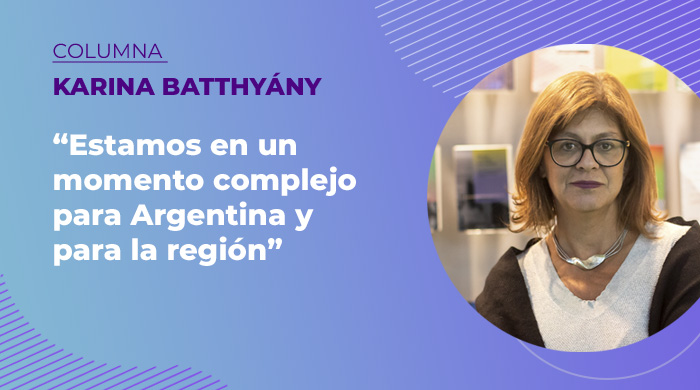
Transcript of Karina Batthyány's column
in InfoCLACSO – November 22, 2023
First, I must express my concern about this issue and my solidarity with my colleagues in Argentina. I am concerned about the outcome in that country, but more broadly, about the regional trend. Our Latin American and Caribbean region is at a crossroads in terms of election results and processes of political instability in some countries.
It is a crossroads that transcends the economic question, although that is an important factor. It addresses other dimensions linked to environmental, ideological, cultural, and political issues. From our perspective as social scientists, from CLACSO, this challenges us even further. In terms of our capacity for understanding, but above all, our capacity for transformation. The social sciences are our work: to understand, interpret, and analyze reality, but above all, to influence it and try to transform it.
The region finds itself in this situation, further compounded by the historical and structural inequalities characteristic of Latin American and Caribbean societies. These inequalities persisted even during periods of economic growth and prosperity, hindering the effective exercise of citizenship, the expansion of citizenship, and the strengthening of democracy.
I would like to call upon all of us who work in the field of social sciences to challenge ourselves and go further in our interpretations, analyzing these fissures or cracks linked to the cultural and political order. These fissures are undoubtedly exacerbated by the negative economic situation, but they are signaling that we need to reinterpret and revise some of the most classic tenets of the social sciences. Argentina finds itself within this context.
We are concerned about everything that was announced during the election campaign: measures that go against rights, democratic consolidation, and that are regressive from a social point of view.
This time, I'm going to set aside the economic aspect and analyze others. For example, the privatization of public media was announced, given the crucial role these media outlets play in democracies in any country. This includes Radio Nacional, Public Television, and the Télam news agency. The media are essential for democratic consolidation. And, in turn, the media have played a fundamental role in the election campaign.
In education, while for now it seems things will remain as they are, there are clear indications of plans to move forward with voucher programs or privatization of various educational levels. It's said that this won't happen in the short term, but perhaps in the medium or long term. Furthermore, we know all too well what happens when these types of governments come to power; we have examples throughout the region. We can cite the case of Uruguay, where, under the current neoliberal government, resources for public education have been cut, particularly for the University of the Republic. This affects, for example, the social sciences, which are our focus at CLACSO, but also other areas of knowledge.
On the other hand, we must talk about rights, especially from a women's rights perspective. Given what the feminist movement, the green wave, represented in Argentina in recent years—a movement that later spread throughout the region in pursuit of the right to abortion—a congressman elected from Milei's party has already stated that he will seek to repeal the Law on Voluntary Termination of Pregnancy, which was passed at the end of 2020. He specifically said, "That we have an abortion law in Argentina today seems to me an appalling atrocity."
This demonstrates the depth of her ideological perspective and her understanding of the progress made in terms of rights in Argentina and other countries in the region in recent years. I offer this example because Argentina was a leading example in the fight for abortion rights, a law that is now rapidly being challenged.
Furthermore, we have the restructuring at the state level of all work related to public policy, specifically in the organization of the ministries. There is a decision to reduce the cabinet to eight ministries and to integrate some areas, such as health, labor, education, and social development, into a single Ministry of Human Capital. All these changes do nothing but relegate to the background the public policies that aim for well-being at both the individual and social levels, which have been so characteristic of Argentina. Argentina and Uruguay are the only two countries in the region that, when analyzing issues related to well-being, we can say have made progress.
Internationally, there are concerns about the policies the President-elect has implemented. For example, his first trip will be to the United States and then to Israel, even before taking office, as well as his firm commitment during the campaign to sever ties with China and Brazil and, in his words, to not make pacts “with communists.” This also gives us a glimpse into the ideological depth behind this type of government.
There is a lot of concern about what might happen in Argentina after December 10th. That date marks the 40th anniversary of democracy in Argentina. And of course, this government was elected within the framework of the democratic system, but some of the issues I mentioned, and many others, show that it will not pursue a path toward deepening democracy.
This is a complex moment for Argentina and the region, in which we must double down, imagine alternatives, build forms of resistance, and work towards understanding reality in order to influence it towards building more just, more democratic, and more equitable societies.
On behalf of CLACSO, I want to emphasize our commitment to democracy, to social justice—which is threatened by the proposed measures—to intellectual and academic freedom, and to the continued expansion of rights for all. I also want to stress that the alternatives must be collective, beginning with strengthening the public and common space, which is what allows us to guarantee levels of well-being for everyone.
– Today we are very concerned to see a climate of great hostility and a wave of threats on social media against opposition leaders, against anyone who says anything contrary to Javier Milei…
Absolutely. We already saw it in Bolsonaro's Brazil, where this type of rhetoric from the president and his political group enables and encourages profoundly anti-democratic expressions of intolerance on social media, in workplaces, in public spaces, and on the streets. This previously suppressed rhetoric now allows some sectors to feel free to attack and disrespect people's rights. We saw it in Brazil, and we fear this could happen in Argentina. CLACSO, which is also headquartered in Buenos Aires, will be closely monitoring these situations to denounce them and intervene, seeking solutions and alternatives.
Of course, the focus of the analysis now is surely on Argentina, but we have to look at this from a regional and global perspective. Because this result there, and the next government they will have, is part of the phenomena we have analyzed in other columns at the Latin American and global levels.

Statement from the CLACSO Steering Committee on the elections in Argentina
If you would like to receive more information about CLACSO's training programs:
[widget id=”custom_html-57″]
to our email lists.

