
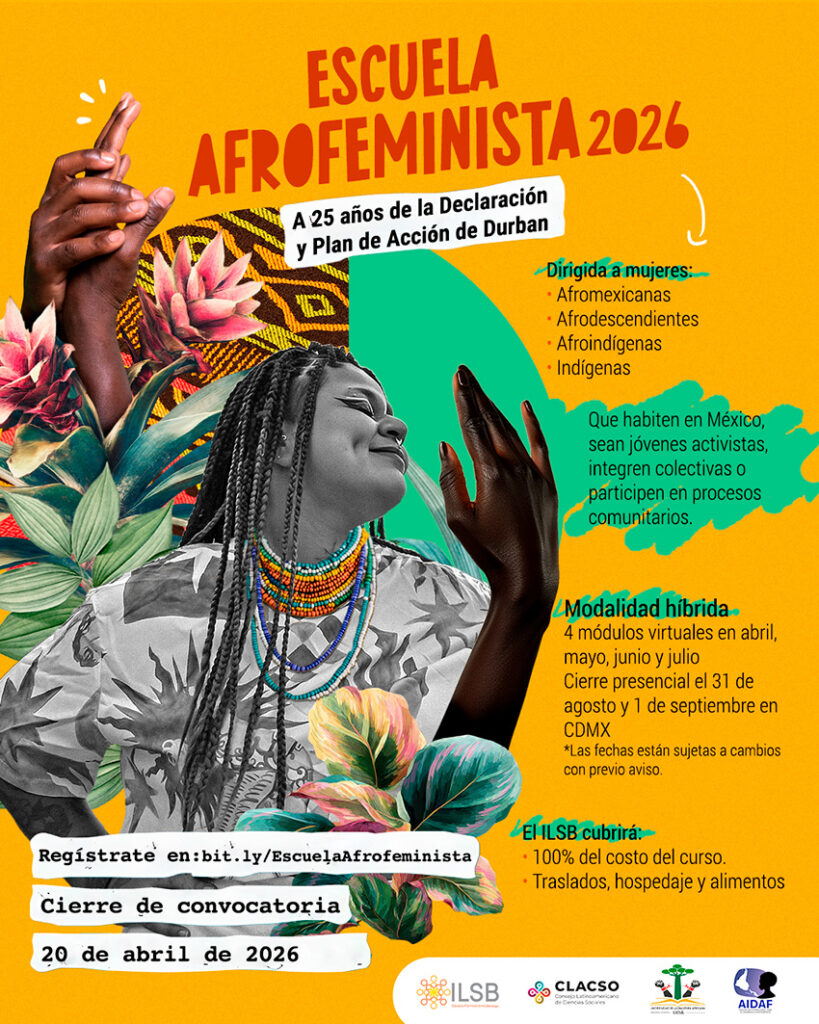
Afrofeminist school 2026
The Simone de Beauvoir Leadership Institute (ILSB) is a civil society organization that, since 2000, has contributed to the strengthening of social leadership and citizen participation; through training, support and advocacy, with a gender, intercultural and human rights perspective.
The Indigenous Women's Program (PROMUI) is the ILSB's specialized area for training, supporting, and connecting Indigenous and Afro-Mexican women leaders from an anti-racist and non-discrimination perspective to promote identity recognition, political participation in decision-making spaces, the exercise of sexual and reproductive rights, and the incorporation of youth in advocacy processes.
Aimed at: Afro-Mexican, Afro-descendant, Afro-Indigenous or Indigenous activist women, members of collectives, networks and organizations or who are interested in participating in training processes from an anti-racist perspective.
Seasonality: April – August.
PROMUI has supported Afro-Mexican women, primarily from the Costa Chica region of Oaxaca, in strengthening collectives like MUAFRO , as well as in the LPEN social oversight project. The goal has been to strengthen the capacities and social networks of Indigenous and Afro-Mexican women's organizations. Furthermore, PROMUI has implemented networking and training programs for Afro-descendant women, such as the Regional Leadership School: Afro-descendant Women Leaders of Latin America, the National Meeting of Afro-Mexican Women, and has promoted the participation of Afro-Mexican women in capacity-building courses for Indigenous and Afro-Mexican women in municipal and community positions, as well as in the four editions of the Advanced Training Course for the Leadership of Young Indigenous and Afro-Mexican Women.
Over the years, we have learned from our fellow Afro-Mexican, Afro-descendant, and Afro-Indigenous women—including teachers and consultants—the importance of creating spaces where Black experience is central to dialogue and reflection. We have also acknowledged PROMUI's responsibility to guarantee Afrocentric processes that recognize the knowledge and contributions of Black, Afro-Mexican, Afro-descendant, and Afro-Indigenous women. Consequently, PROMUI is weaving feminist advocacy.
A first step in this direction was the fourth edition of the Advanced Training Course, which for the first time adopted the name CAFOLIA Youth, a political decision to explicitly include Afro-Mexican women in the course. This edition was characterized by its critical analysis, from an anti-racist perspective, of how Indigenous and Afro-Mexican women experience caregiving. This Afrocentric approach fostered greater participation of Afro-Mexican women enrolled in the course, as well as greater recognition of the knowledge of Afro-descendant and Afro-Mexican women, through their participation as instructors and through a consultancy led by young Afro-Mexican women, one of whom was a former participant in CAFOLIA Youth.
To continue along these lines, in 2026, the Afro-feminist School will be implemented, a training space that takes place within the framework of an alliance with the Latin American Council of Social Sciences (CLACSO), which will allow us to explore new training strategies, as well as add the learnings acquired by the Program in previous training processes.
For the construction of this Afro-feminist School, we will have the consulting services of Rosa Campoalegre, a Cuban sociologist and Afro-feminist activist, who taught at CAFOLIA and contributed her expertise to the development of the “Recipe Book of Knowledge for Care and Well-being” created by CAFOLIA participants. This partnership will allow us to join forces with the Latin American Council of Social Sciences (CLACSO) to develop an Afro-feminist school that will provide a space where Afro-descendant and Indigenous women can engage in critical dialogue, in light of the 25th anniversary of the Durban Declaration and Programme of Action, about the current challenges they face. This educational process will also foster a space for encounter where their knowledge will enable them to develop proposals and demands, particularly in the areas of health, democracy, territories, and care. This school is designed to have 4 virtual sessions that will provide training prior to your attendance and participation in the International Convention: 25 years of Durban, to be held from August 31 to September 5, 2026 in Mexico City.
Justification
Twenty-five years after the Durban Declaration and Programme of Action, it is valuable to reflect on the progress and challenges in implementing the measures adopted by the Mexican State to prevent and eradicate racism, discrimination, xenophobia, and related forms of intolerance. Likewise, it is necessary to undertake an exercise that makes visible and acknowledges the contributions of Afro-descendant and Indigenous women's movements to the anti-racist struggle.
This becomes more urgent in the current context of multiple crises in the world and the region, which not only intensify expressions of racism and xenophobia, but also aggravate the inequalities experienced by impoverished and marginalized populations, causing differentiated impacts on Afro-descendant, Afro-Mexican, Afro-indigenous and indigenous women and girls.
In this context, the ILSB's commitment to developing a critical mass of leaders dedicated to social justice and gender equality from a rights-based and intersectional perspective is reaffirmed, aiming to transform realities of discrimination and inequality. This school contributes to Institutional Outcome 1: Women, youth, and historically disadvantaged populations are consolidated as key political actors in their spheres of influence (public and community decision-making spaces and their movements).
Through Popular Feminist Pedagogy, we will develop an Afrocentric, anti-racist, and decolonial Afro-feminist educational process that will allow for dialogue and knowledge sharing to analyze current problems, particularly, but not exclusively, those related to the ILSB agendas: care, health, democracy, and the sustainability of life and territories. Furthermore, participants will be able to recognize the progress and challenges of the Durban Declaration and Programme of Action, in order to propose common agendas that contribute to the anti-racist struggle.
This school will culminate in participation in the International Convention: 25 Years After Durban, which will allow the participating women to connect not only with each other in the School, but also with leaders of the Afro-descendant movement from around the world, who are invited to participate in the International Convention.
This collaborative effort between ILSB and CLACSO also represents a commitment to contribute to epistemic justice, promoting the voices of Afro-Mexican and Indigenous women and ensuring that their knowledge is recognized as valid in academic spaces.
The Afro School will be conducted through the ILSB's digital training platform. This will allow participants to access selected materials and resources that will reinforce the knowledge acquired in the virtual sessions.
Objective:
The School's main objective is to develop an Afrocentric training space for young women, activists, and members of collectives that contributes to the dialogue 25 years after the Durban Declaration and Programme of Action. Through Feminist Popular Pedagogy, theoretical tools will be collectively constructed to enable them to analyze current problems and propose common agendas from an Afrocentric, feminist, and anti-racist perspective.
Specific objectives:
- To assess, from a critical, Afrocentric, feminist, and anti-racist perspective, how systems of oppression operate in the current context of polycrisis.
- To analyze the differentiated impacts of crises on the bodies and territories of Afro-descendant, Afro-Mexican, Afro-Indigenous and Indigenous women, specifically in health, democracy, territory and care, based on their rights.
- To identify current scope, progress and challenges that contribute to collective reflection on the Durban Declaration and Plan of Action, in order to propose common agendas that contribute to the anti-racist struggle from the decolonial Afro-feminist perspective.
- Promote the connection between Afro-Mexican, Afro-descendant, Afro-Indigenous and Indigenous women to contribute to the sustainability of the movements.
Thematic proposal:

