
Is knowledge a common good of humanity?
On Wednesday, October 15, InfoCLACSO will be live on the YouTube channel and the Facebook and LinkedIn profiles.
-International Open Access Week
From October 20 to 26 under the slogan: “To whom does knowledge belong?"Convened by CLACSO, the Latin American Forum for Scientific Evaluation, the Union of University Presses of Spain, and the Association of University Presses of Latin America and the Caribbean. Interviews with:
Pablo VommaroExecutive Director of CLACSO
Laura Figueroa Lizarraga, coordinator of the Altexto National Network of University Presses – Mexico
Pilar Rico Castro, head of the open science unit of the Spanish Foundation for Science and Technology, FECYT
Remedios Pérez García, Vice President of UNE, the National Union of University Publishers of Spain
Dominique BabiniSpecial Advisor for Open Access Mobilization at CLACSO
Fernanda Pampín, Director of Publications at CLACSO
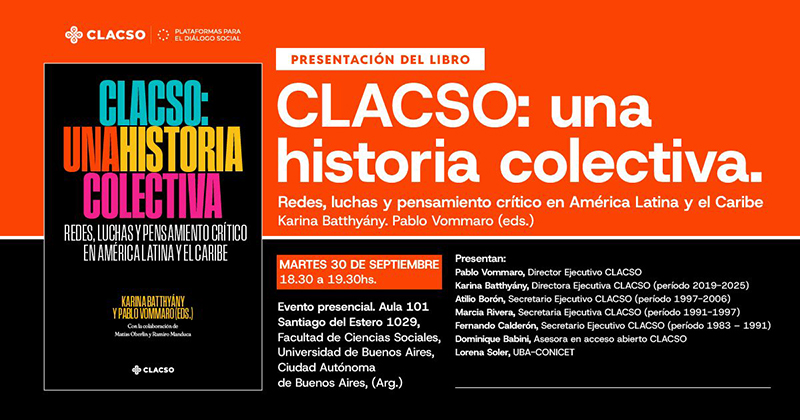
- «CLACSO: a collective history» Networks, struggles and critical thinking in Latin America and the Caribbean"
Book presentation by two former Executive Secretaries of CLACSO: Fernando Calderón Gutiérrez (1983-1991) y Atilio Borón (1997-2006)
Make your contribution and receive one of the thousand books in the special edition
The program for Wednesday, October 8th covers one of the main themes of the Platforms for Social Dialogue which CLACSO is promoting for the coming years: “Right to education, public policies and pedagogical alternatives”
She drives: Gustavo Lema, Director of Communication and Information at CLACSO
Directed and edited by: Guido Fontán
Production: Eric Domergue and Noelia Croci
Design and programming: Sebastián Higa, Christian Iturricha and Renata Maestrovicente
Open to the addresses of the Executive Secretariat and the members of the Steering Committee of CLACSO to disseminate activities and topics specific to each country, this communication channel is also a space to analyze and deepen the Platforms for Social Dialogue (PDS) that CLACSO promotes for the coming years, to interview researchers, and for everything that makes up the life and production of the Latin American Council of Social Sciences.

