
Epistemologies of the South
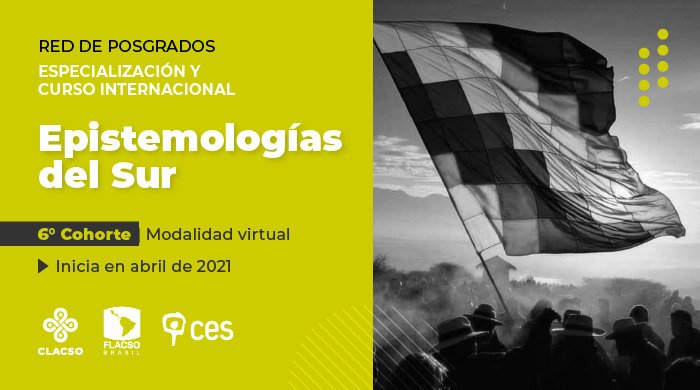
6th Cohort (2021-2022)
VIRTUAL MODALITY
Specialization: 40 credits, 360 lecture hours
International course: 9 credits, 90 lecture hours
Duration: April 2021 to March 2022
The accreditation and certification of the Specialization and the International Course will be carried out by the Center for Social Studies (CES), by the Latin American Council of Social Sciences (CLACSO) and by the Latin American Faculty of Social Sciences (FLACSO Brazil).
GENERAL COORDINATION:
Boaventura de Sousa Santos (Center for Social Studies, University of Coimbra, Portugal)
ACADEMIC COORDINATION:
Karina Bidaseca (CLACSO, National University of San Martín and University of Buenos Aires, Argentina) and María Paula Meneses (University of Coimbra, Portugal)
ACADEMIC COMMITTEE:
Salete Valesan Camba (FLACSO, Brazil)
Boaventura de Sousa Santos (University of Coimbra, Portugal)
Karina Bidaseca (CLACSO, UNSAM and UBA, Argentina)
María Paula Meneses (University of Coimbra, Portugal)
We live in turbulent and complex times. The Epistemologies of the South, as proposed by Boaventura de Sousa Santos, advocate for the expansion of political imagination beyond the intellectual and political exhaustion of the Global North. This exhaustion translates into an inability to confront the challenges of this century and into threats to democracy, law, and human dignity. The Global South, the South we will be discussing in this course, is a metaphor for the human suffering caused by the major forms of oppression—capitalism, colonialism, and patriarchy—and the various forms of struggle and resistance against these oppressions. In this sense, the Epistemologies of the South seek to broaden the possibilities of rethinking the world based on the knowledge and practices of the Global South, challenging attempts at epistemicide, linguicide, or epistemic subalternization. In this scenario, the Epistemologies of the South provide theoretical and methodological tools that allow for the development of a critical diagnosis of the present, which has as its constitutive element the possibility of reconstructing, formulating and legitimizing alternatives for a more just and free society.
The Specialization and the International Course are based on three fundamental axes based on the Epistemologies of the South:
- That the interpretation of the world transcends the Eurocentric interpretation of it;
- That global social justice is not possible without global cognitive justice;
- The emancipatory transformations produced in the world cannot be confined to grammars and scripts developed by critical theory centered on the Global North; on the contrary, the Epistemologies of the South claim a diversity of knowledges that support the social struggles that are important to (re)cognize and value.
This training space, focused on promoting South-South interdisciplinary dialogues, seeks to document and interpret the knowledge that underpins social struggles in our times and societies. This knowledge is not solely academic; it encompasses the knowledge of artists, farmers, activists, and many others. Simultaneously, the objective is to study the Global South in all its diversity—a South that metaphorically represents a vast field of economic, social, cultural, and political innovation of increasing diversity, in which dialogues between different forms of knowledge reflect the conditions of pluriversality.
The Specialization and International Course in Epistemologies of the South They are aimed at undergraduate and postgraduate university students; teachers at all levels; activists and members of social movements, organizations and political parties; members of civil society; journalists, communicators and press workers; members and managers of non-governmental organizations and professionals interested in social and political issues that characterize the diversity of the Global South.
PROFESSORS


Center for Social Studies, University of Coimbra, Portugal


Centre for Social Studies, University of Coimbra, Portugal





El International Course It will last for one year and requires, for accreditation, participation in discussion forums and the completion of a final project.
La Specialization It will last for one year and requires for its accreditation, in addition to the completion and approval of the International Course; the accreditation of 2 elective virtual seminars from the curriculum; a methodological workshop and a final specialization project.
La Specialization and the International Course Epistemologies of the South will be developed between April 2021 and March 2022.
The virtual seminars The International Course classes will be offered in either Spanish or Portuguese. These two languages are used by the teachers and tutors, but this does not mean that they are native speakers of these languages.
The bibliography will be provided in the official languages of the course – Spanish and/or Portuguese – depending on availability. Student contributions to the discussion forums must also be in these languages. The final monograph may be submitted in either Portuguese or Spanish.
Students in the Specialization and International Course will have the support of academic tutors who will accompany them through the virtual seminars and guide them in completing their final projects.
El International Course It also seeks to build a library and a cartography of social movements, where other voices and knowledge can find space and visibility, challenging attempts at epistemicide and epistemological subalternization.
The online seminars will be offered in Spanish, Portuguese, and English. Similarly, the course materials may be provided in all three official languages. Student contributions to the discussion forums may also be in these languages. The final research paper may be written in Spanish, Portuguese, or English.
Epistemologies of the South and knowledge born from social struggles
This international course on Epistemologies of the South, a term coined by Boaventura de Sousa Santos, aims to present and discuss knowledge produced in the Global South, providing a foundation for reflection on social transformation in our times. In other words, through the study of the diverse possibilities revealed by Epistemologies of the South, this course's theoretical and methodological objective is to overcome the characteristic Eurocentric model of modern thought, namely, abyssal thinking.
Understanding from and with the Global South requires a distinct political and epistemic orientation. The Global South, the central theme of this course, seeks to recognize and validate the knowledge produced by the oppressed, by women and men who have suffered and continue to suffer injustice, oppression, domination, and exclusion caused by capitalism, colonialism, and patriarchy. Epistemologies of the South, as a metaphor for the exclusion, silencing, and destruction of peoples and knowledge systems, seek to give form to the knowledge and experiences of the Global South, based on methodological and reflective assumptions in dialogue, in opposition to any ethnocentric approach.
The course instructors will explore, from diverse geopolitical and epistemic perspectives, the conditions for horizontal dialogue between different forms of knowledge, for ecologies of knowledge. These dialogues, and the lessons they offer, reflect the innovations taking place in countries and regions of the Global South. This demanding approach presupposes a willingness to recognize one another, intercultural understanding, political and ideological convergence, respect for identity, and a celebration of diversity, as conditions for a more democratic dialogue in the Global South.
Building knowledge from the Epistemologies of the South requires different working methodologies. Learning from the South itself, in its diversity, means going beyond conventional academic knowledge. Constructing dialogues between different forms of knowledge and struggles seeks to give visibility to the peoples and social groups whose practices are built upon this knowledge. Only in this way will it be possible to develop alternative narratives that challenge the impossibility of considering difference (sexual, ethnic, racial, class, caste, religious, etc.) in conjunction with equality, the intimate connection between the local and the global, and the projects of other economies and other political societies. The second part of the course proposes to map, present, and discuss a variety of working methodologies anchored in the body of knowledge developed from the perspectives of the Epistemologies of the South, prioritizing the ecology of knowledges and the possibilities of intercultural translation between knowledges born from struggles.
Teaching Team of the International Course
- Boaventura de Sousa Santos (Centro de Estudos Sociais da Universidade de Coimbra, Portugal)
- Carla Braga (Eduardo Mondlane University, Mozambique)
- Gladys Tzul Tzul (Amaq' Institute, Guatemala)
- Ivani Ferreira de Faria (Federal University of Amazonas, Brazil)
- Jorge Ramos Tolosa (Universidade de Valência, Spain)
- Karina Bidaseca (National University of San Martín and University of Buenos Aires, Argentina)
- Leonardo Avritzer (Universidade de Minas Gerais, Brazil)
- João Arriscado Nunes (Centro de Estudos Sociais da Universidade de Coimbra, Portugal)
- Verónica Yuquilema (University of Coimbra, Portugal)
- Mario Rufer (Autonomous Metropolitan University, Mexico)
- Nilma Gomes (Federal University of Minas Gerais, Brazil)
- Rosalva Aída Hernández (Center for Research and Higher Studies in Social Anthropology, Mexico)
This workshop aims to support the development of final projects for the Specialization in Epistemologies of the South. It will assist in identifying the topic of the final project by interconnecting the themes covered throughout the International Course with the students' research/action interests and individual learning paths. The workshop seeks to support the identification and justification of the chosen topic; consolidate the conceptual and methodological tools developed; and support the production of the final project, which may be written, audiovisual, performative, or of another genre.
Optional Seminars:
First semester
Summary: The seminar proposes an exploration of contemporary migration theories and their interpretations from Latin America, as well as focusing on material and symbolic sites in modern colonial history and the present day, such as the Mediterranean Sea and internal diasporic circuits within Africa and from Africa to Latin America. It will delve into categories such as intersectionality and differential inclusion, contemporary migration policies, conflicts, and experiences of struggle at borders.
Coordination: Karina Bidaseca (National University of San Martín, University of Buenos Aires) and Maura Brighenti (National University of San Martín).
Guest Professors: Sandro Mezzadra (University of Bologna, Italy) and Ángeles Castaño Madroñal (University of Seville, Spain).
Summary: The aim of this course is to discuss how the coloniality of power is inscribed on bodies marked by gender and social class. Coloniality is an open wound that leaves an indelible mark on bodies. Our proposal is that a situated and liberating aesthetic, such as that practiced by the artists considered here, allows us to break with the legacy of victimization and violence. In this course, we engage in dialogue with other writings that also reflect on the importance of a situated and liberating aesthetic. The course's greatest contribution is exposing students to a broad network of theorists who construct different interpretations of situated thought on the coloniality of power. Based on this, students will review critical theories on decolonial aesthetics and how it applies to the following artists: Ana Mendieta, Zanele Muholi, Regina José Galindo, Shirin Neshat, Fatima Mernissi, Teresa Margolles, Adriana Varejao, Joyce Kozlof, Mona Hatoum, among others.
Coordination: Marta Sierra (Kenyon College) and Karina Bidaseca (National University of San Martín, University of Buenos Aires).
Summary: This seminar is structured around the theme of the Pandemic, many representations and two diverse knowledges, practices and voices that emerge from the geographical, geopolitical and epistemic South as you respond to each other, creating alternative(s) and resistance(s), seeking a more far-reaching, horizontal and heterogeneous knowledge. As the narratives and creativity of researchers, activists, citizens, patients, therapists and caregivers express, their demands and mourning strategies are the starting point, something that links the teaching team to their different reflections. The theoretical and empirical approaches will be presented by teachers/researchers from South America, Africa and South Europe, with lines of work articulated with current strategies that start from other knowledge, where science is just two very many pieces of knowledge in dialogue. Linking the pandemic to the remaining spheres of existence, this seminar aims to rethink health and COVID-19, opening up to reflection as the interweaving of incorporated, scientific and creative knowledge, learning through academia, or activism, through imagination and lived experience. Our three-month duration, the online seminar will have 12 classrooms, with the first and last (opening and enclosing) presented for the coordination.
Coordination: Susana de Noronha and João Arriscado Nunes (Centro de Estudos Sociai, Universidade de Coimbra, Portugal)
Second semester
Summary: With a keen eye on the ways in which biocultural knowledge and practices are constructed in the territories of the Global South, this weekly publication aims to analyze the diverse responses to global threats, civilizational collapse, and the forms of struggle in these territories for the defense of the right to life. By situating the study within the impact of capitalist modernity and historically rooted socio-territorial colonial projects, it seeks to foster dialogue around new perspectives in decolonial research that narrate knowledge-building practices from the Global South.
Coordination: Antonio Ortega (South Training Network Action of Decoloniality)
Summary: In many societies of the global South, deeply marked by the colonial relationship, the knowledge about their history is built on assumptions, methodologies and sources that perpetuate the maintenance of Eurocentric perspectives. This is a colonial heritage that is intended to be replaced by an agenda of production of plural knowledge and intercultural translations, starting from an analytical perspective on oral, collective and personal histories, starting from the arts and two creative spaces.
The seminar presents research carried out in various social and political contexts, reflecting on how to educate new generations about the histories and struggles for social justice that are found in the cultural and artistic expressions such as cinema, literature, theater, music, plastic arts, oral narratives, street arts, privileged means to communicate, produce knowledge about these stories and their cultural identities.
Coordination: Marisa Ramos Gonçalves (CES - Centro de Estudos Sociais, Universidade de Coimbra), Maria Paula Meneses (CES - Centro de Estudos Sociais, Universidade de Coimbra) and Iolanda Vasile (CES - Centro de Estudos Sociais, Universidade de Coimbra)
|
SPECIALIZATION AND INTERNATIONAL COURSE - COHORT 2021-2022 |
|||||||
|
2021 - 2022 |
Virtual Courses |
||||||
|
April |
International Course Epistemologies of the South and knowledge born from social struggles |
Seminar I I "Writings on the body: situated feminist aesthetics and decoloniality of power" |
Seminar I "Challenging borders: migrations, coloniality and resistance from the south" |
Seminar I I "Pandemia and Society: resistance(s)" |
|
|
|
|
May |
|
|
|
||||
|
Jun |
|
|
|
||||
|
Jul |
|
|
|
|
|
|
|
|
August |
|
|
Seminar II "Arts, Ativisms and Memories: the archives of two world histories" |
Seminar II "Socio-environmental epistemologies. Narratives for re-existence in the global south" |
|
||
|
Sept |
|
|
|
||||
|
Oct |
|
|
Support workshop to the preparation of the final work |
||||
|
Nov |
|
|
|
|
|
||
|
dec |
|
|
|
|
|
|
|
|
jan |
|
|
|
|
|
|
|
|
Feb |
|
|
|
|
|
|
|
CM PlenosIf you belong to a Full Member Center of CLACSO.
CM Associates: Yes You belong to a CLACSO Associated Centre.
No linkIf you DO NOT has any of these links with CLACSO.
| One payment |
Discount for payments made before 22/03 |
Payment in 3 installments | |
| CM Plenos | $500 | $400 | USD 660 (3 x USD 220) |
| CM Associates | $600 | $500 | USD 870 (3 x USD 290) |
| No link | $800 | $550 | USD 1080 (3 x USD 360) |
In all cases, payment can be made by credit card, deposit or bank transfer.
CM PlenosIf you belong to a CLACSO Full Member Center
CM Associates: Yes You belong to a CLACSO Associated Centre
No linkIf you DO NOT has any of these links with CLACSO
| One payment |
Discount for payments made by 22/03 |
Payment in 3 installments | |
| CM Plenos | $200 | $150 | USD 270 (3 x USD 90) |
| CM Associates | $250 | $200 | USD 360 (3 x USD 120) |
| No link | $320 | $250 | USD 450 (3 x USD 150) |
In all cases, payment can be made by credit card, deposit or bank transfer.
The accreditation and certification of the Specialization and the International Course will be carried out by the Latin American Council of Social Sciences (CLACSO) and the Latin American Faculty of Social Sciences (FLACSO Brazil)
The training proposals are aimed at undergraduate and postgraduate university students; teachers at all levels; activists and members of trade union organizations, social movements and political parties; public officials and operators in the legal field, journalists, communicators and press workers; members and managers of non-governmental organizations and professionals interested in the subject.
To participate, it is essential that you register through the website.
Registration will be open between December 7, 2020 and March 25, 2021.
Upon completion of the registration process, you will receive a confirmation in your email.
If any of the mandatory training sessions are owed, in all cases, an additional amount must be paid in order to retake said credit.
If the student decides not to enroll in the Specialization or International Course before its formal start date, they may request a refund of their tuition fees. CLACSO will retain the equivalent of 10% for administrative costs.
Exceptional criteria: In exceptional cases, and within the first two months of the specialization, students may request to withdraw from the cohort and rejoin the following year. In all cases, the reasons for the request must be submitted in writing. No requests will be accepted after two months from the start of the course.
If the student decides not to enroll in the specialization or international course before its formal start date, they may request a tuition refund. CLACSO will retain the equivalent of 10% for administrative costs. No refunds will be issued after the course has begun.
Classes will begin in April 2021 and will conclude in March 2022.
All registered participants will receive the necessary instructions to access the classes, bibliography and discussion forums through the CLACSO Virtual Training Space.
Accessing and navigating the Virtual Learning Environment is very simple and user-friendly. In any case, a technical and academic support team will always be available to you.
You must complete the International Course, two (2) elective Virtual Seminars, the methodological workshop and complete the final monograph.
To obtain the Specialization degree, you must complete a final monograph. The methodological workshop is mandatory and aims to support you in completing this final project.
You must participate in the classes and activities proposed by the teachers and complete the final monograph.
Yes, the specialization and the International Course are certified. The Specialization and the International Course are certified by CLACSO and FLACSO Brazil.
The Specialization certifies 360 hours/chair of work; the International Course 90 hours/chair.
The diploma and certificates will be sent digitally and are completely free of charge.
The specialization and international course are accredited by CLACSO and FLACSO Brazil.
See the table of prices and options above.
If you wish to obtain certification from FLACSO, you will need to pay an additional fee.*
For those who wish to request only the diploma, the cost is USD 160,00 (one hundred sixty US dollars). For those who wish to request both diplomas and academic transcripts, the cost is USD 200,00 (two hundred US dollars). These costs cover the production, administrative processes, and processing of the aforementioned stamps and seals, as well as shipping costs. Payment can be made by credit card via PayPal invoice, which will be sent by email.
*Values subject to change
See the price list and payment options. Payment does not include the cost of issuing and shipping the physical diploma.
Payment can be made in one installment by credit card, bank deposit, or bank transfer. We also offer the option of paying in 3 installments.
Yes. There will be discounts for students belonging to CLACSO Member Centers and CLACSO Associate Centers, for CLACSO Associate Researchers, and for all those who pay before March 22, 2021.
For any other questions, please contact us at [email protected]
Or send a WhatsApp message to + 5491138801388
For group and institutional discounts, please contact us. [email protected]
More specializations and international courses
[widget id=”glob_block_5_widget-42″]
If you would like to receive more information about CLACSO's training programs:
[widget id=”custom_html-57″]
to our email lists.

