
Salary and budget emergency of the Argentine university and scientific system
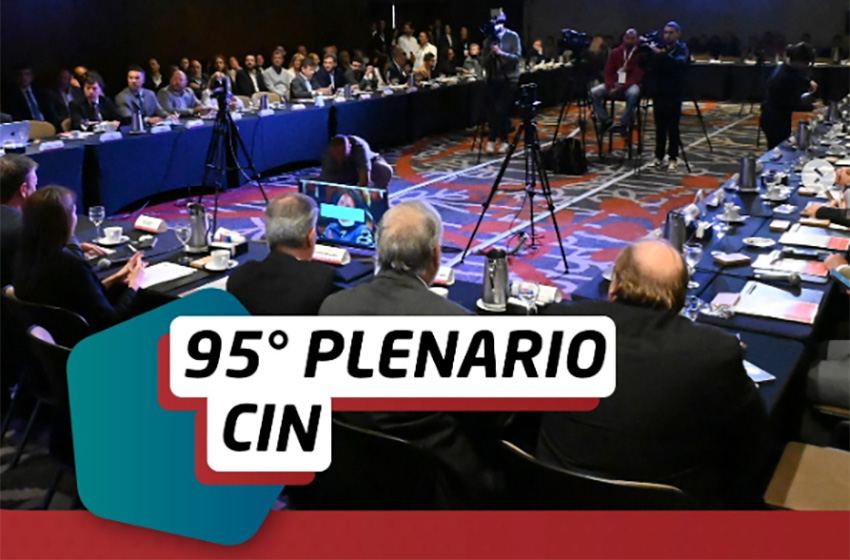
The 95th Plenary Meeting of Rectors of the National Interuniversity Council of Argentina (CIN) was held on March 27 at the National University of La Pampa, in Santa Rosa, with in-person and remote participation of authorities from all over the country and of Pablo Vommaro, Executive Director of CLACSO.
The meeting declared a budgetary and salary emergency in the public university system due to the severe resource cuts and concluded with the election of the Rector of the National University of Rosario. Franco Bartolacci, as president, and the Rector of the National University of Rio Negro Anselmo Torres as vice president for the period 2026-2027.
On that occasion, the CIN resolved to join as a co-organizer of the CLACSO Essay Call: «50 years after the civic-military coup in the ArgentinaChallenges of memory and democracy in Latin America and the Caribbean«.
Declaration of the 95th Plenary of Rectors of the CIN
The highest authorities of the Argentine public university institutions, gathered at the 95th Plenary of Rectors of the National Interuniversity Council (CIN), express our deep concern about the situation facing the public university system, in a context of budget restrictions, salary deterioration and growing uncertainty for the development of the substantive functions of our institutions.
From the National University of La Pampa on March 27, 2026:
We declare a salary and budget emergency for the national university and scientific system.
We demand compliance with the University Financing Law approved by the National Congress.
We demand the urgent convening of a national joint committee to restore the salaries of higher education workers.
Santa Rosa, La Pampa
March 27th 2026

Summary of the budgetary situation of the national university system
The budgetary situation in the national university system is critical. Cuts are occurring across all dimensions of university affairs. Overall, transfers to national universities have registered a cumulative real decline of 45,6% between 2023 and 2026, representing an unprecedented reduction in the resources available for the operation of the university system.
Regarding university salaries, the decline in purchasing power is equally significant. Between November 2023 and February 2026, salaries accumulated a 158% increase, while accumulated inflation over the same period reached 280%. This implies a loss of purchasing power of approximately 32%. To put this loss into perspective, the systematic erosion of purchasing power is equivalent to the loss of roughly 7,3 monthly salaries during the period considered, based on the November 2023 salary. This situation currently places university salaries at their lowest level in the last 23 years and among the lowest levels since the return of democracy.
To recover lost purchasing power, university salaries should experience a 47,3% increase compared to the levels in force in February 2026. This percentage arises from the accumulated difference between the evolution of prices and salaries and represents the increase necessary to equalize the purchasing power of the salary to the level prior to the assumption of the current national government.
The purchasing power of the funds allocated to University Operating Expenses has not exceeded 64% of its value in January 2023 in any month of the current administration. Currently, it stands at around 40% of the January 2023 values, and in relation to the average value of this allocation between January and November 2023, the equivalent of almost 9 months of transfers has been lost during the current administration.
Analysis of specific budget items shows that the cuts not only affect transfers to universities, but also include budget lines that, while not part of university budgets, are central to sustaining the system's operation. For example, looking exclusively at the budget actually executed, in 2025 the purchasing power of the funds allocated to strengthening science and technology in universities was equivalent to 38,05% of that executed in 2023; the funding for strengthening university outreach activities was only 1,02%; the funding for Progresar Scholarships was around 26,02% of the 2023 level; and those related to the development of university infrastructure or support for the educational pathways of Progresar Scholarship recipients were at 0%.
More specifically regarding the Progresar Scholarships, the current budget for the items related to their financing and the support of educational paths was reduced by 82% in nominal terms between 2026 and 2025, which places the expenditure, in real terms, more than 95% below the value it had in 2023.
95th Plenary Session of Rectors
Santa Rosa, La Pampa
March 27th 2026

