
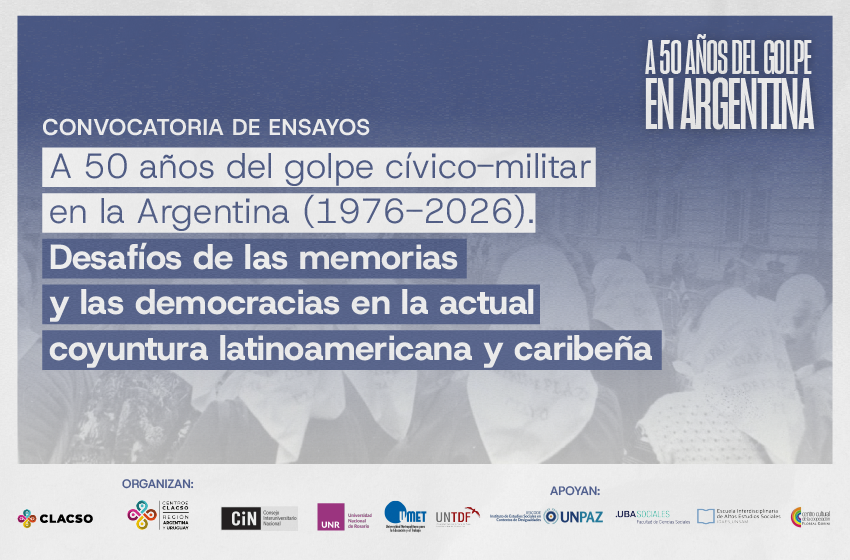
Call for Essays: 50 Years After the Civic-Military Coup in Argentina
REGISTRATION CLOSED
Latin American and Caribbean democracies are currently facing a critical juncture. The spread of authoritarian rhetoric, the rise of the far right, the political manipulation of the judicial system, the criminalization of social protest, the militarization of security, and attacks on human rights policies have created a scenario of open conflict over the meaning and strength of democracy. In this context, policies of memory, truth, and justice are not a consolidated legacy, but rather a battleground that continues to be fought daily. Their questioning, erosion, or relativization are part of contemporary political strategies that seek to redefine the boundaries of democracy and deny the past.
Within this historical and political context, this year marks the fiftieth anniversary of the civic-military coup that established a dictatorship in Argentina, imposing a regime of state terrorism. The structural economic and social effects, the power dynamics, and the symbolic disputes of this event directly impact Argentina's current political situation, with regional repercussions. Therefore, creating a collective memory of the 1976 coup is, today, a way to engage with the present and envision a better future.
The state terrorism established in Argentina was not merely a repressive machine. It was the enabling condition for an economic, social, and cultural project that reorganized society through violence, dismantled popular organizations, and laid the foundations for a model of inequality that persists to this day. This project was part of a regional cycle of dictatorships in Latin America and the Caribbean, linked to transnational interests and strategies of political control and extermination that transcended national borders. Therefore, 50 years after the coup, memory demands a reading situated in the present and with a regional perspective.
In Argentina, the current regional processes we have referred to are taking on a particular intensity. The consensus built since 1983 around the "Never Again" movement, the prosecution of crimes against humanity, and the centrality of human rights is being challenged by discourses and practices that trivialize state terrorism, promote denialist narratives, or present memory as an obstacle or a biased ideological construct. These disputes are not merely symbolic: they have concrete effects on institutions, public policies, democratic life, and the ways in which social conflict is expressed.
In this context, the Latin American Council of Social Sciences (CLACSO), the CLACSO Argentina Member Centers and the National Interuniversity Council (CIN, Argentina) call for the submission of original and unpublished essays by individual or collective authors (up to 3 authors) that critically analyze the relationship between historical memory and the current political situation, articulating the recent past with the contemporary challenges of democracy in Argentina, in Latin America, the Caribbean and the Global South, engaging in dialogue with the Global North and including a perspective towards the future. This initiative is also supported by the National University of Rosario (UNR), the Metropolitan University for Education and Work (UMET), the National University of Tierra del Fuego, Antarctica and the South Atlantic Islands (UNTDF), the Institute of Social Studies in Context of Inequalities of the National University of José C. Paz (IESCODE-UNPAZ), the Faculty of Social Sciences of the University of Buenos Aires (FSoc, UBA), the Interdisciplinary School of Higher Social Studies of the National University of San Martín (EIADES-UNSAM), and the Cultural Center of Cooperation (CCC).
This call to action stems from a clear political assertion: memory is a tool for interpreting the present, challenging narratives, and envisioning more democratic and just futures . Reflecting on the 1976 coup 50 years later involves examining the current conditions that enable new forms of authoritarianism, denialism, and attacks on hard-won rights, as well as the social, institutional, and cultural resistance movements that are building alternative and transformative proposals.
Deadline for essay submissions: June 4, 2026
Date of publication of results: July 30, 2026
New closing date: June 9, 2026
- The 1976 coup and state terrorism as antecedents of the current configurations of political and economic power.
- Memory, truth and justice in dispute: denialist offensives, institutional setbacks and contemporary resistance.
- Democracy and authoritarianism in the regional context: extreme right, lawfare and redefinition of the rule of law.
- Criminalization of social protest and control of political conflict in formal democracies.
- Inequalities and democracy: historical continuities and current forms of violation of rights and denial of diversities.
- The role of the State and the Armed and Security Forces: dictatorial past, democratic transitions and current tensions.
- Political culture, media and battles for the meaning of the past, the present and disputes for the future.
- Latin American and Caribbean experiences of democratic resistance against processes of authoritarian regression.
- Memory and future: how the struggles of the past inform the political disputes of the present and the horizons of transformation.
- For the nomination of researchers, teachers, communicators, members of CLACSO member centers, activists, and representatives of social, trade union and human rights organizations in Latin America and the Caribbean.
- For applications from young people (people under 35 years of age without a doctoral degree) and undergraduate and postgraduate students.
- The proposals that pass to the next stage will be evaluated by an International Committee that will assess the quality and relevance of the trials.
- Situations not covered by this call for proposals will be resolved by CLACSO.
- The ruling will be final.
- The authors declare that all rights to the winning works of this competition belong to them entirely and exclusively, and they assign and transfer to CLACSO all exclusive worldwide rights of publication and sale in all languages and in any format that CLACSO deems appropriate. The authors will not receive any royalties.
- ISBN and Legal Deposit registrations will be processed by CLACSO. CLACSO reserves the right to include the final digital book in its Virtual Library and Latin American Bookstore, as well as to make it available for free and unrestricted distribution and download.
- Likewise, CLACSO may make the work available to establish publishing partnerships that allow for a greater and wider circulation of the material through print and digital media.

