
South-South Cooperation Day
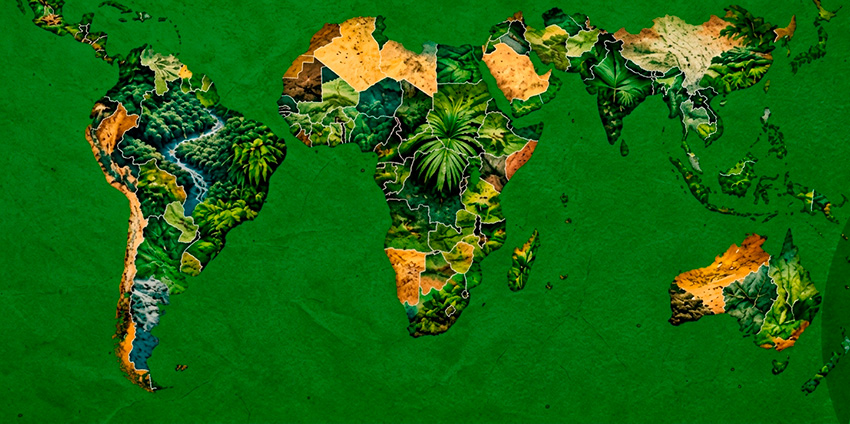
In a world beset by geopolitical disputes, a crisis of multilateralism, and increasing competition for resources, technology, and power, cooperation among countries of the Global South is once again taking on a strategic dimension. September 12th is not merely a reminder of a form of international cooperation; it is a reminder of the possibility of building less dependent relationships and a world with more centers of decision-making.
For much of contemporary history, talking about international cooperation meant almost automatically thinking in one direction: from North to South. Developed countries provided financing, technology, and knowledge; developing countries appeared primarily as recipients. But for decades now, another logic has been trying to gain ground.
Every September 12, the United Nations commemorates the “Day of South-South Cooperation”, a date that recalls a simple but profoundly political idea: the countries of the so-called Global South not only have common problems, they also possess knowledge, experiences, technologies, resources and capabilities that they can share among themselves.
Cooperation doesn't necessarily have to flow from richer countries to poorer ones. It can also circulate horizontally between societies facing similar challenges.
From Bandung to Buenos Aires
The political roots of this idea can be traced back to the mid-20th century, when dozens of countries in Asia and Africa were beginning to gain independence from former colonial powers. A pivotal moment was the 1955 Bandung Conference, held in Indonesia, where 29 Asian and African countries discussed how to strengthen their economic and political cooperation in an international arena dominated by the Cold War and the former colonial powers.
Bandung raised a question that would resonate throughout the following decades: could newly independent countries build their own international relations without becoming subordinate to any of the major power blocs? This quest progressed over the following decades until it reached a decisive moment. In 1978, representatives of developing countries met in Buenos Aires at the United Nations Conference on Technical Cooperation among Developing Countries. There, they adopted the "Buenos Aires Plan of Action," known as BAPA, one of the foundational documents of what we now know as South-South Cooperation.
The Plan was approved on September 12, 1978. That date was later enshrined by the United Nations as South-South Cooperation Day. But behind that decision lay something deeper than a technical cooperation mechanism; it reflected a particular way of thinking about the world.
South-South Cooperation is based on a different principle than the traditional donor-recipient model. One country may have developed a public policy, technology, productive capacity, or institutional experience that could be useful to another country facing similar problems. Cooperation can then consist of sharing knowledge, training technicians, transferring technology, developing joint research, building infrastructure, exchanging institutional experiences, or coordinating policies.
The United Nations defines this cooperation as a process based on common goals, solidarity, and mutual respect, driven by the priorities of the participating countries themselves. And it establishes something important: South-South Cooperation does not seek to replace North-South Cooperation, but rather to complement it.
It's not just about who has the resources to help whom, but about what capabilities each country has and what it can build together with others. And that idea, which in 1978 was mainly associated with economic and technological development, now takes on a much greater geopolitical dimension.
A South that no longer occupies the same place
The world of 2026 is radically different from that of 1978. China has become one of the world's leading economic powers. India has acquired increasing demographic, technological, and geopolitical influence. Countries in Asia, Africa, the Middle East, and Latin America are demanding greater participation in international institutions. New development banks, economic blocs, and regional mechanisms are attempting to expand their autonomy from traditional power structures. Economic flows have also changed.
According to data released by the United Nations for this year's commemoration, trade between countries of the Global South reached $6,8 trillion in 2025, and more than half of developing countries' exports are now destined for other developing economies. Three decades ago, that proportion was 38%.
In other words, the Global South no longer trades solely with the Global North. It increasingly trades with itself. And it doesn't just exchange raw materials. Current cooperation includes renewable energy, digital infrastructure, public health, sustainable agriculture, education, disaster prevention, public services, financial technology, satellite applications, and data management. This transforms the meaning of South-South Cooperation because sharing knowledge also means sharing decision-making power.
The date also comes at a particular moment. The international system is going through a period of increasing geopolitical fragmentation, trade competition, technological disputes, wars, climate crisis, and challenges to the functioning of multilateral institutions. At the same time, countries are competing for strategic resources: energy, critical minerals, food, water, semiconductors, digital infrastructure, and technological capacity. In this scenario, cooperation ceases to be merely a matter of solidarity and becomes also a matter of autonomy.
This discussion is particularly relevant for Latin America. The region possesses enormous reserves of food, fresh water, biodiversity, hydrocarbons, and strategic minerals. It has scientific capabilities, universities, public enterprises, regional institutions, and internationally recognized experience in social policies, health, agriculture, energy, and public administration.
It is also one of the regions with the strongest institutional tradition in South-South Cooperation. A report published in 2026 by the United Nations highlights precisely the Latin American and Caribbean leadership and the existence of consolidated institutional frameworks for this type of cooperation.
However, Latin America continues to face a historical contradiction: it possesses globally strategic resources, yet still struggles to transform that wealth into collective political power. Therefore, discussing South-South Cooperation from a Latin American perspective necessarily implies discussing regional integration, sharing scientific capabilities, coordinating infrastructure, complementing production chains, cooperating in energy, building health sovereignty, developing proprietary technologies, and even coordinating international positions. All of this is not about isolating itself from the world, but rather about engaging with it from a different perspective.
2026 seeks to update that idea born decades ago
Under the slogan “ Solidarity on the Rise: A Global Partnership for Inclusive and Innovative Development ”, the United Nations launched this year a new Global Partnership for South-South and Triangular Cooperation, designed to connect the concrete needs of countries with knowledge, experience, financing and solutions developed in other parts of the Global South.
The initiative stems from a key observation: many of the solutions needed by developing countries already exist in other developing countries. The challenge is to ensure their dissemination, so that a successful experience developed in Latin America can be adapted in Africa, an African agricultural innovation can be used in Asia, or a digital infrastructure developed in an Asian country can help improve public services in Latin America.
But the existence of a “Global South” does not mean that all its countries share the same interests. Within the South, there are enormous economic, political, and military differences. There are great powers and small states. Raw material exporting countries and industrial powers. Creditors and debtors. Giant economies and extremely vulnerable countries. South-South Cooperation, by itself, does not eliminate these asymmetries. Therefore, the challenge is not simply to replace dependence on the North with new dependencies within the South itself, but rather to focus on building relationships capable of expanding the margins of autonomy, development, and decision-making power of the participating countries. And therein lies perhaps the true political significance of this September 12th.
South-South Cooperation emerged almost half a century ago and is once again on the table because, in a world that seems to be fragmenting, cooperation can also be a way to build sovereignty. And perhaps the true challenge for the Global South is not only to have more influence in the world to come, but to learn how to use that influence to build it together.
CLACSO IN SOUTH-SOUTH COOPERATION
Building bridges of exchange in the South, between Africa, Asia, Latin America, the Caribbean and the Middle East.
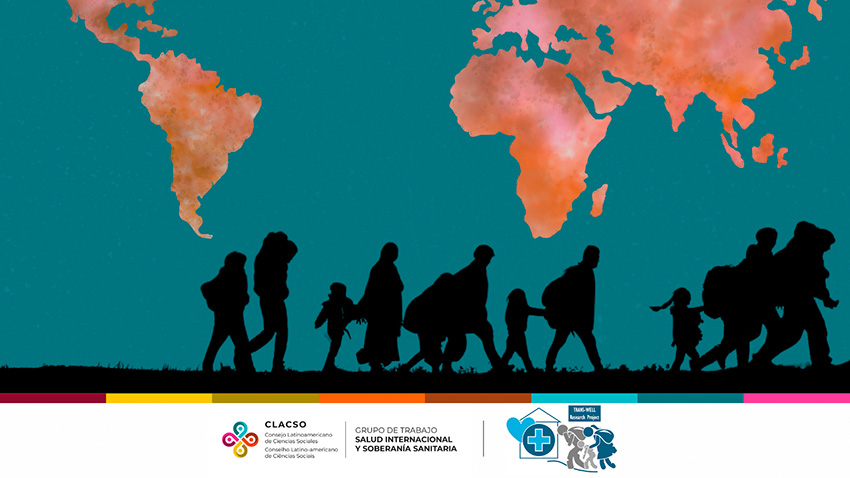
South-South Migration and Health Systems
The Latin American Council of Social Sciences, through its Working Group “International Health and Health Sovereignty”, launched in 2026 the new TRANS-WELL Research Consortium “South-South Migration and Health Systems”, which develops a research network on “human mobility and public health” among researchers and institutions from Mozambique (Africa), Myanmar/Thailand (Asia), Dominican Republic/Haiti (Caribbean), Germany and Switzerland.
The Southern Program – Strategic Program for Support and Strengthening of South American Integration – is an initiative of the Institute of International Studies of the University of Chile, developed with the support of CAF (Development Bank of Latin America and the Caribbean).
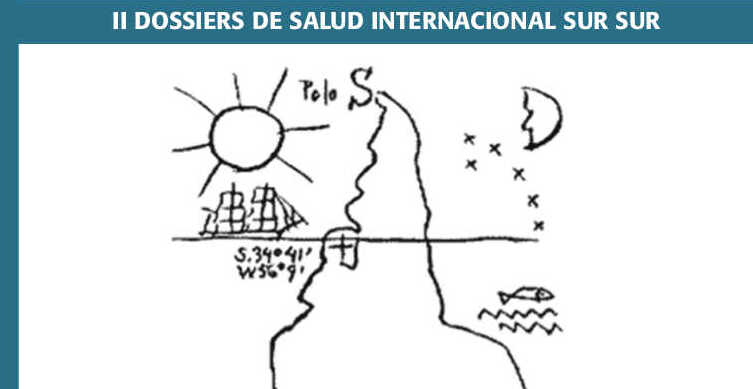
South-South international health: towards a decolonial and epistemological turn
The CLACSO Working Group “International Health and Health Sovereignty” presented the II Dossier on South-South International Health, a joint work of the International Health Program of FLACSO RD (Dominican Republic Program), the Health Area of IDEP-Institute of Participation and State Studies (Argentina) and Ediciones De la Comarca.
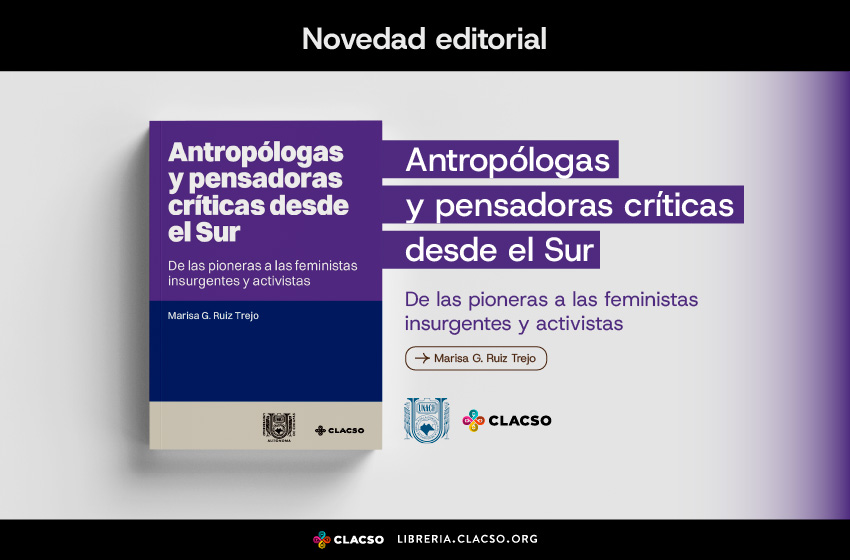
Anthropologists and critical thinkers from the South
This book by Marisa G. Ruiz Trejo, co-published by CLACSO with the Autonomous University of Chiapas, brings together the voices of twenty-eight anthropologists and critical thinkers from the South, whose diverse trajectories, marked by different ethical and political positions and life experiences, have shaped unique ways of doing anthropology and inhabiting the world.
South-South critical decolonial thought, praxis and aesthetics
The objective of the CLACSO Working Group on Critical South-South Decolonial Thought, Praxis and Aesthetics is to analyze this imbrication and the historical specificities that it has expressed in various stages.

