
Decolonization and NGOs
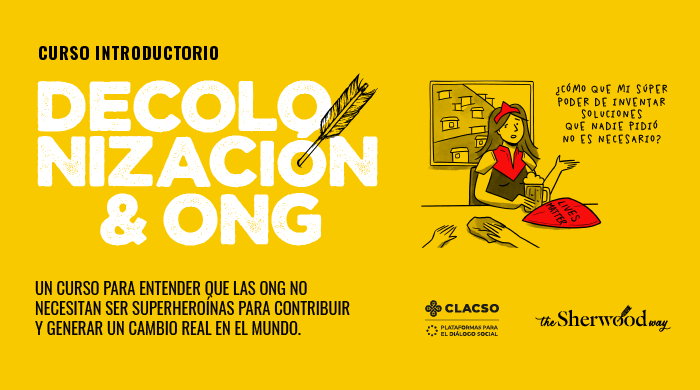
COORDINATION: Asier Hernando Malax-Echevarria (The Sherwood Way) and Pablo Vommaro (CLACSO)
TEACHING TEAM: Karina Batthyány (CLACSO/University of the Republic, Uruguay) | Asier Hernando Malax-Echevarria (The Sherwood Way) | Claudia Miranda (Federal University of Rio de Janeiro, Brazil) | Sergio Calundungo (The Sherwood Way) | Adriana Anacona (University of Valle, Colombia) | Luciana Peker (Author of the books "Sexteame" and "The Daughters' Revolution", Argentina) | Pablo Vommaro (CLACSO) | María Teresa Blandón (Director of the Central American Feminist Program 'La Corriente') | Karina Bidaseca (CLACSO/National University of San Martín/University of Buenos Aires, Argentina) | Sofía Sprechmann Sineiro (Secretary General of CARE International)
Start: 21/05/2024
Registration: 22/04/2024 to 20/05/2024
The Sherwood Way and CLACSO are organizing this course, which will introduce you to the most important topic in the international cooperation sector today—a topic that is shaking its very foundations. Through this course, you will learn about the main concepts, the origins of the debate, the most influential people, and practical tools that you can apply in your own NGO.
Decolonization is not a new concept. There has been research, debate, and action on the subject from the Global South. But with the death of George Floyd and the increased visibility and impact of the Black Lives Matter movement, the Global North has awakened. The issue is more present than ever in its societies and also within NGOs. A journey has begun that encompasses museums, how we interpret history, film, and more.
There is a challenge to a Eurocentric interpretation of the world, since global social justice is impossible without the global distribution of knowledge. Furthermore, the transformations taking place in the world should not be guided solely by the ideas and plans of critical theory from the Northern Hemisphere.
It's hard to admit, but development cooperation is intertwined with our colonial history. It's rooted in the civilizing mission that accompanied colonization, and therefore in the racist logic of Western superiority and the inferiority of other peoples. Traces of this can be seen in the terms we still use to describe our work, such as 'development cooperation' and 'North-South'.
Some of the world's leading NGOs are already part of this process of change, each at its own pace and based on its starting point. This is the case with Plan International, Save the Children, CARE, Oxfam, and Doctors Without Borders, among many others. Their partner organizations demand it, but so do their donors; 30 of the world's 36 largest donors and foundations are modifying their practices in this same direction. The process is now unstoppable.
The course is designed for international cooperation professionals with both technical and managerial backgrounds. It will have a practical focus and will be delivered in eight 90-minute weekly sessions.
This training will allow you to learn about how the world's leading NGOs are transforming in four areas: their programs, organizational culture, funding, and governance. It will also feature the collaboration of some of the main Latin American social movements.
The sessions will be held on Tuesdays at the following times: 9:00 to 10:30 AM Central America-Mexico | 10:00 to 11:30 AM Peru-Ecuador-Colombia | 11:00 AM to 12:30 PM New York-Dominican Republic-Haiti-Cuba | 12:00 to 1:30 PM Argentina-Brazil
- Session 1: Epistemologies of the South and decoloniality
We live in turbulent and complex times. Epistemologies of the South propose expanding the political imagination beyond the intellectual and political exhaustion of the Global North. This exhaustion translates into an inability to confront the challenges of this century and into threats to democracy, law, and human dignity. The Global South, the South we will be discussing in this course, is a metaphor for the human suffering caused by the major forms of oppression: capitalism, colonialism, and patriarchy.
-
Session 2: Emancipation and scripts developed in the Global North
The emancipatory transformations produced in the world cannot be confined to grammars and scripts developed by critical theory centered on the Global North; on the contrary, the Epistemologies of the South claim a diversity of knowledges that support the social struggles that are important to (re)cognize and value.
-
Session 3 : Origin, definitions and scope of the debate on decolonization for NGOs
The concepts of colonization, decolonization, and localization. We will learn about the meaning of these terms, the reasons for their use, their origin, the reflections currently being discussed by donors, NGOs, and social movements, and their implications for the transformation of international cooperation.
-
Session 4 : Dialoguing with social movements on the decolonization of cooperation
You will have the opportunity to engage in dialogue with social movements about why it is important to move forward with this process and how failing to do so undermines the defense of their social causes. You will also learn about the perspectives and proposals of social organizations in the Global South.
-
Session 5 : Learn about the tools and areas in which to advance the decolonization of NGOs
You will have access to and learn how to apply the tools to advance the decolonization of partnership strategies, organizational culture, financing strategies, and governance.
-
Session 6: Learning from practice: NGOs with the greatest progress in their decolonization
You will learn about the progress and lessons learned by several leading NGOs, how they are implementing changes, and what challenges they face. This class will be led by Sofía Sprechmann, Secretary General of CARE International.

|
Latin America, Caribbean, Africa or Asia |
$150 |
|
Europe, USA, Canada or Oceania |
$180 |
Inquiries: [mail protected]

