
Decolonization and NGOs
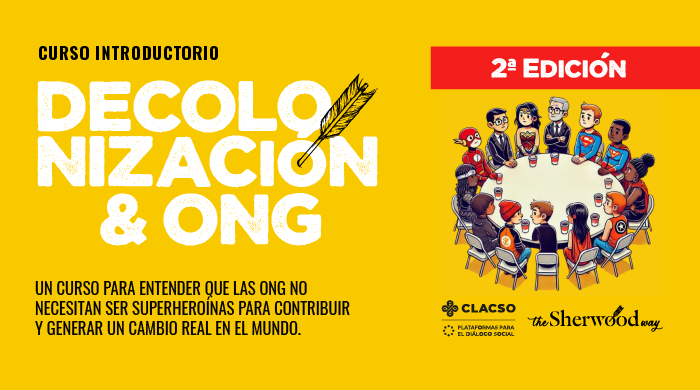
COORDINATION: Asier Hernando Malax-Echevarria (The Sherwood Way) and Pablo Vommaro (CLACSO)
TEACHING TEAM: Karina Batthyány (CLACSO/University of the Republic, Uruguay) | Asier Hernando Malax-Echevarria (The Sherwood Way) | Claudia Miranda (Federal University of Rio de Janeiro, Brazil) | Sergio Calundungo (The Sherwood Way) | Adriana Anacona (University of Valle, Colombia) | Pablo Vommaro (CLACSO) | Damaris Ruiz (We Effect) | Andrea Villaseñor (Hispanics in Philanthropy) | Carlos Bedoya (Latindadd) | Kate Moger (Pledge for Change) | Claudia Caselli (The Sherwood Way) | Alba Murcia (Development Hub)
New start date: 01/10/2024
Registration: 05/08/2024 to 30/09/2024
The Sherwood Way and CLACSO are organizing the second edition of this course, which will introduce you to the most important topic in the international cooperation sector today—a topic that is shaking its very foundations. Through this course, you will learn about the main concepts, the origins of the debate, the most influential people, and practical tools that you can apply in your own NGO.
Decolonization is not a new concept. There has been research, debate, and action on the subject from the Global South. But with the death of George Floyd and the increased visibility and impact of the Black Lives Matter movement, the Global North has awakened. The issue is more present than ever in its societies and also within NGOs. A journey has begun that encompasses museums, how we interpret history, film, and more.
There is a challenge to a Eurocentric interpretation of the world, since global social justice is impossible without the global distribution of knowledge. Furthermore, the transformations taking place in the world should not be guided solely by the ideas and plans of critical theory from the Northern Hemisphere.
It's hard to admit, but development cooperation is intertwined with our colonial history. It's rooted in the civilizing mission that accompanied colonization, and therefore in the racist logic of Western superiority and the inferiority of other peoples. Traces of this can be seen in the terms we still use to describe our work, such as 'development cooperation' and 'North-South'.
Some of the world's leading NGOs are already part of this process of change, each at its own pace and based on its starting point. This is the case with Plan International, Save the Children, CARE, Oxfam, and Doctors Without Borders, among many others. Their partner organizations demand it, but so do their donors; 30 of the world's 36 largest donors and foundations are modifying their practices in this same direction. The process is now unstoppable.
The course is designed for international cooperation professionals with both technical and managerial backgrounds. It will have a practical focus and will be delivered in eight 90-minute weekly sessions.
This training will allow you to learn about how the world's leading NGOs are transforming in four areas: programs, organizational culture, funding, and governance. It will draw on the experience of social movements, academia, and NGOs to provide a broad perspective on how to advance this important agenda.
The sessions will be held on Tuesdays at the following times: 9:00 to 10:30 AM Central America-Mexico | 10:00 to 11:30 AM Peru-Ecuador-Colombia | 11:00 AM to 12:30 PM New York-Dominican Republic-Haiti-Cuba | 12:00 to 1:30 PM Argentina-Brazil
Session 1: Decolonization of Power and Epistemologies of the South: Implications for NGOs
Prof. Claudia Miranda and Pablo Vommaro
The class will address how coloniality still affects our social structures and the importance of ideas from the Global South and collective resistance. This topic is important for NGOs because it helps them understand the historical roots of inequality and oppression, and recognize and value ancestral knowledge and practices. The ideas of Aníbal Quijano and Rita Laura Segato on colonial power and its impact on Latin America will be highlighted, using examples such as Indigenous communal governance and the role of the Tumaqueñas in Afro-Colombian education to demonstrate the relevance of decolonization to the work of NGOs.
Session 2: Healing Colonial Narratives for Equitable Development
Prof. Adriana Anacona
The importance of questioning and healing colonial narratives for NGOs, highlighting the need to decolonize knowledge and identity to heal historical wounds. The class will discuss the differences between colonialism, coloniality, and decoloniality, and their role in perpetuating oppression. It will also explore examples of resistance and the recovery of ancestral knowledge, underscoring the importance of recognizing and listening to the voices of marginalized communities so that NGOs can promote more just and equitable development.
Session 3: Decolonizing International Cooperation: Towards an Equitable Transformation
Prof. Sergio Calundungo
This class addresses the need to decolonize international cooperation, especially in the humanitarian field. It highlights the importance of the participation and leadership of local and national actors in humanitarian responses and questions the effectiveness of large donor agencies in facilitating necessary social and institutional changes. Furthermore, it discusses how structural racism and the colonial legacy remain present in the humanitarian system and the urgency of addressing these issues to achieve more equitable and effective cooperation.
Session 4: Decolonial Programmatic Approaches from the Global South
Prof. Andrea Villaseñor
Programs developed in collaboration with partner organizations offer new perspectives and decolonial approaches to international cooperation. This class will focus on how to implement transformative programmatic planning that challenges and redefines traditional practices. It will analyze how decolonial initiatives are questioning hegemonic narratives and building alternative models that reflect the realities and needs of the Global South.
Session 5: Decolonization in Action: Governance, Operations, and Language
Prof. Asier Hernando and Claudia Caselli
Implementing decolonial practices in governance and language is essential for change. This class will focus on how NGOs can adopt participatory and inclusive governance models. It will also underscore the importance of non-colonial communication in dismantling oppressive narratives. Strategies and practical examples for implementing these changes will be presented.
Session 6: Feminist Innovation: Decolonial Funding and Operations
Prof. Damaris Ruiz and Alba Murcia
A feminist perspective plays a crucial role in the decolonization process within NGOs. This class will address how to integrate decolonial and feminist principles into operations and fundraising. Practical examples will be discussed of how NGOs can adopt transformative approaches that challenge traditional power and funding structures, fostering systemic change toward more equitable cooperation.
Session 7: Proposals from social movements
Prof. Carlos Bedoya
This class explores the proposals that social movements are making to NGOs in Africa, Asia, and Latin America. It will examine the initiatives of the Permanent Latin American Forum on the Decolonization of International Cooperation and reflect on how NGOs should adapt to contribute to the challenging agenda of social movements and organizations. It will offer practical recommendations.
Session 8: How to Change the Cooperation System: Pledge For Change
Prof. Kate Moger
This class explores how to collectively transform the development system toward a truly decolonial approach. Using the "Pledge for Change" initiative as a case study, it will examine the commitments and strategies that some of the world's largest NGOs are implementing to reshape their practices. The class will discuss the challenges inherent in this transformation process, including internal and external resistance, as well as the tangible progress and results that have been achieved.

|
Latin America, Caribbean, Africa or Asia |
$185 |
|
Europe, USA, Canada or Oceania |
$215 |
Inquiries: [mail protected]

