
"CLACSO is an ally with whom we can achieve many of our objectives."
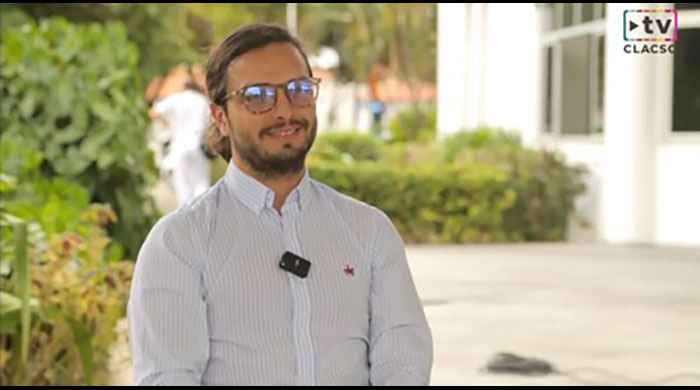
Within the framework of the Forum "Social Movements and Territories for Life”, which took place on June 29 and 30 in Fortaleza, Brazil, spoke with CLACSO.tv Mateo Adarve, Programme Officer at the Swedish International Development Cooperation Agency (SIDA).
– What is the importance of these types of meetings within the framework of the Platforms for Social Dialogue from your perspective as a Swedish Cooperation professional?
– Something has been resonating with us throughout this time we've been interacting within these international forums, and that's the peak moments of the Platforms for Social Dialogue (PDS). Because I truly believe you experience firsthand what it means to meet these three dimensions: social movements, public policy decision-makers, and academia.
But beyond that, I believe the significance of the PDS for us takes the form of regional integration for Latin America, both bottom-up and decentralized. It's an integration that isn't part of diplomacy, of the traditional state, which is where integration is typically centered. Furthermore, it's decentralized because it happens in places where Latin American integration doesn't usually occur.
For example, today we are in Fortaleza, which, although one of the five most important cities in Brazil, is not a traditional venue for a forum of this kind: international, with intergenerational and intercultural dialogue. For us, this is what we have come to reflect on: how the Platforms for Social Dialogue contribute to a form of regional integration that will surely replace these traditional models and will generate much discussion.
– In that sense, I'm interested in exploring what you were saying, that some powerful new approaches are being discovered. We're moving from a more traditional approach to diplomacy and integration to one that's large-scale yet local, personal, one-on-one, group-to-group. We were talking with some social movements about how they perceive members of social movements who come from other parts of the region, and there's a very powerful exchange happening to understand possible solutions to common issues despite the distance. What are your thoughts on this?
It's very interesting because what does this convergence between the local and the global mean? I was also talking, I think even with some of the people you were talking to, and they feel confined to their way of cooperating in a specific area of Brazil. I mean, I was asking them: what kind of dialogue do you have, for example, with the indigenous movement in the Amazon? I was just in Belém do Pará last week, where there's a large trans-Amazonian indigenous movement, which has developed over time through some rather unique dynamics and because the river itself, the natural means of communication for the entire region, facilitates it.
But here in northeastern Brazil, there's no dialogue between the movements in the region and those in the Amazon, and even less between this locality and the Latin American region as a whole. So, I think there's a significant challenge there, and that's also one of the gaps we're trying to bridge.
– That makes me think about how many possible dialogues there are. What do you think is the contribution of Swedish Cooperation to this type of dialogue? Because this is a transatlantic dialogue, thinking about Sweden and Latin America, but also about the internal dynamics within Latin America. It's about strengthening internal dialogues that, even though the distances are shorter, seem longer in terms of communication, right?
– Well, in fact, in my personal experience, it was easier to get to Stockholm in terms of time than to get to Fortaleza. That's also the kind of distance we're trying to shorten.
But to answer your question more directly, what is the role of Swedish Cooperation? We have a long-standing relationship with CLACSO for several reasons. There's a history that goes back to the authoritarian regimes that existed in South America, which made these networks necessary. It was a very reactive approach. At that time, it was about supporting political refugees and giving them opportunities outside their countries until they could return from exile. And those solidarity networks later grew into the larger networks that are what CLACSO is today.
But the role of Cooperation for us also aligns with CLACSO's objectives and mission because CLACSO, first and foremost, focuses on inequalities and eliminating all the structural barriers to poverty. Secondly, it promotes the democratization of knowledge and free access to it, which is fundamental for Swedish society. And there are a number of other key areas of alignment that I could elaborate on at length.
So, for us, CLACSO is an ally with whom we can achieve many of our objectives. And on the other hand, at a more direct level of cooperation between countries—at the academic and cultural levels—we are also interested in these potential dialogues between academics, not only in Sweden, but throughout the Nordic countries. That's why we've been working on these potential dialogues, for example, with the Nordic Institute for Latin American Studies and Latin Americanists based in the Nordic countries.
All of this generates discussions that are not only broader, but also involve navigating between different levels: local, national, regional, and now, to a lesser extent, international. And in these discussions, if we focus on the issues that bring us together today, it is essential to engage all levels. We are talking about issues of the environment, territoriality, climate change, and so on.
– Understanding that the logic of globalization has had some very destructive processes, especially for local communities, but also that there are potential benefits, particularly in access to knowledge, as you mentioned. How do you interpret this exchange of knowledge between the Nordic countries and Latin America? Both in terms of considering solutions and strategies from the Nordic countries that could be very powerful for certain issues in Latin America, and in terms of some Latin American issues that could be very valuable for the Nordic countries. What is the nature of this communication?
– I'll try to give a specific example, because it's difficult to grasp these kinds of ideas otherwise. Something many people don't know is that Sweden also faces many dilemmas regarding environmental issues, such as its relationship with the Sapmi people, the indigenous population of Sweden. In that case, what kind of dialogue is possible? It's based on those other ways of inhabiting the world that exist not only here in Latin America, those epistemological and ontological ways of relating to the land, the environment, and life, but that also exist in Sweden.
So that's a possible dialogue that we've facilitated in a limited way on previous occasions. For example, representatives of the SAPMI Parliament went to Guatemala to talk with representatives of Guatemala's indigenous peoples. These are the kinds of scenarios—global and local at the same time—that we want to encourage and promote.
– Within this context, one of the major themes that emerged here, in the talks and debates we had on CLACSO.tv, is climate change. It's a topic of extreme depth and gravity, and it cuts across different social movements. What importance do you assign to these issues when the discussion surrounding them is sometimes clouded by fake news, and when it's difficult to present the reality of climate change clearly?
– First, I want to say that the Swedish government and people place such a high priority on climate change worldwide. It's the most important issue. In fact, I can attest to that importance with something that happened yesterday: the appointment of the new Director General of SIDA. This change came about due to the new government, and this person comes precisely from academia, having worked, for example, on data related to climate change. So, it's very significant.
But beyond that, for us, cooperation, for example, regional cooperation with Latin America and the Caribbean, goes beyond our partnership with CLACSO, because of course we have many other partners who are also working on climate change from different perspectives. One of these is a topic that is currently very relevant: the bioeconomy. How can we manage alternative economic models to sustain the lives of communities in areas most affected by climate change? How can we generate adaptation and resilience strategies in some way?
On the other hand, we are working on a very important dimension, which also brings us together here in Fortaleza today: climate justice, how we can mobilize more effectively. And here we must also take advantage of a crucial moment for Latin America, which is the convergence of different governments and political will to mobilize on the issue of climate change.
To that extent, our strategy also involves mobilizing movements to be well-prepared for these upcoming events. One, happening very soon, is the Amazon Summit of Presidents in August, which will take place in Belém do Pará. The second is the United Nations Climate Change Conference (COP), also in Belém do Pará. Now the eyes of the world will be on Brazil, on Belém do Pará, on the Amazon. And I believe that this renewal of political will in Latin America regarding the Amazon treaty, this attempt to revive its fundamental essence, is part of what Sweden also wants to mobilize at this time.
– Throughout this time, we've been talking with Karina Batthyány, Executive Director of CLACSO, about the Platforms for Social Dialogue, each of them, and their growing importance. The word "transversality" is also very powerful here, because understanding one platform without the others means failing to grasp the complexity, how everything works, and how this very powerful work with ASDI is progressing. What is your perspective from the other side regarding what this progress implies and what's next for the Platforms for Social Dialogue in this alliance with CLACSO?
– I think we've very successfully navigated the initial phase of developing these Platforms for Social Dialogue. We've built a structure that allows us to attract a critical mass. I think now is the moment for impact. It's time to scale up, to take the messages we've been developing with academia, policymakers, and social movements, and bring them to the decision-making arenas where they need to reach. And to a broader audience as well. The challenge now is how to present them in a way that makes them accessible and appropriate in different contexts. I think that's what's coming next.
Interviewed by Gustavo Lema.
International Forum on Social Movements and Territories for Life
If you would like to receive more information about CLACSO's training programs:
[widget id=”custom_html-57″]
to our email lists.

