
Social sciences and violence in Central America
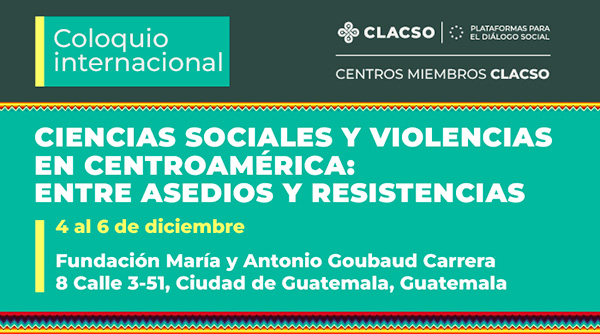

From December 4 to 6, Guatemala City is the venue for the International Colloquium “ Social Sciences and Violence in Central America: Between Sieges and Resistances ”, a joint initiative of the Latin American Council of Social Sciences, the CLACSO Member Centers in Central America and the CLACSO Working Groups “Violence in Central America”, “Feminisms, Resistances and Emancipation” and “Ruralities and Political Transitions in Central America and Colombia”.

This colloquium, which took place at the facilities of the María and Antonio Goubaud Carrera Foundation, is part of the Platform for Social Dialogue “Democracy, Human Rights and Peace” that CLACSO has been promoting since 2022. It consisted of panels, working groups, book presentations and a film screening and discussion.


Among other CLACSO activities, Pablo Vommaro , Academic Secretary, moderated on Thursday, December 5, the “Presentation of the CLACSO/French Development Agency Report: State of Democracies in Latin America and the Caribbean. (Narco) Authoritarian Neoliberalism or Democracy with Demos,” which was analyzed by René Ramírez (Latin American Strategic Center for Geopolitics, Coordinator of the CLACSO Working Group “Studies on Time and Temporalities”) and Gabriela Gallardo Lastra (Academic Unit in Development Studies, Autonomous University of Zacatecas and CLACSO Working Group “Studies on Time and Temporalities”) and commented on by Clara Arenas Bianchi (Association for the Advancement of Social Sciences) and Carlos Figueroa Ibarra (Institute of Social Sciences and Humanities, Meritorious Autonomous University of Puebla, Coordinator of the CLACSO Working Group “Violence in Central America”).

And on Friday the 6th, Pablo Vommaro first participated in the presentation of the book “Bodies of injustice: a feminist critique from Central America together with Monserrat Sagot (Center for Research in Women's Studies – University of Costa Rica, Representative of the CLACSO Steering Committee) and Ana Silvia Monzón (FLACSO Guatemala, Coordinator of the CLACSO Working Groups “Violence in Central America” and “Feminisms, resistances and emancipation”.

Finally, he was part of the closing session of the colloquium along with Manuel Rivera (Institute of Political and Social Research, San Carlos University of Guatemala. Representative of the CLACSO Steering Committee), Ana Silvia Monzón, Azael Carrera (Center for Latin American Studies “Justo Arosemena” and University of Panama. Representative of the CLACSO Steering Committee) and Mario Sánchez (Nicaraguan activist. Member of the CLACSO Working Group “Ruralities and political transitions in Central America and Colombia”).


Meeting of the Working Groups from CLACSO


Central America significantly raises the average for all forms of violence recorded in the region. The armed conflicts of the 1980s registered levels of violence previously unimaginable. The social order structured after the peace processes of the 1990s, the transition to liberal democratic institutions, and the transition to neoliberalism, far from what was expected, failed to reduce violence. Its dynamics and forms of manifestation changed, but its presence did not diminish. The large and complex processes that shape the violence present today in each of the Latin American countries have a long history in Central America: territorial dispossession, remilitarization, drug trafficking and organized crime, migration, patriarchal violence, structural weakness of the state, impunity, criminal governance, gangs, and organized crime groups.
Despite the regional and global importance of Central American processes, the region remains largely overlooked by Latin American social sciences. Therefore, this event aims to deepen dialogues on violence in Central America among the academic and university sectors, social organizations, and political actors, and to reaffirm the crucial role of the social sciences in constructing knowledge about social reality and in its transformation—a role that is part of the resistance that has always been present in the region.


Thematic axes: Violence and accumulation processes – Violence and politics – Violence, society and culture – Violence, human rights and justice – Violence and social sciences.


Organizing committee:
Ana Silvia Monzón (Guatemala), Latin American Faculty of Social Sciences
Carlos Figueroa Ibarra (Mexico), Postgraduate Program in Sociology. Institute of Social Sciences and Humanities. Meritorious Autonomous University of Puebla
Julieta Rostica (Argentina), Institute of Latin American and Caribbean Studies, Faculty of Social Sciences, University of Buenos Aires
Kristina Pirker (Mexico), Dr. José María Luis Mora Research Institute
Laura Yanina Sala (Argentina), Institute of Social Studies in Contexts of Inequality, National University of José C. Paz
Leonardo Herrera Mejía (Mexico), University of the Valley of Puebla
Úrsula Roldán (Guatemala), Institute for Research and Outreach on Global and Territorial Dynamics. Vice-Rectorate for Research and Outreach. Rafael Landívar University


If you would like to receive more information about CLACSO's training programs:
[widget id=”custom_html-57″]
to our email lists.

