
International Colloquium: Social Sciences and Violence in Central America: Between Sieges and Resistance
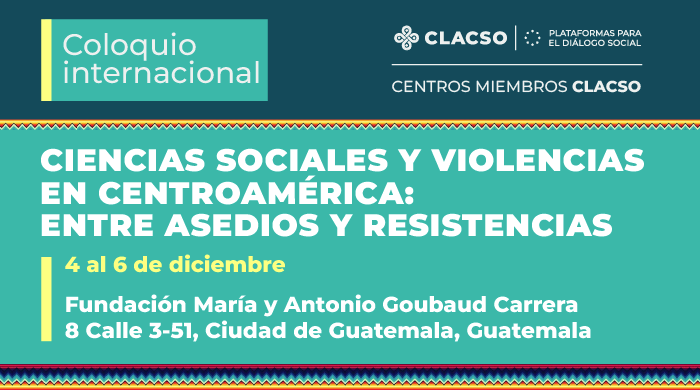
International Colloquium
Social sciences and violence in Central America: between sieges and resistance
December 4-6 | Guatemala City
María and Antonio Goubaud Career Foundation
Platform for Social Dialogue | Democracy, Human Rights and Peace
The International Colloquium: Social Sciences and Violence in Central America: Between Sieges and Resistance is a joint initiative of the Latin American Council of Social Sciences (CLACSO), various CLACSO Member Centers in Central America, and the CLACSO Working Groups on Violence in Central America , Feminisms, Resistance and Emancipation , and Ruralities and Political Transitions in Central America and Colombia . This colloquium is part of the Platform for Social Dialogue on Democracy, Human Rights and Peace, which CLACSO has been promoting since 2022.
It will take place at the facilities of the María and Antonio Goubaud Carrera Foundation , Guatemala City, on December 4, 5 and 6, 2024.
Central America significantly raises the average for all forms of violence recorded in the region. The armed conflicts of the 1980s registered levels of violence previously unimaginable. The social order structured after the peace processes of the 1990s, the transition to liberal democratic institutions, and the transition to neoliberalism, far from what was expected, failed to reduce violence. Its dynamics and forms of manifestation changed, but its presence did not diminish. The large and complex processes that shape the violence present today in each of the Latin American countries have a long history in Central America: territorial dispossession, remilitarization, drug trafficking and organized crime, migration, patriarchal violence, structural weakness of the state, impunity, criminal governance, gangs, and organized crime groups.
Despite the regional and global importance that Central American processes had and continue to have, the region remains of little importance to Latin American social sciences.
This event aims to deepen the dialogues on violence in Central America between the academic and university sector, social organizations and political actors and to revalue the determining role of the social sciences in the construction of knowledge about social reality and in its transformation, which is part of the resistances that have always been present in the region.
Themes
- Violence and accumulation processes
- Violence and politics
- Violence, society and culture
- Violence, human rights and justice
- Violence and Social Sciences
PANELS – WORKSHOPS – BOOK PRESENTATIONS – FILM DISCUSSIONS
PROGRAM
TABLE: AXIS 1 - VIOLENCE AND ACCUMULATION PROCESSES I
Sam Colop Hall
Participate
- Luis Manuel Martínez Estrada (National Autonomous University of Honduras of the Sula Valley)
Common goods, violence and resistance: the experiences of struggle on the Atlantic Coast of Honduras - Alexis Rodríguez Mojica (University of Panama)
Victoriano Jaramillo Nuñez (FAT Panama)
Panama 2022. Consensus and dissent, fragility of governance mechanisms and development style. - Daniel Cieza (University of Buenos Aires)
Illicit economy and political financing - Nelly Carina Moreno Parada (National University of Lanús)
Massacres as processes of accumulation by dispossession: El Mozote
coordinate
Selvin Torres
Rafael Landivar University
Andrés León Araya
Indiana University
TABLE: AXIS 1 - VIOLENCE AND ACCUMULATION PROCESSES II
Sam Colop Hall
Participate
- Hilary Goodfriend (National Autonomous University of Mexico)
Migration and accumulation: the migration pattern and its crisis in Central America - Julio Orellana (University of California, Santa Barbara, USA)
Racialized Guatemalan labor migrations in the Los Angeles metropolitan area - María del Rocío Chamorro Tasies (University of Costa Rica)
César Augusto Gómez Calderón (University of Costa Rica)
Tensions and contradictions in the state management of water resources in Costa Rica: bases for documenting the neo-extractivist dispossession of water - Denia Román Solano (University of Costa Rica and CLACSO Working Group The Central American Isthmus: Peripheral Epistemological Perspectives)
The fading of sustainable democracy: violence and the indigenous land recovery movement in the South Pacific of Costa Rica.
coordinate
Selvin Torres
Rafael Landivar University
Andrés León Araya
Indiana University
BOOK PRESENTATION: LET'S GO FOR SOCIALISM
Sam Colop Hall
Present
- Laura Sala
National University of José C. Paz and Group of Studies on Central America/Institute of Studies on Latin America and the Caribbean, University of Buenos Aires
Coordinator of the CLACSO Working Group on Violence in Central America - Marcelo Colussi
University of San Carlos of Guatemala
TABLE: AXIS 2 - VIOLENCE AND POLITICS I
Sam Colop Hall
Participate
- Ana González (Central American Studies Group, Institute of Latin American and Caribbean Studies, University of Buenos Aires)
The insurgent church: liberation theology as an internal enemy in the Guatemalan internal armed conflict - Leonardo Astorga Sánchez (University of Costa Rica)
The colossus awoke: Cold War, press, and military invasions. The case of the invasions of Grenada (1983) and Panama (1989), from the pages of La Nación - José Julian Llaguno Thomas (School of Political Science and Institute of Social Research. University of Costa Rica)
Political violence and anarcho-syndicalism in Central America: the experience of the American Continental Association of Workers (ACAT), 1929-1932. - Adriana Sánchez Lovell (Costa Rica university)
State, violence and institutional authoritarianism in Costa Rica. 1930s to 1940s. Agricultural, transport and unemployed workers - Mauricio José Chaulón Vélez (Institute of Historical, Anthropological and Archaeological Research. School of History, University of San Carlos of Guatemala)
Anti-communist discourse in the Guatemalan press during the government of Carlos Manuel Arana Osorio. Part I: 1970
coordinate
Ana González
Group for Studies on Central America, University of Buenos Aires
Mario Zúñiga Núñez
Costa Rica university
TABLE: AXIS 2 - VIOLENCE AND POLITICS II
Sam Colop Hall
Participate
- Mario Zúñiga Núñez (University of Costa Rica)
Youthicide in Central America: the case of El Salvador (the state organization of youth for repression 1992-2023) - Jeannette Aguilar Villamariona (University of Costa Rica)
States of exception as new youth-killing devices - Rafael Cuevas Molina (CLACSO Working Group on Violence in Central America)
Costa Rica: Violence and the breakdown of the welfare state - Adriana Monge Arias (University of Costa Rica)
Poverty and state violence in the neoliberal and neoconservative context of Central America - Esperanza Tasies Castro, Cesar Gómez Calderón and Rocío Chamorro Tasies (University of Costa Rica)
The Costa Rican public debt system: Impact on the human rights of the population
coordinate
Ana González
Group for Studies on Central America, University of Buenos Aires
Mario Zúñiga Núñez
Costa Rica university
OPENING TABLE
Margarita Carrera Hall
Participate
- Pablo Vommaro
Academic Secretary of CLACSO - Laura Sala
National University of José C. Paz and Group of Studies on Central America/Institute of Studies on Latin America and the Caribbean, University of Buenos Aires
Coordinator of the CLACSO Working Group on Violence in Central America - Carlos Figueroa Ibarra
Institute of Social Sciences and Humanities, Meritorious Autonomous University of Puebla
Coordinator of the CLACSO Working Group on Violence in Central America -
Ursula Roldán
Institute for Research and Projection on Global and Territorial Dynamics
Rafael Landivar University
Coordinator of the CLACSO Working Group on Ruralities and Political Transitions in Central America and Colombia
PANEL: SOCIAL SCIENCES AND VIOLENCE IN CENTRAL AMERICA
Margarita Carrera Hall
Participate
- Marcel Arévalo
Director of FLACSO Guatemala - Wendi Bellanger
Nicaraguan academic - Luz Martínez
Guatemalan student activist
Moderator:
Ana Silvia Monzón
FLACSO Guatemala
Coordinator of the CLACSO Working Group on Violence in Central America
Member of the CLACSO Working Group on Feminisms, Resistance and Emancipation
PRESENTATION OF THE CLACSO/AFD REPORT: STATE OF DEMOCRACIES IN LATIN AMERICA AND THE CARIBBEAN. (NARCO) AUTHORITARIAN NEOLIBERALISM OR DEMOCRACY WITH DEMOS
Margarita Carrera Hall
Present
- René Ramírez
Latin American Strategic Center for Geopolitics, CELAG
Coordinator of the CLACSO Working Group on Studies of Time and Temporalities - Gabriela Gallardo Lastra
Academic Unit in Development Studies, Autonomous University of Zacatecas and CLACSO Working Group on Studies of Time and Temporalities
They comment
- Clara Arenas Bianchi
Association for the Advancement of Social Sciences (AVANCSO) - Carlos Figueroa Ibarra
Institute of Social Sciences and Humanities, Meritorious Autonomous University of Puebla
Coordinator of the CLACSO Working Group on Violence in Central America
Moderator:
Pablo Vommaro
Academic Secretary CLACSO
PANEL: MINING EXTRACTIVISM IN CENTRAL AMERICA: CURRENT OVERVIEW AND PERSPECTIVES
Margarita Carrera Hall
Participate
- Cidia Ventura Cortez
Ecofeminist Movement of El Salvador - Mario sanchez
Nicaraguan activist - Guadalupe García
Guatemalan Extractive Industries Observatory - Luis Manuel Martínez Estrada
National Autonomous University of Honduras
Moderator:
Ursula Roldán
Co-coordinator of the CLACSO Working Group on Ruralities and Political Transitions in Central America and Colombia
Institute for Research and Projection on Global and Territorial Dynamics
Rafael Landivar University (Guatemala)
PANEL: VIOLENCE, SOCIETY AND CULTURE. VIOLENCE FROM A GENDER AND INTERSECTIONAL PERSPECTIVE
Margarita Carrera Hall
Participate
- Karina Grégori
Department of Social Sciences and Humanities of the Central American University and CLACSO Working Group on Feminisms, Resistances and Emancipation - Mi'nawee' López
National Youth Council of Guatemala - Tamara Dávila
Nicaraguan feminist activist - María Cecilia Mérida
Quetzaltenango Program - FLACSO Guatemala
Moderator:
Sandra Chuc
Maya K'iche' Social Researcher
Quetzaltenango Program - FLACSO Guatemala
TABLE: AXIS 4 - VIOLENCE, HUMAN RIGHTS AND JUSTICE I
Sam Colop Hall
Participate
- Leonardo Herrera Mejía (University of the Valley of Puebla, UVP)
Feet walking north. Violence in transit and at the destination of Central American migrants. - Linayme Paulette Reyes Ávila y Salvador Rogelio Ortega Martínez (Autonomous University of Guerrero)
Comparative case study on migration needs and forced displacement in Guatemala vs Mexico. - Sandra Patricia Quijas Cristerna (The College of the Northern Border, Mx)
The use of technology in the resilience of Central American refugees during their transit through Mexico
Comment
Danilo Rivera
Director General, Guatemalan Migration Institute
coordinate
Leonardo Herrera
University of the Valley of Puebla
Pilar Maldonado
University of San Carlos of Guatemala
PRESENTATION OF THE SOUTH(ES) BULLETIN OF THE CLACSO WORKING GROUP ON VIOLENCE IN CENTRAL AMERICA
Sam Colop Hall
Present
- Kristina Pirker
Mora Institute
CLACSO Working Group on Violence in Central America - Guillermo Fernandez Ampie
National Autonomous University of Mexico
CLACSO Working Group on Violence in Central America - Ana Karen León Sánchez
National Autonomous University of Mexico
CLACSO Working Group on Violence in Central America
BOOK PRESENTATION: NEO-CONSERVATIVE THOUGHT IN CENTRAL AMERICA IN THE 21ST CENTURY. RAFAEL CUEVAS MOLINA, ANDRÉS MORA RAMÍREZ AND ABNER BARRERA RIVERA (COORDINATOR). SAN JOSÉ: NATIONAL UNIVERSITY OF COSTA RICA, 2024
Sam Colop Hall
Present
- Rafael Cuevas Molina
Costa Rica university - Carlos Figueroa Ibarra
Institute of Social Sciences and Humanities, Meritorious Autonomous University of Puebla
Coordinator of the CLACSO Working Group on Violence in Central America - Julieta Rostica
Institute of Latin American and Caribbean Studies
Faculty of Social Sciences, University of Buenos Aires
CLACSO Working Group on Violence in Central America - Mauricio Chaulón
Institute of Historical, Anthropological and Archaeological Research, School of History, University of San Carlos of Guatemala - Trudy Mercadal
Rafael Landivar University
Moderator:
Laura Sala
National University of José C. Paz and Latin American and Caribbean Studies Group/Institute for Research on Latin America and the Caribbean, University of Buenos Aires
Coordinator of the CLACSO Working Group on Violence in Central America
TABLE: AXIS 3 - VIOLENCE, SOCIETY AND CULTURE I
Sam Colop Hall
Participate
- Marcelo Colussi (University of San Carlos of Guatemala) and Mario Sergio De León (University of Leeds)
Culture of violence in Central America - Oscar Ovidio Cabrera Melgar y Jaime Alfredo Miranda Flamenco (Foundation for the Development of Central America, FUDECEN El Salvador)
Multidimensional Inequality Report on Legal and Physical Security 2022, El Salvador - Yensi Vargas (University of Costa Rica), Yamileth Garcia (National University of Costa Rica) and Aara Zeledón (University of Costa Rica)
Persistent inequalities in rural education: case studies with young schoolchildren in Costa Rica and Colombia
coordinate
Carolina López
Guatemalan researcher
Alejandro flores
University of Edinburgh
TABLE: THEME 3 - VIOLENCE, SOCIETY AND CULTURE II
Sam Colop Hall
Participate
- Allan Armando Barrera Galdámez (National Autonomous University of Mexico)
Flexible accumulation and the representation of its violence in the novel Dance with Snakes (1996) by Horacio Castellanos Moya - Daniela Regina Araujo García y Salvador Rogelio Ortega Martínez (Autonomous University of Guerrero)
Culture and art as a catalyst for reconciliation and peacebuilding in Mexico and Central America
coordinate
Carolina López
Guatemalan researcher
Alejandro flores
University of Edinburgh
TABLE: AXIS 3 - VIOLENCE, SOCIETY AND CULTURE III
Sam Colop Hall
Participate
- Keylor Robles Murillo (University of Costa Rica)
Gender oppression relationships in the LGBTI movement - Edgar Desiderio Menchú Rosal (University of Costa Rica)
Violence and the shaping of subjectivity in youth conditions - José Luis Ramos Ramírez (National School of Anthropology and History, Mexico) and María Elena Guardado (Central American University, El Salvador)
Experiences of a girl during the Salvadoran armed conflict
coordinate
Carolina López
Guatemalan researcher
Alejandro flores
University of Edinburgh
TABLE: AXIS 2 - VIOLENCE AND POLITICS III
Margarita Carrera Hall
Participate
- Alexis Rodriguez Mojica (University of Panama)
Victoriano Jaramillo Núñez (FAT Panama)
Distrust and uncertainty: challenging environments for democracy in Panama - Patrick Illmer (Mora Institute, Mexico)
Authoritarian Trends in Central America: Persistence and Updating in Guatemala, Honduras and El Salvador - Andrés León Araya (Indiana University, USA)
From Fascism to Authoritarianism: Interpretations of State Violence in Central America - Guillermo Fernández Ampie (National Autonomous University of Mexico)
Nicaragua: political crisis, hate speech, homophobia and misogyny
coordinate
Ana González
Group of Studies on Central America IEALC/UBA, Argentina
Mario Zúñiga Núñez neighbourhood,
Costa Rica university
PANEL: AUTHORITARIANISM AND RESISTANCE IN CENTRAL AMERICA
Margarita Carrera Hall
Participate
- Azael Carrera
Center for Latin American Studies “Justo Arosemena” and University of Panama
Representative of the CLACSO Steering Committee - Montserrat Sagot
Center for Research on Women's Studies - University of Costa Rica
Representative of the CLACSO Steering Committee - Ixkik Isabel Zapil Ajxup
Institute 25A
CLACSO Working Group on Violence in Central America - Jaime Alfredo Miranda
Foundation for the Development of Central America, El Salvador - Tamara Dávila
Nicaraguan feminist activist
Moderator:
Manuel Rivera
Institute of Political and Social Research, University of San Carlos of Guatemala - IIPS/USAC
Representative of the CLACSO Steering Committee
PANEL: INTELLECTUAL PROPERTY, ACADEMIC EXTRACIVISM AND CULTURAL HERITAGE
Margarita Carrera Hall
Participate
- Angelina Aspuac
Governor of Sacatepequez - National Movement of Mayan Weavers - Mario Zuñiga
Costa Rica university
CLACSO Working Group on Violence in Central America - Carlos A. Haas
University of Munich
Moderator:
Alejandro flores
University of Edinburgh
CLACSO WORKING GROUP MEETING ON VIOLENCE IN CENTRAL AMERICA
Margarita Carrera Hall
BOOK PRESENTATION: BODIES OF INJUSTICE: A FEMINIST CRITIQUE FROM CENTRAL AMERICA
Margarita Carreras Hall
Present
- Montserrat Sagot
Center for Research on Women's Studies - University of Costa Rica
Representative of the CLACSO Steering Committee - Pablo Vommaro
Academic Secretary of CLACSO - Ana Silvia Monzón
FLACSO Guatemala
Coordinator of the CLACSO Working Group on Violence in Central America
Member of the CLACSO Working Group on Feminisms, Resistance and Emancipation
TABLE: AXIS 5 - VIOLENCE AND SOCIAL SCIENCES I
Sam Colop Hall
Participate
- Brenda Itziguari Muñoz Martínez (Autonomous University of Tlaxcala)
Of Heterotopias and Spaces of Exception: An Approach to the State of the Art on the Spatialities of Disappearance in the Social Sciences - José Angel Vega Chinchilla y Jesus Francisco Martinez Ramirez (University of Costa Rica)
Latin American Memory and its contribution to the social work profession - Anelí Villa Avendaño (Center for Research on Latin America and the Caribbean, CIALC-UNAM)
Sociology of hope: Theoretical contributions and case studies in Guatemala and Argentina
coordinate
Kristina Pirker
Mora Institute, Mexico
Ana Karen León
National Autonomous University of Mexico
TABLE: AXIS 5 - VIOLENCE AND SOCIAL SCIENCES II
Sam Colop Hall
Participate
- Ana Karen León Sánchez (National Autonomous University of Mexico)
“Listening to what they have to say about the war”: A theoretical-methodological approach to working with testimonies of survivors of gender-based political violence - Kristina Pirker (Mora Institute, Mexico)
Traces of violence(s) and hindsight bias: Potential and risks of secondary analysis of life histories of left-wing militants in Central America (El Salvador and Nicaragua) - Silvia Soriano Hernández (Center for Research on Latin America and the Caribbean/UNAM)
Violent memories: from the natural to the supernatural
coordinate
Kristina Pirker
Mora Institute, Mexico
Ana Karen León Sánchez
National Autonomous University of Mexico
BOOK PRESENTATION: WE SURVIVED, WE ARE HERE, WE ARE ALIVE: WAR, POLITICAL GENDER VIOLENCE AND SOCIAL SURVIVAL PRACTICES OF MAYAN WOMEN (HUEHUETENANGO AND QUICHÉ)
Sam Colop Hall
Present
- Ana Karen León (author)
National Autonomous University of Mexico
CLACSO Working Group on Violence in Central America - María Guadalupe García Hernández
Member of the Mamá Maquín organization - Julieta Rostica
Institute of Latin American and Caribbean Studies
Faculty of Social Sciences, University of Buenos Aires
CLACSO Working Group on Violence in Central America - Elsa Rabanales
Member of Actors of Change
Moderator:
Kristina Pirker
Mora Institute
CLACSO Working Group on Violence in Central America
TABLE: AXIS 4 - VIOLENCE, HUMAN RIGHTS AND JUSTICE II
Sam Colop Hall
Participate
- Trudy Mercadal (Rafael Landívar University)
Gender violence in the neoliberal framework: The case of Guatemala - Pilar Maldonado Arreaga (University of San Carlos of Guatemala)
A psychosocial perspective as a proposal for addressing the effects of the criminalization of women defending territory and water in Guatemala - Paula Cuellar Cuellar (University of Texas - Dallas Campus)
See, Hear, and Remain Silent"
coordinate
Leonardo Herrera
University of the Valley of Puebla
Pilar Maldonado
University of San Carlos of Guatemala
PANEL: MEMORY, TRUTH AND JUSTICE IN CENTRAL AMERICA
Margarita Carrera Hall
Participate
- Paulo Estrada
Association of Families of Detainees of Guatemala - FAMDEGUA - Jovita Tzul tzul
Maya Kich'e Lawyer - CALDH - Paula Cuellar Cuellar
Human Rights Activist from El Salvador - Nelly moreno
Human Rights Lawyer from Honduras - Sonja Perkic
Human Rights Expert - Mario Polanco
Mutual Support Group - GAM - Carlos Figueroa Ibarra
Institute of Social Sciences and Humanities, Meritorious Autonomous University of Puebla
Coordinator of the CLACSO Working Group on Violence in Central America
They moderate
Laura Sala
National University of José C. Paz and Group for Studies on Central America/Institute of Studies on Latin America and the Caribbean, University of Buenos Aires
Coordinator of the CLACSO Working Group on Violence in Central America
Julieta Rostica
Group for Studies on Central America/Institute of Latin American and Caribbean Studies, University of Buenos Aires
Faculty of Social Sciences, University of Buenos Aires
CLACSO Working Group on Violence in Central America
FILM DISCUSSION: SCREENING OF THE DOCUMENTARY "INDIGNOT" (2023)
Margarita Carrera Hall
Screening of the documentary "Añil" (2023) by Julio López Fernández, based on the doctoral research of Paula Cuéllar Cuéllar on the sexual violence suffered by women in the context of the armed conflict in El Salvador by both belligerent parties.
Comment
Paula Cuéllar Cuéllar
Human Rights Activist from El Salvador
BOOK PRESENTATION AND DISCUSSION: RACISM AND GENOCIDE IN GUATEMALA. A LONG-TERM VIEW FROM THE PRESENT
Margarita Carrera Hall
Participate
- Julieta Rostica
Group for Studies on Central America/Institute of Latin American and Caribbean Studies, University of Buenos Aires
Faculty of Social Sciences, University of Buenos Aires
CLACSO Working Group on Violence in Central America - Marta Casaus
Gaubaud Career Foundation - Lucía Xiloj
Achi Women's Lawyer - Elizabeth moreno
ADVANCSO
CLACSO Working Group on Violence in Central America - Santiago Bastos
Center for Research and Higher Studies in Social Anthropology / Community Press - Pablo Vommaro
Academic Secretary of CLACSO
Moderator:
Manuel Rivera
Institute of Political and Social Research, San Carlos University of Guatemala - IIPS/USAC (Guatemala)
Representative of the CLACSO Steering Committee
CLOSING SPACE
Participate
- Pablo Vommaro
Academic Secretary of CLACSO - Manuel Rivera
Institute of Political and Social Research, San Carlos University of Guatemala - IIPS/USAC (Guatemala)
Representative of the CLACSO Steering Committee - Ana Silvia Monzón
FLACSO Guatemala
Coordinator of the CLACSO Working Group on Violence in Central America
Member of the CLACSO Working Group on Feminisms, Resistance and Emancipation - Azael Carrera
Center for Latin American Studies “Justo Arosemena” and University of Panama
Representative of the CLACSO Steering Committee - Mario Sánchez
Nicaraguan activist
Member of the CLACSO Working Group on Ruralities and Political Transitions in Central America and Colombia
ORGANIZING COMMITTEE
- Ana Silvia Monzón (Guatemala)
Latin American Faculty of Social Sciences - Carlos Figueroa Ibarra (Mexico)
Postgraduate Program in Sociology
Institute of Social Sciences and Humanities
Benemérita Autonomous University of Puebla - Julieta Rostica (Argentina)
Institute of Latin American and Caribbean Studies
Faculty of Social Sciences, University of Buenos Aires - Kristina Pirker (Mexico)
Dr. José María Luis Mora Research Institute - Laura Yanina Sala (Argentina)
Institute of Social Studies in Contexts of Inequalities
National University of José C. Paz - Leonardo Herrera Mejía (Mexico)
University of the Valley of Puebla - Ursula Roldán (Guatemala)
Institute for Research and Projection on Global and Territorial Dynamics
Vice-Rectorate for Research and Outreach
Rafael Landivar University
CLACSO WORKING GROUPS ORGANIZING THE COLLOQUIUM
- Violence in Central America
- Feminisms of resistance for emancipation
- Ruralities and political transitions in Central America and Colombia
SUPPORTED AND SPONSORS


