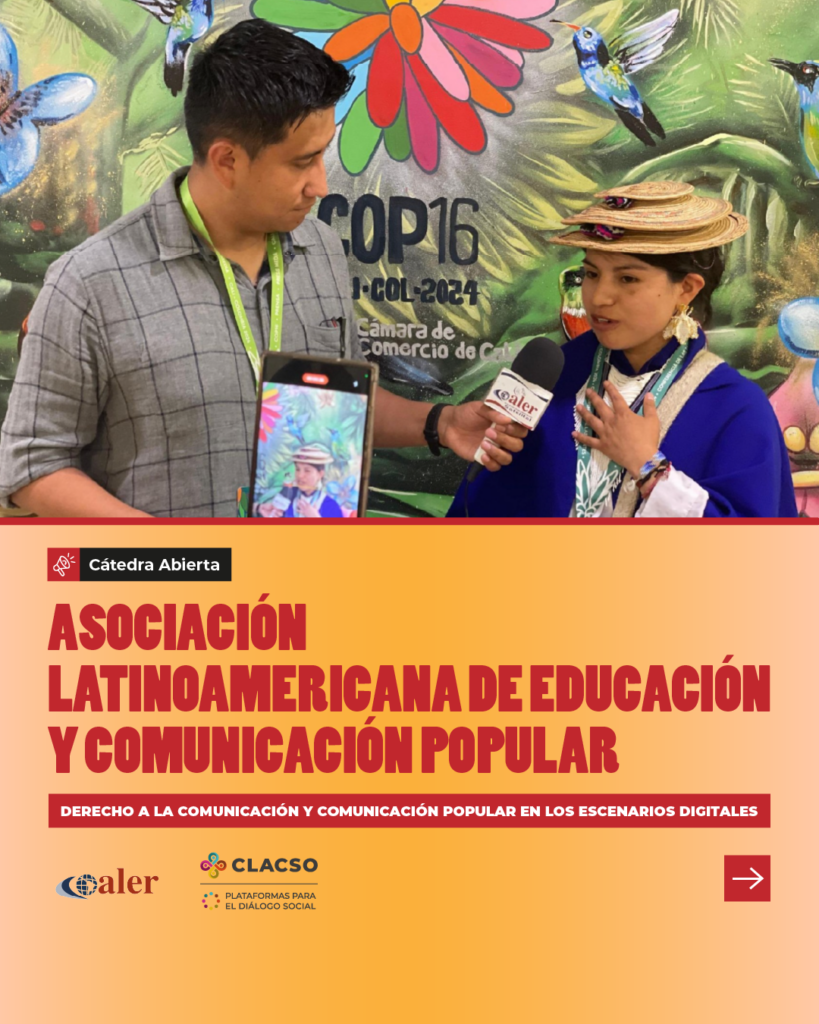
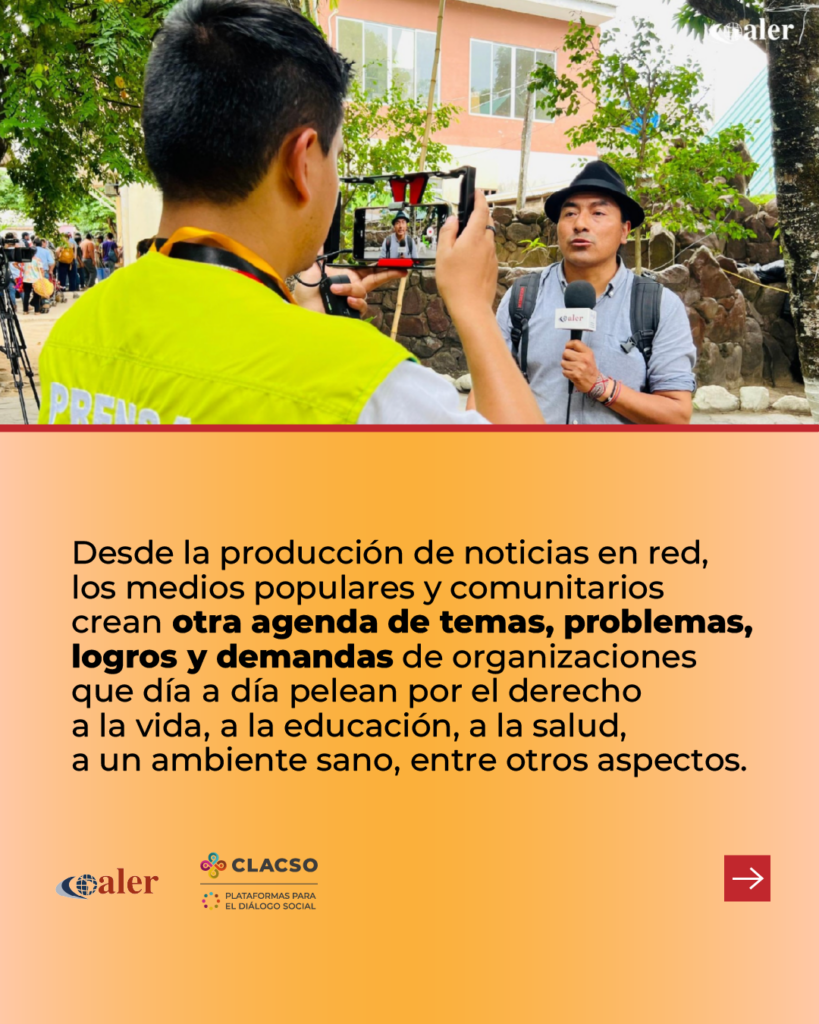
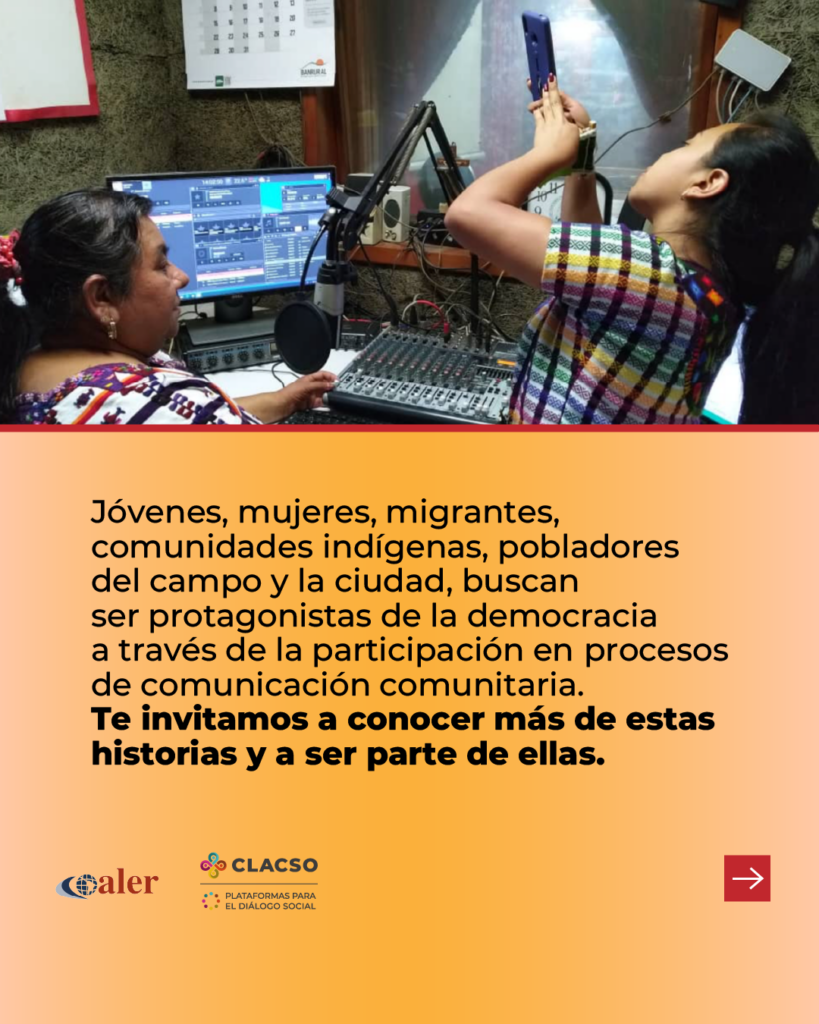
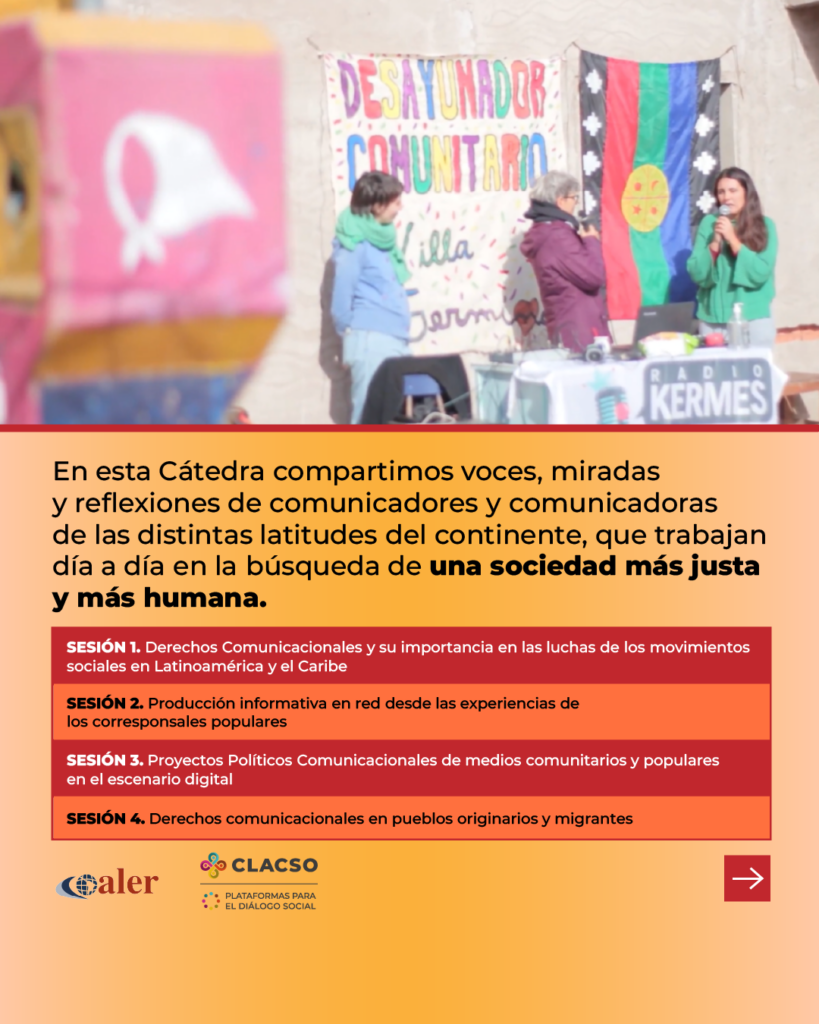
Open Chair of the Latin American Association of Popular Education and Communication (ALER).
The Open Chair of the Latin American Association of Education and Popular Communication (ALER) Right to Communication and Popular Communication in digital scenarios aims to be a space for training, reflection and exchange from the communication and education practices that social movements and popular organizations have been developing in Latin America.
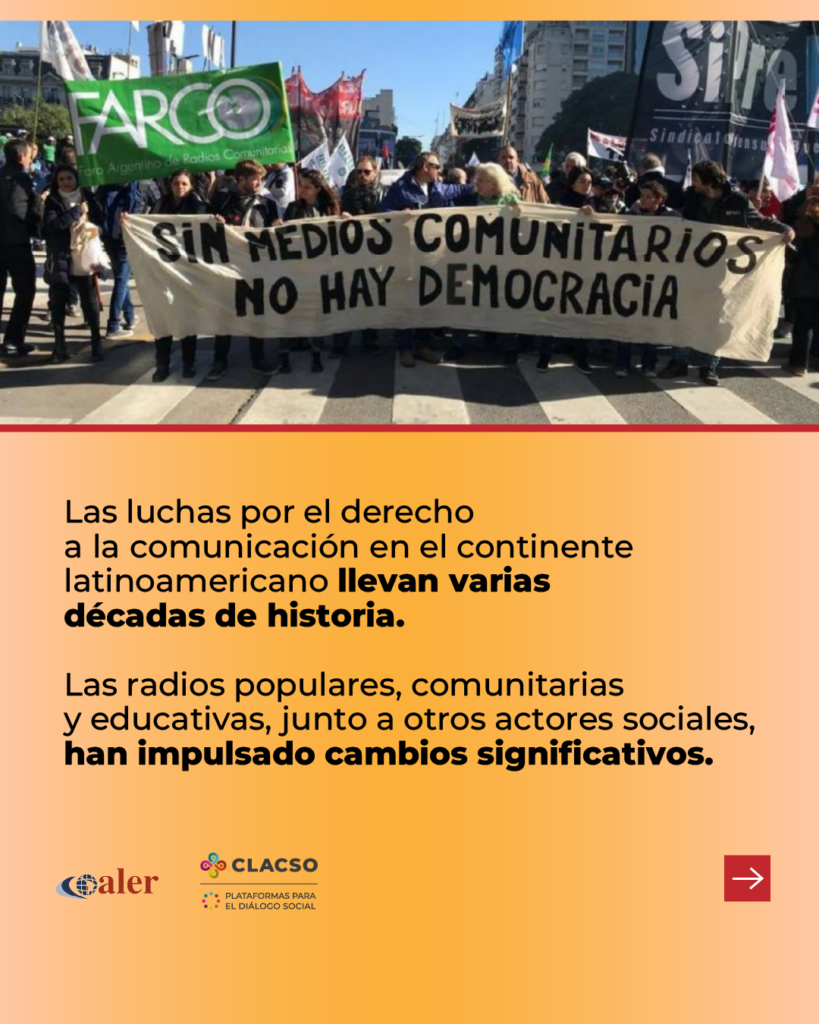
Based on the trajectory of ALER, an entity that has brought together a hundred educational, popular and community media outlets for more than five decades, we take on the challenge of thinking collectively, with others, about how to position ourselves from the digital stage to strengthen the right to communication for the majority.
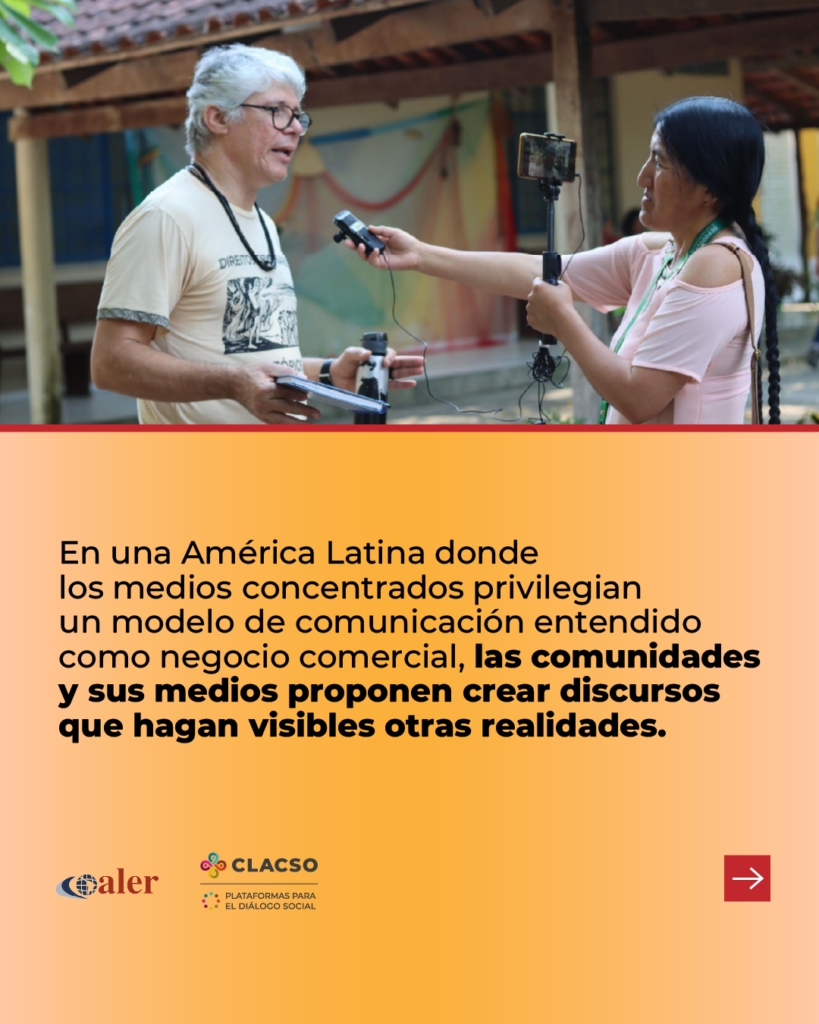
We invite you to this new dialogue based on the voices and perspectives of communicators from different parts of the continent, from the Rio Grande to Patagonia, crossing the jungle, the mountains, the coast, the countryside and the city, where the media report, manage, educate and learn from the daily life of their communities in the search for a more just and humane society.
SESSION 1
Communication Rights and their importance in the struggles of social movements in Latin America and the Caribbean
What path has been taken from the concept of freedom of expression to the right to communication? What role did grassroots and community media and their networks play in securing this right? What are the challenges in the digital landscape?
SUGGESTED READINGS:
- María Cristina Cabral: Contributions of popular communication to good living. Available https://sedici.unlp.edu.ar/handle/10915/34418
- Néstor Busso and Diego Jaimes: The inner workings of the law: The process of influencing the Audiovisual Communication Services Law in Argentina. Available https://www.farco.org.ar/formacion-material/
- McBride Report: One world, many voices. Available https://diversidadaudiovisual.org/un-solo-mundo-voces-multiples-informe-macbride/
- Humberto Vandenbulcke: Communicating hope. A path to a good life. https://aler.org/comunicar-la-esperanza-camino-al-buen-convivir/
SESSION 2
Networked news production from the experiences of grassroots correspondents
How is news produced from the perspective of social movements and grassroots organizations? What is their editorial approach, and how do they develop their own agenda? What is the relevance of networking and connecting the experiences of different Latin American countries?
SUGGESTED READINGS:
- From the microphone to the street. News production for a good life. Available https://www.farco.org.ar/formacion-material/
- Pepe Frutos: FARCO Newsletter Style Guide. Available https://www.farco.org.ar/formacion-material/
- Training manuals in popular radio (ALER). Available https://www.farco.org.ar/formacion-material/
SESSION 3
Political and Communicational Projects of Community and Popular Media in the Digital Scenario
How do you build a long-term project that strengthens the management and sustainability of a popular, community-based media outlet? What are the main dimensions of a Political Communication Project (PCP)? What progress has been made in Latin America in this regard?
SUGGESTED READINGS:
- Various Authors (2007): The Turn and a Half: Reflections on the Political-Communicative Project Available https://radioformateca.wordpress.com/2019/06/06/la-vuelta-y-media-reflexiones-alrededor-del-proyecto-politico-comunicativo/
- Various Authors (2008): Dreamcatchers: Sustainability in popular and community radio. Available https://www.amarcmexico.org/pdf/internacional/02-AtrapaSuenos.pdf
- Fossaroli, D. (2023): Every radio station is its own world. A guide to building the political and communication project of a community radio station. Available https://www.farco.org.ar/formacion-material/
SESSION 4
Communication rights in indigenous and migrant communities
What are the realities of migrant populations and Indigenous communities in our continent, and how can these realities be addressed through the media? What relevant experiences of networking can we find in this field that build democratic agendas and perspectives? What challenges does this type of communication practice face today?
SUGGESTED READINGS:
- Doyle, MM (2015): “Indigenous debates and demands on the right to communication in Latin America.” In Temas Antropológicos, Scientific Journal of Regional Research, volume 37 no. 2. April – September 2015. Mexico: Autonomous University of Yucatán. Available at https://dialnet.unirioja.es/servlet/articulo?codigo=5267277
- Memory of the Voices of the Peoples of the Pan-Amazon Region – CUMARE. Available at https://aler.org/42122-2/
SESSION
Diffusion kit