
Social welfare and disputes over the public and the common in Latin America and the Caribbean
Open call FOR INDIVIDUAL AND TEAM RESEARCH
Registration closes: June 28, 2021
Latin America and the Caribbean have historically waged a persistent struggle for the public and the common, understood in a broad sense encompassing the environment and natural resources; as well as public services and companies, education, health, housing, communication, knowledge, political participation, territories, urban space, heritage and biocultural assets and, in more contemporary times, matters relating to sexual dissidence and gender.
The struggle for the public and the common good has been raised in territories and communities, not only in the sense of defending it, but also in terms of recovering and contesting it in a region marked by authoritarian experiences, privatizations, inequalities and different forms of segregation, discrimination and denial of rights.
In the context of the Covid-19 pandemic and its effects, a clear tension and dispute have emerged regarding the role and capacity of the State in the production and meaning of public policies that can contribute to the social well-being of the majority of the population, counteracting inequalities and expanding the commons. Likewise, experiences of producing the public sphere—community-based initiatives—are expanding in the current circumstances, while simultaneously being attacked and limited by conservative forces that deny the right of peoples to build and share the commons based on logics different from the dominant ones. In other words, both materially and symbolically, disputes can be observed over the use, appropriation, and production of the public sphere as the commons, from both the state and societal perspectives.
In this context, the actions of popular movements have also been significantly revalued and made visible as spaces that promote the democratization and expansion of the public sphere. This is expressed in diverse experiences, such as: social production of housing, various types of cooperatives, the establishment of community media outlets, conflicts surrounding human mobility as a right, experiences in popular education and collective knowledge production, and struggles against extractive and predatory models, among others.
All of the above is expressed in environmental, urban, rural, gender, racial and ethnic, health, educational, and migratory dimensions, among others. All of these are potential fields of study for this call for proposals.
Based on these analyses, we are revisiting successful previous research initiatives, such as the Support Program for Engaged Research “Disputes over the Public Sphere in Latin America and the Caribbean,” as a way to support the systematization of experiences aimed at recovering and strengthening the public sphere in a broad sense. In this spirit, CLACSO is launching the Call for Individual and Team Research Proposals “Social Welfare and Disputes over the Public Sphere and the Commons in Latin America and the Caribbean.” This call seeks to promote the submission of research proposals from researchers with diverse disciplines, backgrounds, and experiences, with a particular focus on encouraging the participation of researchers from Central America and the Caribbean or research projects about these regions.
CONTEST RULES
-
The applicant must be a researcher with accredited ties to CLACSO Member Centers, which they will support with a sworn statement. If awarded the scholarship, they must submit a letter of support signed by the highest authority of the member center.
-
Submissions from individual or collective authors (up to 3 members) will be accepted.
-
In the case of teams, their composition must respect gender parity, and one member must be designated as responsible for project registration. These teams must be composed of established researchers—those with a master's degree, doctorate, or equivalent qualification and a proven academic track record—and researchers in training—those currently pursuing a master's or doctoral degree or who are up to 35 years of age and hold an undergraduate degree. Therefore, in the case of group applications, teams are expected to be intergenerational, integrating researchers with diverse backgrounds and experiences.
-
In the case of collective applications, the composition of the team will be an indicator to be taken into account in the evaluation of the proposal.
-
Each researcher may only participate with one proposal in this call.
-
If the scholarship is awarded and travel is necessary, the winners will be responsible for covering the costs of medical insurance or similar expenses.
Up to 14 scholarships will be awarded . Of these, at least 50% will be for women and gender-diverse individuals, and at least 30% will be for students from Central American and Caribbean island countries.
The amount of the scholarships awarded will consist of US$6.000 (six thousand US dollars or its equivalent in local currency) for each winning proposal.
The proposed research will be carried out over a maximum period of 10 (ten) months. The scholarships will be paid in installments via bank transfers made to the recipients. It is expected that at least 60% of the scholarship funds will be used for activities related to gathering and processing the information necessary for the research, which must be reported to CLACSO with supporting documentation.
The winners will work with the support of tutors assigned by CLACSO who will follow the process of their research and results.
CLACSO will publish the final products in print and/or digital media, giving them wide publicity and dissemination through the means it deems appropriate. If necessary, researchers will be asked to make the adaptations and adjustments required for the publication of the resulting research.
The authors will transfer the original publication rights of their works, given that CLACSO adheres to and defends the principles of open science and open access to knowledge, so that the resulting work is easy to find, accessible, interoperable, and reusable. Subsequently, these works may be published in any other medium, always citing the grant received. Researchers must inform CLACSO of the subsequent publication of works resulting from the grant work.
-
The member centers to which the applicants are linked must not have any outstanding debts in the payment of membership fees corresponding to the year 2020, due on June 30 of the same year.
-
Completed research projects will not be accepted. Proposals may be linked to ongoing research processes, but the final works must be original and unpublished products and developed within the period established by the call for proposals.
-
Members of the Steering Committee or officials of the CLACSO Executive Secretariat may not participate.
-
Proposals from researchers who are currently recipients of research grants, fellowships, or research projects organized by CLACSO will not be accepted. Applications from researchers who have previously received a CLACSO research grant will be accepted, provided that the recipient has fulfilled all obligations in a timely manner.
-
Texts written in the four languages commonly used in Latin America and the Caribbean (Spanish, English, Portuguese and French) will be accepted, depending on the country of origin of the proposal.
-
In the first stage, the submitted proposals will be reviewed for their formal and administrative aspects to ensure their compliance with the competition rules. Proposals that do not meet the established requirements will be rejected.
-
Applications that pass to the next stage will be evaluated by an International Committee composed of experts who will assess the quality and relevance of the proposals, which will be submitted under a pseudonym.
-
The Call may be declared void or a smaller number of scholarship recipients may be selected, if the proposals submitted do not meet the required quality and consistency.
-
Situations not covered in this document will be resolved by the convening institution.
-
The ruling will be final.
-
The research projects will develop their work plan between August 2021 and May 2022. This plan will be implemented under the facilitation of tutors assigned by CLACSO.
-
The progress and final reports submitted by the scholarship recipients will be evaluated by the tutors.
-
In their final version, the research papers submitted as a result should be between 12.000 and 15.000 words in length (excluding appendices and bibliography), written in Times New Roman 12-point font, single-spaced. This is an approximate guideline, and CLACSO reserves the right to make revisions or exceptions if deemed necessary. Furthermore, once submitted, CLACSO may request adjustments and changes from researchers to ensure the final research papers meet institutional publication criteria.
-
The structure of the text will be free, respecting the conventions of presentation of an academic text and the editorial standards of CLACSO, in addition to APA + GENRE.
-
In addition, each team must submit a Guidelines for Action Document, containing inputs and recommendations for public policies and social intervention on the topics investigated.
-
Texts written in the four languages commonly used in Latin America and the Caribbean (Spanish, English, Portuguese and French) will be accepted, depending on the country of origin of the proposal.
It is mandatory that the submission be made through the online registration system provided by CLACSO. Printed submissions and submissions sent by email will not be accepted. It is recommended to access the online system to review the registration form.
-
Visit the CLACSO website www.clacso.org . The online registration system will be available starting May 14 , 2021.
-
Register in the CLACSO Single Registration System (SUIC). The generated username and password will be required each time you wish to access the system to consult, modify, add, or submit information for this or any other CLACSO activity. Applicants with collaborative proposals must open a single form that includes all researchers on the team. One of the authors must also be designated as responsible for the registration. This same person will receive the corresponding monetary award if the proposal is selected by the Jury.
-
Identify the proposal by indicating its title and the pseudonym of the applicant(s). Applications with pseudonyms that correspond to the applicant's first and/or last name will not be accepted. Once the corresponding fields are completed, the system will enable the uploading of the following data.
-
Applicants must complete the sworn statement on the registration form indicating their affiliation with a Member Center belonging to the CLACSO network. The database of member centers can be found at: www.clacso.org.ar/clacso/centros_miembros_clacso/inicio.php.
-
Complete the personal and academic data form and attach the curriculum vitae in free format; the digital copy of the identity document, passport or ID card; the digital copy of the highest academic degree obtained (or proof of degree in process) and the photograph.
-
The proposal must be filled out on the form that appears once the personal and academic data has been completed.
-
Once registration is closed, the system will produce an electronic certificate of receipt that will serve as proof.
Registration closes: June 28, 2021, 23:59 PM (Argentina)
Winners will be announced in July 2021.
Project implementation: August 2021 – May 2022.
Final report due: May 31, 2022
The results will be published on the CLACSO website. The winners will be contacted by email.
Inquiries: [mail protected]
RESULTS
OPINION
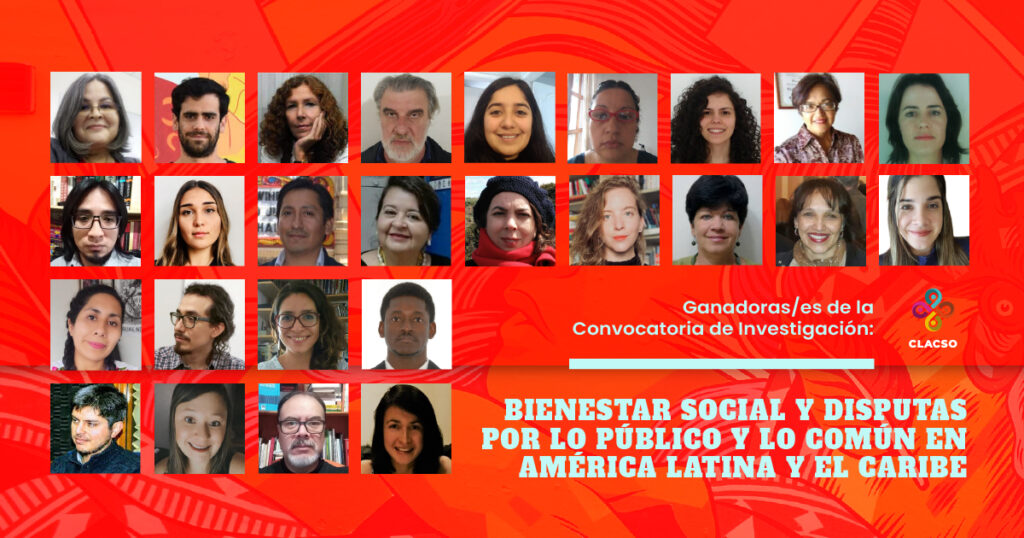
The Latin American Council of Social Sciences (CLACSO) announces the results of the Call for research teams “ Social welfare and disputes over the public and the common in Latin America and the Caribbean ” , which focuses on the persistent struggles for the public and the common, understood in a broad sense from the environment and natural resources; as well as from public services and companies, education, health, housing, communication, knowledge, political participation, territories, urban space, heritage and biocultural goods and, in more contemporary times, matters relating to sexual dissidence and gender.
187 applications were received , of which, after the technical and formal review, 179 were in a condition to be qualitatively evaluated by the International Committee to consider the quality, relevance and coherence of the proposals according to the Call.
The evaluation process was carried out by an International Committee composed of 33 experts from 13 countries: Ernesto Rodríguez (Uruguay), María Inés Fernández Álvarez (Argentina), Fabiana Espíndola (Uruguay), Luciana Ghiotto (Argentina), Manuel Dammert (Peru), Pascualina Curcio (Venezuela), Ximena González-Broquen (Venezuela), Oscar Feo (Venezuela), María Alicia Gutiérrez (Argentina), Carolina Tetelboin (Mexico), Amparo Marroquín (El Salvador), María Cristina Cravino (Argentina), Eduardo Aguado (Mexico), Andrea Lampis (Colombia), Antonio Hernández (El Salvador), María Celia Cotarelo (Argentina), Jorge Radesca (Uruguay), Ana María Costa (Brazil), Fernando Rincón (Colombia), Hernán Ouviña (Argentina), Grettel Navas Obando (Costa Rica), Mabel Thwaites (Argentina), Vicente Sisto (Chile), Franklin Ramírez (Ecuador), Angélica De Sena (Argentina), Berenice Ramírez (Mexico), Natalia Genta (Uruguay), Darío Clemente (Argentina), María Fernanda Sañudo Pazos (Colombia), Cecilia Gárgano (Argentina), Sergio Carpenter (Argentina), Clyde Soto (Paraguay), Edwin Catacora (Peru).
Following the evaluation, which recognized the excellent quality, relevance and rigor of most of the applications, 14 proposals were selected.
The list of winning proposals from the Call for Proposals is as follows:
|
Winning Proposals |
|||
| Authors | Member Center or Institution | Country | Title of the proposal |
| Rolando Alonzo Gutiérrez | GT-002 – Latin American Faculty of Social Sciences, Guatemala – FLACSO | Guatemala | Indigenous communal economy: Elements from the management of water as a common good (case of the municipality of Totonicapán, Guatemala) |
| Daniel Fernández, Dylanna Margarita Rodríguez Muñoz, Jimena Palma Chacón | CR-004 – Institute of Social Research – IIS/UCR – Faculty of Social Sciences – University of Costa Rica | Costa Rica | Megatourism in Guanacaste: disputes, social welfare and defenses of the commons |
| Dora Suyapa Díaz Quintero | HN-002 – Directorate of Scientific Research – DICIHT/UNAH – National Autonomous University of Honduras | Honduras | The Lenca indigenous group of women in the COPINH organization and the right to participate in public policy for the educational offer with a view to sustainable human development |
| Tania de Armas Fonticoba, Thais Puentes | CU-030 – Department of Sociology – Dept. Sociology – Faculty of Philosophy and History – University of Havana | Cuba | Right to have rights: disputes for the legal and social recognition of sexually diverse families in Cuba |
| Jorge Eduardo Santiago Matías, Ester Emilse Siares | GT-001 – Association for the Advancement of Social Sciences – AVANCSO | Guatemala | The right to Indigenous communication and disputes over the commons: A comparative perspective between Argentina and Guatemala |
| Marina Bolfarine Caixeta, Félix Pablo Friggeri, Wisly Joseph | BR-005 – ELA – Department of Latin American Studies – ELA – Universidade de Brasilia | Brazil | Food sovereignty and popular sovereignty from the worldviews and practices of peasant communities in Artibonite and Haiti's South-South cooperation with Latin America |
| Roger Arturo Merino Acuña | PE-014 – Research Center – UP – CIUP – Universidad del Pacífico | Peru | Global Amazon: towards the construction of pluriversal governance |
| Sara Raquel López Cristaldo, Celeste María Houdin Gomez | PY-006 – Research for Development. – ID | Paraguay | Community kitchens in Paraguay: between survival and the territorial struggle for the common public |
| Sara Esther Bravo Ramírez | MX-037 – Academic Unit in Development Studies – UAED/UAZ – Autonomous University of Zacatecas | Mexico | The Zapatista Good Government Councils and the construction of the common good |
| Constanza Moreira, Lucía Giudice, Nicolás Iglesias | UY-006 – Institute of Political Science – ICP/UDELAR – Faculty of Social Sciences – University of the Republic | Uruguay | Conservative activism in Uruguay against the rights agenda: new alliances between religion and political parties |
| Paola Moreno | CO-004 – Center for Social Studies – CES/UNAL – Faculty of Human Sciences – National University of Colombia | Colombia | Careful reintegration. Joint trajectories of ex-combatants and social groups towards civilian life |
| Hilda María Cristina Mazariegos Herrera, René Abel Tec López | MX-048 – Division of Social Sciences and Humanities – DCSyH/UGTO León – University of Guanajuato, León Campus | Mexico | Borders that cross. Experiences of Central American and Caribbean migrants of sexual and gender dissidence in their passage through Mexico, attached to shelters or spaces of a religious nature |
| Elizabeth María Lezama Hernández | VE-026 – Institute of Regional and Urban Studies Attached to the Division of Social Sciences and Humanities – IERU – Simón Bolívar University | Venezuela | Communes in Ciudad Guayana, The challenge of Popular Participation towards the Construction of the Communal State in Venezuela (2010-2021) |
| Claudia Luisa Zeferino Pires, Lara Machado Bitencourt, Laisa Zatti Ramirez Duque | BR-113 – Associação Nacional de Pós-Graduação e Pesquisa em Geografía – ANPEGE – Universidade Federal da Paraíba (UFPB) | Brazil | Social Cartography and Quilombola in Porto Alegre/RS |
This ruling is irrevocable and cannot be appealed.
Buenos Aires, September 6, 2021

