
"CLACSO Classroom seeks to innovate the ways in which teaching and learning take place"
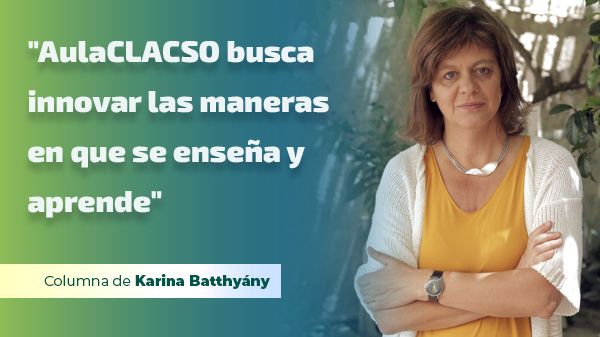
Transcript of Karina Batthyány's column
in InfoCLACSO – September 27, 2023
Today, the central theme of InfoCLACSO is dedicated to the ruling of the Supreme Federal Court of Brazil, against the thesis of the “time frame” on September 21, rejecting it by 7 votes to 2 (with another 2 pending).
The “time frame” thesis is used by rural entities that are associated with agribusiness and implies the recognition of indigenous peoples’ lands only to those that were occupied by them until October 5, 1988, when the Brazilian Constitution was enacted.
The "time frame" thesis arose from a 2009 Supreme Federal Court ruling amidst the conflict over the demarcation of the Raposa Serra do Sol Indigenous Territory. On that occasion, under intense pressure from the agribusiness sector, the Supreme Federal Court suggested a "time frame" as a condition, defining Indigenous occupations up to October 5, 1988. As this was a ruling on a specific case, it could not be applied to others.
However, following Dilma Rousseff's impeachment in 2016, rural landowners managed to enact sub-legal ordinances from the Attorney General's Office that transformed these conditions into legally binding elements. From then on, the "time frame" began to be used as a general argument in other cases; that is, it acquired the status of a legal thesis.
Indigenous communities maintain that the "time frame" argument is unconstitutional because the Constitution upholds the right of indigenous peoples to their land, a right that predates the creation of the Brazilian state. Specifically, Article 231 of the Constitution defines indigenous lands as those "permanently inhabited, used for productive activities, and essential for the preservation of environmental resources," as well as for "the customs and traditions" of these peoples.
Two votes from the Supreme Court remain pending. The two votes that supported the request from rural landowners and agribusiness sectors were cast by judges appointed during Bolsonaro's term: the jurist and Presbyterian pastor André Mendonça and Nunes Marques.
Although the Supreme Federal Court formed a majority to reject the "time frame" rule, the trial is not over. The justices must discuss solutions for specific disputed lands and solutions for "non-Indigenous" people currently occupying areas of Indigenous peoples who are considered to have acquired them "in good faith."
Compensation for indigenous peoples will also be considered if it is not possible to grant a claimed area. Solutions must be discussed once the 11 justices of the Supreme Federal Court (STF) have voted (on the "timeframe").
According to official data, Brazil has just over one million indigenous people, who occupy about 14% of the national territory, represented by some 500 already delimited areas, to which another 200 that are still being analyzed by the various State institutions can be added.
The demarcation of Indigenous lands is a constitutional obligation of the State, but it was suspended between 2019 and 2022, during the administration of then-President Jair Bolsonaro. It was resumed this year by the Lula da Silva government, which opposes the notion of a "time frame" and has the first cabinet in Brazil to include a Ministry of Indigenous Peoples.
Finally, according to the NGO Instituto Socioambiental, almost a third of the more than 700 indigenous reserves in Brazil - most of them in the Amazon and considered a barrier against deforestation - were threatened by the "time frame" rule because they have not yet been demarcated.
– In this particular case, there is a court decision, but without any impetus from the creation of the Ministry of Indigenous Peoples, it seems very unlikely that progress has been made, unless there is a setback and an advance against indigenous peoples…
– Absolutely. There is a factor associated with the decision and the political will to address the dimensions of inequality, in this case the inequalities linked precisely to indigenous peoples in Brazil and also in Latin America and the Caribbean, where public policies promoted in this area are important and have clear definitions in order to try to mitigate or overcome these dimensions of inequality.
CLACSO Classroom
Furthermore, I would like to take this opportunity to present a new initiative for training in the field of social sciences and critical humanities. It is open to the entire CLACSO community and anyone interested in further training, and will be available starting October 1st. We have named it AulaCLACSO.
I would like to especially acknowledge the work of the CLACSO Training team, who are constantly working together to develop new proposals to make broad and diverse training in the social sciences a reality. In this case, AulaCLACSO is the first self-directed training platform focused on Latin American and Caribbean social sciences and humanities from a critical perspective.
AulaCLACSO aims to innovate teaching and learning methods by offering over 200 high-quality classes in the coming months, with more to be added as the weeks progress. This training platform allows you to access classes whenever and wherever you want. AulaCLACSO offers self-paced learning, so everyone can explore the content at their own pace.
This initiative complements CLACSO's existing academic offerings, expanding training opportunities for the entire community and incorporating a new modality compared to the range we have offered until now, such as seminars, diplomas, specializations, and master's degrees. The platform will offer a set of free, open-access classes and another set of classes accessible only by subscription at a low cost of $5 per month.
The initiative aims to continue growing, inviting leading figures in the social sciences from the region and the world to participate. New content will be added each month, multiplying the voices and broadening the perspectives and topics available for users to explore and learn about in this new AulaCLACSO platform.
We have high expectations for how this new proposal will be received. We also hope that it will allow us to reach beyond the audiences and people we already work with in training at CLACSO, and transform AulaCLACSO into a training space for a much broader public. For us, AulaCLACSO is a pedagogical innovation initiative to continue building this great community of dialogue and learning that is CLACSO.
For this first stage we will be launching the following programs:
– “Concepts”, where leading figures from the region will address key concepts in the social sciences and humanities through three dimensions: their genealogy, the main epistemological and methodological debates, and their empirical approaches.
– “A collective question”, in which, starting from a provocative question, specialists from different areas of critical thinking in the social field accompany us to try out possible answers and new questions that may arise around it.
– “How to write a thesis?”, which covers everything from choosing the research topic, constructing the problem (conceptual and empirical) to developing the objectives and putting together the thesis itself.
There will also be a cycle linked to the “40-50-50” program, which presents a review of the events in the contemporary history of Latin America that shape current challenges in the search for alternatives to strengthen democracy, human rights and work on collective memory.
Starting with this premiere, we will be adding new cycles such as “Latin American Perspectives on Care”, “Latin American Perspectives on Social Movements and Activisms”, “Just Latin American Transitions” and a cycle linked to the archive: a set of contents produced by CLACSO in the past, curated and presented from the questions of the present.
We are truly excited to launch this new educational initiative called AulaCLACSO, a learning community with exclusive content created by social scientists and humanities professionals committed to our Latin American and Caribbean region. This initiative innovates in pedagogical formats and in the way it addresses the diverse issues currently challenging Latin American social critical thinking.

The new “CLACSO Classroom” Platform
If you would like to receive more information about CLACSO's training programs:
[widget id=”custom_html-57″]
to our email lists.

