- This event has passed.
Slovenian School: Philosophy, Politics and Ideology | Lecture by Gregor Moder & Ales Mendizevec at the IIGG
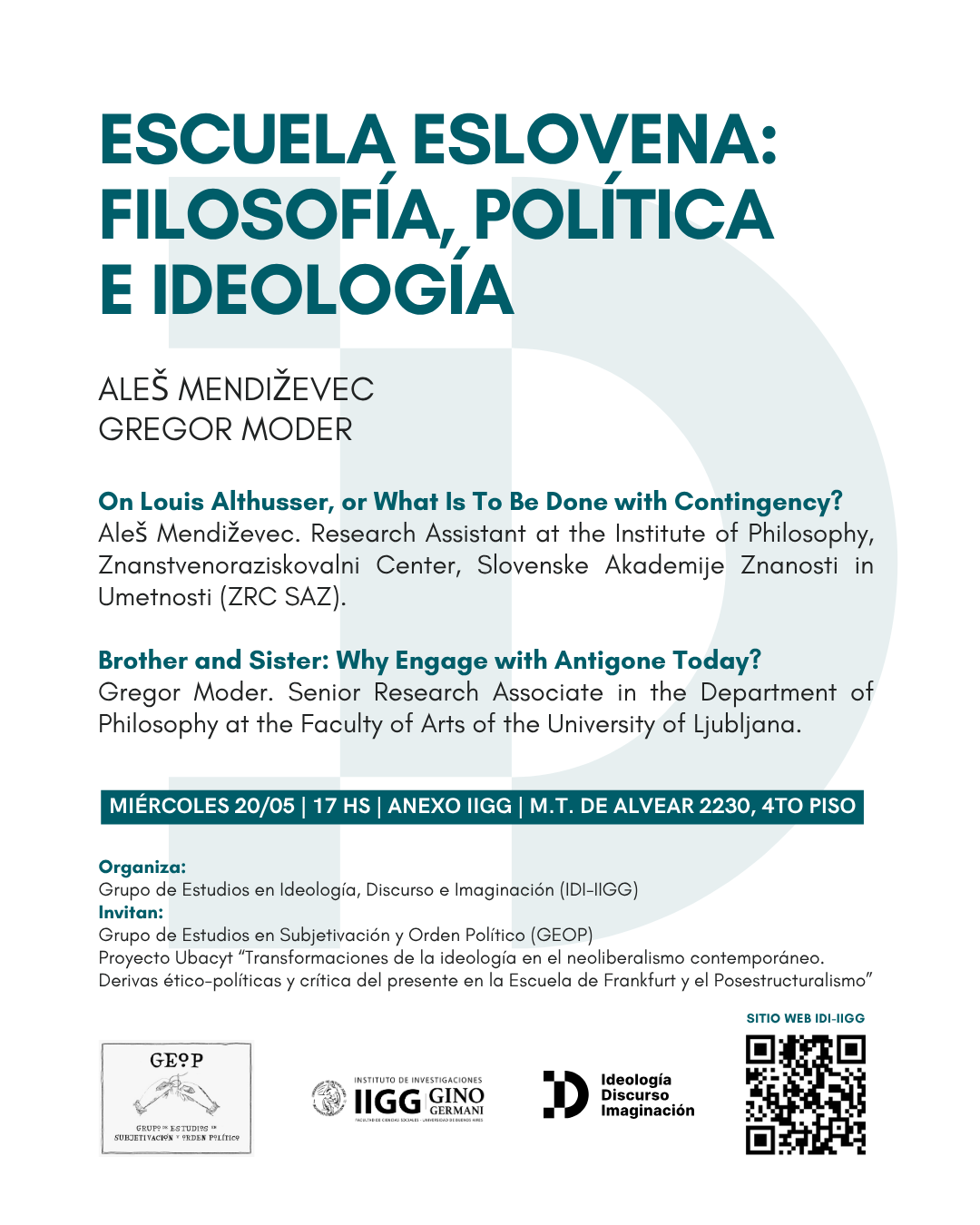
The Research Group on Ideology, Discourse, and Imagination (IDI-IIGG), in conjunction with the Research Group on Subjectivation and Political Order (GEOP) and the Ubacyt Project “Transformations of Ideology in Contemporary Neoliberalism: Ethical-Political Drifts and Critique of the Present in the Frankfurt School and Poststructuralism,” invite you to an open conversation with researchers Gregor Moder and Aleš Mendiževec, to be held next Wednesday, May 20, at 5:00 p.m. in the Annex (Room 400) of the Gino Germani Research Institute, MT de Alvear 2230, 4th floor, Faculty of Social Sciences, University of Buenos Aires.
Brother and Sister: Why Engage with Antigone Today? – Gregor Moder
In her final monologue, Sophocles's Antigone delivers a surprising justification of the law that guided her to defy Creon's decree and bury her brother Polyneices. She claims that she risked her life only for her brother's body, and that she would leave a husband's or a child's body to mold unburied. These words have always puzzled interpreters. In this talk, we shall claim that Hegel's chapter on ethical life (Sittlichkeit) in the Phenomenology of Spirit can be read precisely as an attempt to give a metaphysical and ethical account of Antigone's last words, which is why the relationship between brother and sister becomes the pivotal relationship not only of Hegel's understanding of the family, but also of the polity and the substance of ethical life itself. This is a major difference that sets the understanding of Antigone in Phenomenology apart from the ones in Philosophy of Right and Aesthetics. Furthermore, we shall argue that the way in which Antigone formulates her demand to bury her brother becomes the paradigmatic example of how a historical transformation of the world is possible.
Gregor Moder is Senior Research Associate in the Department of Philosophy at the Faculty of Arts of the University of Ljubljana. He co-founded Aufhebung – International Hegelian Association and served as its first president (2014-2020). His works include the edited volumes The Object of Comedy (Palgrave 2020), The Ethics of Ernst Lubitsch (Rowman & Littlefield 2024), and The Resilience of History (Maska 2024), as well as the monographs Hegel and Spinoza (Northwestern University Press 2017) and Antigone as Political Philosophy (Northwestern University Press 2026).
On Louis Althusser, or What Is To Be Done with Contingency? – Aleš Mendiževec
The concept of contingency plays a crucial role in the philosophy of Louis Althusser; we would dare say that it had been done so from the very beginning. Yet this is by no means peculiar to Althusser. The idea of contingency has a long history, even among theoreticians who attempted to affirm it and ascribe to it a veritable ontological status. In fact, it seems that today even neoliberal capitalist ideology places its bets on contingency (“be flexible,” “seize the opportunity,” etc.); and if Althusser's philosophy is anything, it is a criticism of capitalist ideology, especially when ideology manages to break through into its adversary: Marxism and communism. It therefore seems essential to differentiate the concept of contingency, to trace its role within Althusser's general philosophical project of defining history (as a process without a subject), and, finally, to delineate its political stakes.
Aleš Mendiževec is a Research Assistant at the Institute of Philosophy, ZRC SAZU. His research focuses on ontology, political philosophy, and technology. In particular, his work centers on the concept of contingency, its implications for political theory, and its role and significance in the sciences and technology. He is the author of the monograph Contingency and I: Philosophy for Louis Althusser (in Slovene, Maska, 2022).