
Actions and networks of think tanks in China-Latin America cooperation on climate change
On Tuesday, November 4, within the framework of the XVI Sociology Conference of the UBA, the book Actions and networks of think tanks in the China-Latin America cooperation on climate change was presented , written by Florencia Lederman (UBA, Argentina), Orlando Aguirre Martínez (UNO/UBA, Argentina), Juan Jesús Morales Martín (UCSH, Chile) and Liu Xiaoyu (CASS, China).
The presentation was given by Teresa Arteaga , coordinator of research calls at CLACSO, and Verónica Giordano , professor of sociology and CONICET researcher at the Institute of Latin American and Caribbean Studies (IEALC), Faculty of Social Sciences, University of Buenos Aires, Argentina.
The book is the result of research conducted in response to a joint call for proposals between CLACSO and the Chinese Academy of Social Sciences (CASS) in 2023, which received over 200 applications, two of which were awarded grants. This team was one of those selected.
The publication presents an in-depth analysis of the work carried out by think tanks in Argentina, Brazil, Paraguay, Uruguay, and Chile regarding climate change. It also contributes to a discussion of China's role in international cooperation on this issue, taking into account contemporary challenges.
During the presentation, the conversation revolved not only around the relevance of the research reflected in the publication, but especially around the enriching learning and articulation experience that the joint work between a Latin American team (based in Argentina and Chile) and a Chinese team represented.
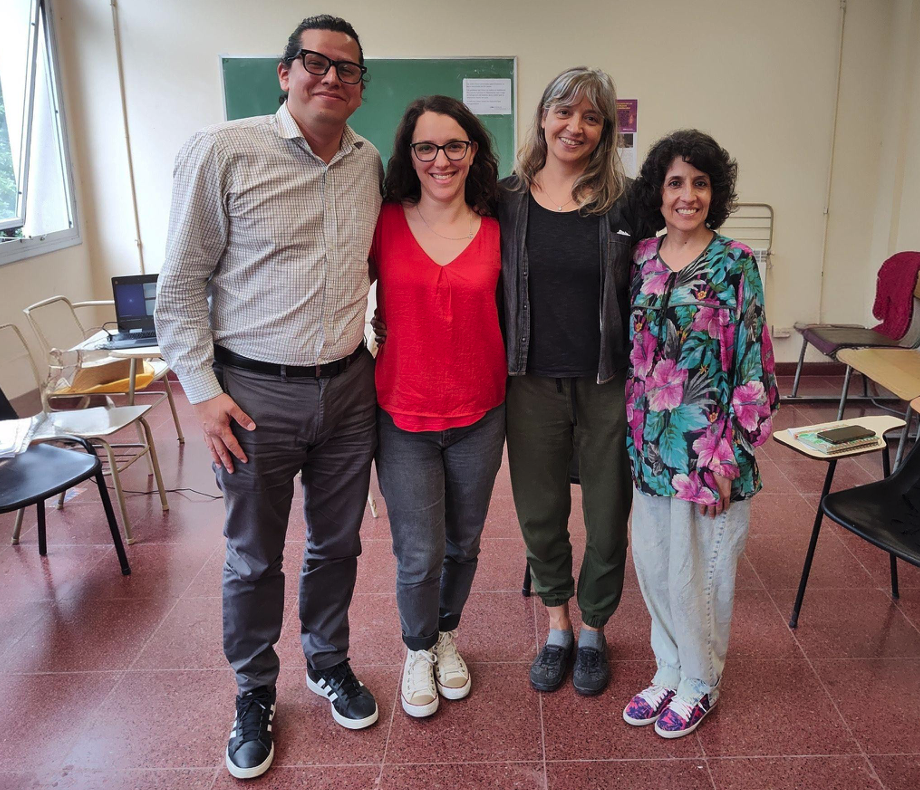
Verónica Giordano presented a summary of the research team's composition and the contemporary perspective on Sino-Latin American cooperation in its cultural, economic, and social aspects. Teresa Arteaga, for her part, discussed the research team recruitment process: over two hundred applications, fifteen shortlisted proposals, and the selection criteria that led to their selection.
The authors presented the work in general terms and commented to those present on the experience of working with an interdisciplinary, intercontinental, and intercultural team, highlighting the challenges involved in continuing to strengthen academic cooperation between both regions of the Global South in order to think about tools to improve the quality of life of people.

