
Half a century after the last military coup in Argentina
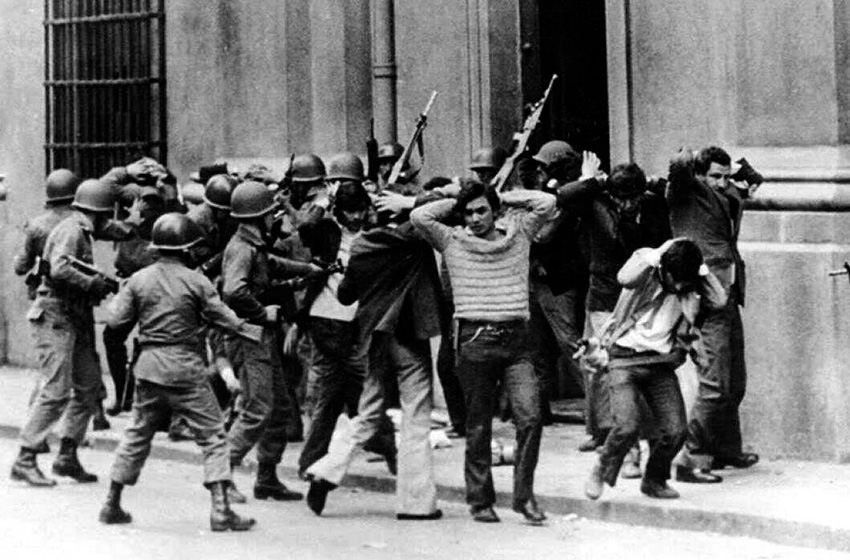
This March 24 marks 50 years since the civic-military coup in Argentina that gave way to a military dictatorship that lasted until the return to democracy on December 10, 1983, with the inauguration of the radical president Raúl Alfonsín.
The origin of the most cruel military dictatorship in the memory of the South American country must be sought in the recurring practice of the Armed Forces of interrupting weak, unstable or adverse democratic regimes to the interests of the dominant classes (whom the uniformed men represented as a praetorian guard) since the first coup of the modern era on September 6, 1930, overthrowing the then constitutional president Hipólito Yrigoyen.
While it is true that in 1976 Argentina was going through extreme instability, exacerbated after the death of Juan Domingo Perón on July 1, 1974, and the accession to the presidency of his wife María Estela Martínez de Perón, in a context of leadership vacuum and strong internal conflicts within Peronism, with far-right paramilitary groups (such as the Triple A) that operated under the protection of the State and active guerrilla groups (such as Montoneros and ERP), the Armed Forces overthrew the government a few months before general elections called to redirect democratic life.
The regional context was not immune to this new irruption of the Argentine military; dictatorships had already been established in the Southern Cone of America: Brazil, Paraguay, Bolivia, Uruguay and Chile, protected by the National Security Doctrine and the Condor Plan of repressive coordination, promoted by the United States of America in the midst of the Cold War.
Under the euphemism of "National Reorganization Process", the dictatorship commanded by General Jorge Rafael Videla eliminated all democratic institutions: it dissolved Congress, banned political parties and suspended constitutional rights, prohibited union activity, intervened in universities, burned books and censored media to control what was thought and said, among many other authoritarian measures.
Under the pretext of combating a "subversion" that was already severely weakened, a systematic plan of state terrorism was implemented. This included the kidnapping, torture, and enforced disappearance of people in clandestine detention centers, including the appropriation of children brought with their parents or born in captivity.
However, the true underlying reasons for the military's seizure of power lie in economic motivations and the aspiration to impose a change in the production model. This is a key point that is often overlooked. The coup had José Alfredo Martínez de Hoz, an economist representing the Argentine business elite, as the principal architect of the dictatorship's economic plan. In short, under his command, free imports were implemented (leading to deindustrialization), price controls were eliminated, and a schedule of devaluations was enacted, causing an overvalued exchange rate that eroded the value of the national peso. Furthermore, his administration facilitated massive indebtedness (which grew exponentially from $8.000 billion to $45.000 billion, jeopardizing the country's future to this day) and favored large local and foreign business groups, while the lower classes and workers suffered a loss of purchasing power as inflation remained high.
The objective was to dismantle the industrial model that Argentina had had for decades, where local factories could not compete with cheap foreign products and many closed.
Added to all this was a financial reform: The "financial homeland" (speculation) was promoted over the production of goods.
It is then understandable why such an economic plan required state terrorism to be implemented. Without the repression of unions, factory delegates, professionals, academics, and young people in general, they would not have been able to impose measures that were so detrimental to the people.
All of this, it is worth mentioning, is the policy being promoted by the current neoliberal government of Javier Milei with all its laws and alliances.
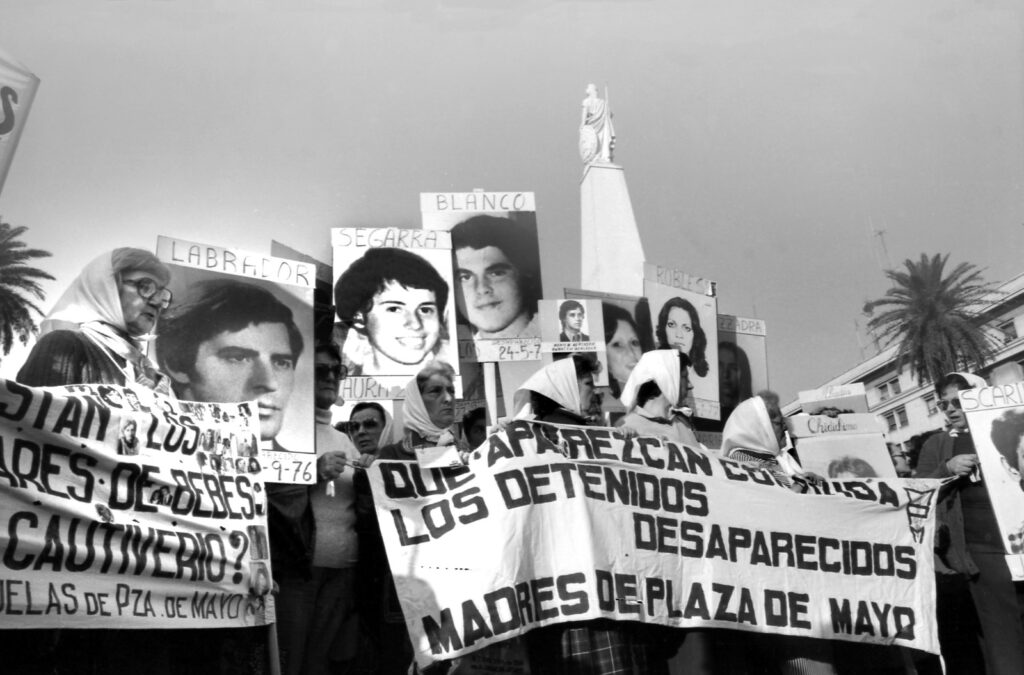
The other side of the coin, to take just a few examples, can be seen in the Mothers and Grandmothers of Plaza de Mayo, in the families of the 30.000 disappeared, the murdered, the political prisoners, the tortured, and the thousands of exiles—a great beacon of denunciation worldwide of the dictatorship's crimes. The white headscarf and the slogan "Memory, Truth, and Justice" are the symbol of resistance to the regime of the generals, admirals, brigadiers, and big business, which, along with the gradual reorganization of the labor movement, brought about the precipitous end of a dictatorship that had promised to last a long time and whose return to the barracks was precipitated by the defeat in the Falklands War in 1982 and the economic collapse.
The lessons of the recent past, half a century after the start of the dictatorship and 43 years after the return to democracy, are what must guide our societies – particularly the youth – to be guarantors of freedoms, in pursuit of greater equality and rights, at a time when governments that take refuge in the fact that they were elected in free elections, promote public policies and economic plans that go against the aspirations and needs of the vast majority, without hesitating to resort to repression to try to silence all protest and opposition.
CLACSO's actions 50 years after the coup in Argentina

