
20 years after Durban, facing post-pandemic challenges
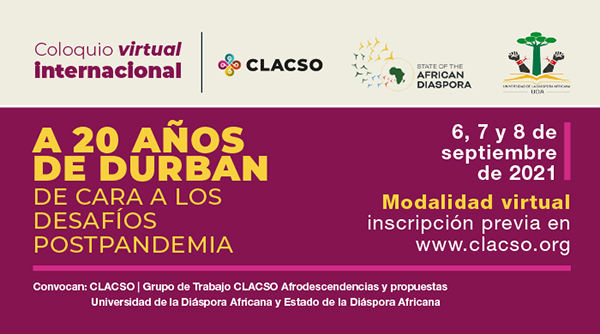
The Latin American Council of Social Sciences, the Working Group on Afro-descendants and counter-hegemonic proposals and the University of the African Diaspora, together with the State of the African Diaspora, convene the International Colloquium “20 years after Durban facing the challenges of the post-pandemic”.
Opening remarks by Karina Batthyány, Executive Secretary of CLACSO.
Panel with leaders who participated in Durban; Coordinated by Pablo Vommaro, Director of Research at CLACSO.
Also: Panel with the United Nations system, meeting of Afro organizations, among other activities.
Twenty years have passed since the World Conference against Racism, Xenophobia and Related Intolerance, held in 2001 in Durban, South Africa. This event systematized a process capable of providing humanity with the most powerful anti-racist program to date, the result of a broad and diverse international consensus and Afro-descendant leadership.
Today, the midpoint of the International Decade for People of African Descent (2015-2024) has passed. However, the Decade's founding goals—recognition, justice, and development—show limited progress and continue to define an enormous racialized and feminized social debt. The impacts of the COVID-19 pandemic and other endemic pandemics are being faced within a context of reconfiguration and intensification of racism, marked by necropolitics (Mbembe, 2018).
In Latin America and around the world, it is becoming increasingly clear that achieving sustainable development without dismantling the matrix of inequality and the culture of privilege is impossible. This reinforces the significance of Afro-descendant issues as a field of study and political action.
“It is not possible to overcome the great challenges facing the region, deeply exacerbated in the context of the Pandemic, and to move towards equality on the path of inclusive development as a fundamental pillar of a new model of sustainable development without undertaking decisive actions to advance in the recognition, protection and guarantee of the rights of the Afro-descendant population (Economic Commission for Latin America and the Caribbean, 2020).
Meanwhile, the Afro-descendant movement continues to grow, expand, diversify, and renew itself by promoting new forms of struggle, new avenues for political influence, new actors involved, and new strategic alliances. The development of networks, Afro-feminist leadership, and the influence of new generations of Afro-descendants on political platforms at the national, local, and global levels, among other trends, demonstrate this.
Objectives:
To take stock of the situation of Afro-descendant populations in Latin America and the Caribbean 20 years after the Durban Declaration and Plan of Action.
To make visible the thought and political and organizational action of Afro-descendants and their contributions to the anti-racist struggle.
To build joint actions of research, training, dissemination and political action as part of the anti-racist struggle to face the post-pandemic context.
If you would like to receive more information about CLACSO's training programs:
[widget id=”custom_html-57″]
to our email lists.

